
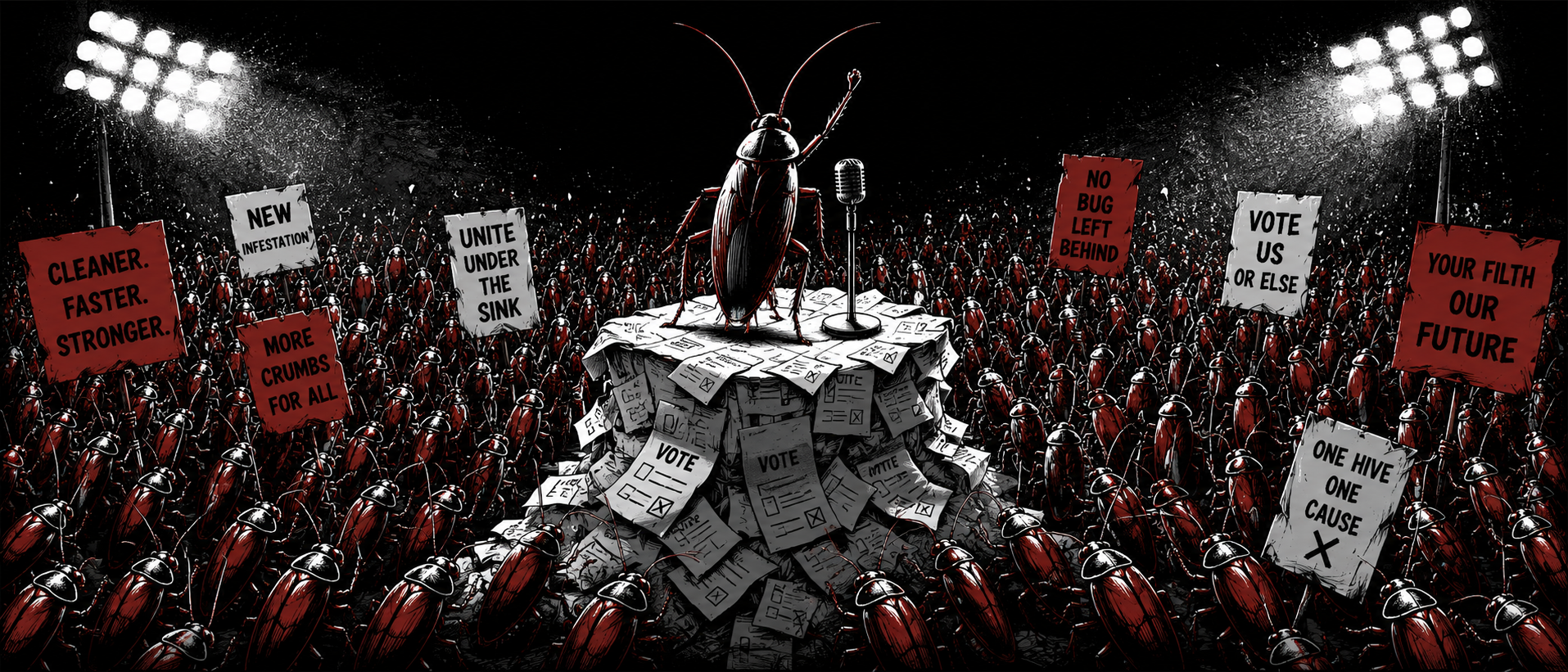
One word from a Supreme Court chamber. Five days. 350,000 sign-ups.
The Cockroach Janta Party — yes, that’s its real name — didn’t emerge from a dusty party office or a backroom deal. It was born on the internet, in outrage, from a slur. And the fact that hundreds of thousands of people immediately said “yes, that’s me” to a name built on humiliation tells you something far more unsettling than any political manifesto could.
This isn’t really about BJP. It isn’t really about one judge’s comment. It’s about what happens when an entire generation decides to stop pretending the system sees them as human — and starts wearing the insult like a badge.
Cockroach Janta Party: What Actually Happened
On May 15, 2026, Chief Justice of India Surya Kant was presiding over a Supreme Court hearing on fake professional credentials. What he said next became the match that lit the fire.
He said — openly, in court — that unemployed young people who don’t find their place in the system are “like cockroaches.” Parasites, he called them. People who drift into journalism, activism, RTI filing, social media — because they couldn’t get proper jobs.
He later clarified that his remarks targeted those using fraudulent degrees, not the broader youth population. But the clarification didn’t land. Because for millions of young Indians — drowning in unemployment, burned by exam scandals, priced out of any dignified future — the comment didn’t feel like a misquote. It felt like an accidental truth-telling by the institutions that are supposed to serve them.
Within 24 hours, Abhijeet Dipke — a 30-year-old from Boston University, a former AAP communications strategist — posted a single question on X:
Then he built the website. The manifesto. The Instagram. The party.
The Cockroach Janta Party — CJP, a deliberate echo of the BJP’s name — was live. And it exploded.
Why the Cockroach Janta Party Spread So Fast
The speed of this movement isn’t random. It follows a specific psychological logic — the same one that drives every viral act of collective reclaiming.
When a powerful institution dehumanizes a group, it creates what psychologists call identity threat. Normally, this triggers shame and withdrawal. But when the dehumanization is public, witnessed by millions simultaneously, something different happens: the shame flips into solidarity. This is exactly why the social contagion effect is so powerful in the digital age — emotional states, especially outrage and solidarity, spread person to person faster than any deliberate campaign ever could.
The Cockroach Janta Party didn’t ask people to be angry. It gave them a name for what they already were — and then made that name cool. The cockroach, after all, survives everything. It outlasts empires. It’s nearly impossible to kill. If the establishment wants to call you that, maybe it’s actually a compliment.
This reclaiming of insults as identity is an old, deeply human mechanism. What’s new is the speed. A slur that would have faded into a news cycle now has a website, a membership count, and a candidate being considered for a Bihar by-election — all within five days.
It’s also worth noting how much our brains are wired toward bad news and threat-based information. The CJP’s founding story — an authority figure insulting the youth — is the exact kind of content the human brain finds impossible to ignore. Outrage, humiliation, and the promise of collective revenge are neurologically sticky. The movement didn’t go viral despite being painful. It went viral because it was.
The Hidden Architecture: It’s Not a Party, It’s a Mirror
Here’s where it gets genuinely interesting.
The Cockroach Janta Party explicitly calls itself satirical. It is not registered with the Election Commission of India. It is not, in any formal sense, a political party.
And yet, as one YouTuber observed: “It’s a satirical, non-existent party — and people still think it’s a better alternative to reality. That’s a giant commentary on Indian political parties in general.”
That’s the real story. Not the CJP itself, but what its popularity reveals.
The psychology of conspiracy theories tells us that people don’t turn to fringe narratives because they’re stupid — they turn to them because official narratives have consistently failed them. The same logic applies here. When 350,000 people sign up for a joke party, they aren’t confused about what it is. They’re making a statement: even a cockroach is more honest than what we have.
The deeper layer isn’t about BJP or the opposition. It’s about a political legitimacy crisis that spans the entire Indian establishment — the judiciary included. The CJI’s comment didn’t come from a BJP politician. It came from the supposedly independent highest court in the land. That’s what made it so sharp.
Cockroach Janta Party and the Gen Z Political Vocabulary
There’s something new happening here that older political frameworks don’t fully capture.
Gen Z politics doesn’t begin with manifestos. It begins with memes. It begins with a slur being turned into a party name, a costume, a protest banner, a merch drop. The bystander effect — the tendency for individuals to disengage when responsibility is diffused across a crowd — breaks down the moment someone gives the crowd an identity and a joke. Humor is, paradoxically, one of the most effective mobilization tools in history.
This generation also grew up watching institutions fail at scale. Exam scandals. Unemployment. Religious polarization. A pandemic mishandled. And then — a judge calling them parasites. The social media loneliness engineered by design that defined their adolescence made them simultaneously hyper-connected and institutionally alienated. They don’t trust parties. They don’t trust media. But they’ll trust a joke that names their pain.
The CJP’s founder, notably, isn’t a random Gen Z kid. He’s a PR-trained, politically experienced strategist who knows exactly how messaging works. Whether the satirical framing stays permanent — or whether it’s a calculated way to build a base before making a real electoral move — remains the genuinely open question.
What the Cockroach Janta Party Actually Wants
The CJP manifesto, such as it is, focuses on unemployment, exam integrity, gig worker rights, and anti-cyberbullying measures. These aren’t fringe demands. They’re the bread-and-butter concerns of every young Indian who graduated into a brutally narrow job market.
What makes the CJP uncomfortable for the political establishment — across party lines — is that it isn’t easily co-optable. It doesn’t fit the BJP vs. Congress axis. It doesn’t fit the Hindu nationalist vs. secular framework. It’s pure class anger, wrapped in irony, worn by a generation that has become deeply skeptical of sincerity in politics.
This is also why dark psychology tactics used by traditional parties — us vs. them framing, fear-based voting, promise-heavy campaigns — are less effective on this demographic. They’ve grown up watching those tactics. They recognize the playbook. The CJP’s entire aesthetic is a parody of that playbook.
The Cockroach Janta Party: A Symptom, Not a Solution
Let’s be honest about what the CJP is — and isn’t.
It is a thermometer, not a cure. It accurately reads the temperature of a generation’s frustration. But viral movements that begin as jokes face a brutal structural challenge: turning online membership into votes, sustained organization, and actual policy change requires exactly the kind of institutional infrastructure that the CJP is built as a rejection of.
The proposed Bankipur by-election candidacy will be the first real test. If it happens, and if the candidate gets even a few thousand votes, it signals that the meme has legs. If it doesn’t happen, the CJP risks becoming another internet moment — loud, cathartic, ultimately absorbed back into the scroll.
What’s harder to dismiss is what it tells us about the texture of political life in India right now. When hundreds of thousands of people find more political meaning in a cockroach than in any registered party, the registered parties should probably be asking themselves what exactly they’ve been offering.
The cockroaches are watching. And apparently, they’ve started to organize.