
You’ve seen lightning thousands of times. A flash, a crack, a rumble rolling in behind it. It’s so familiar it barely registers anymore — just weather, just electricity, just nature doing its thing. But if you slow down what actually happens inside a lightning bolt, frame by frame, at the scale of electrons and plasma channels and shock fronts moving faster than sound, the picture that emerges is almost nothing like the simple “electricity jumping between clouds and ground” story most people carry around. The physics is genuinely bizarre. And the more precisely scientists look at it, the stranger it gets.
What’s Actually Happening Inside a Lightning Bolt
To understand what happens inside a lightning bolt, you first need to understand how impossibly extreme the conditions are.
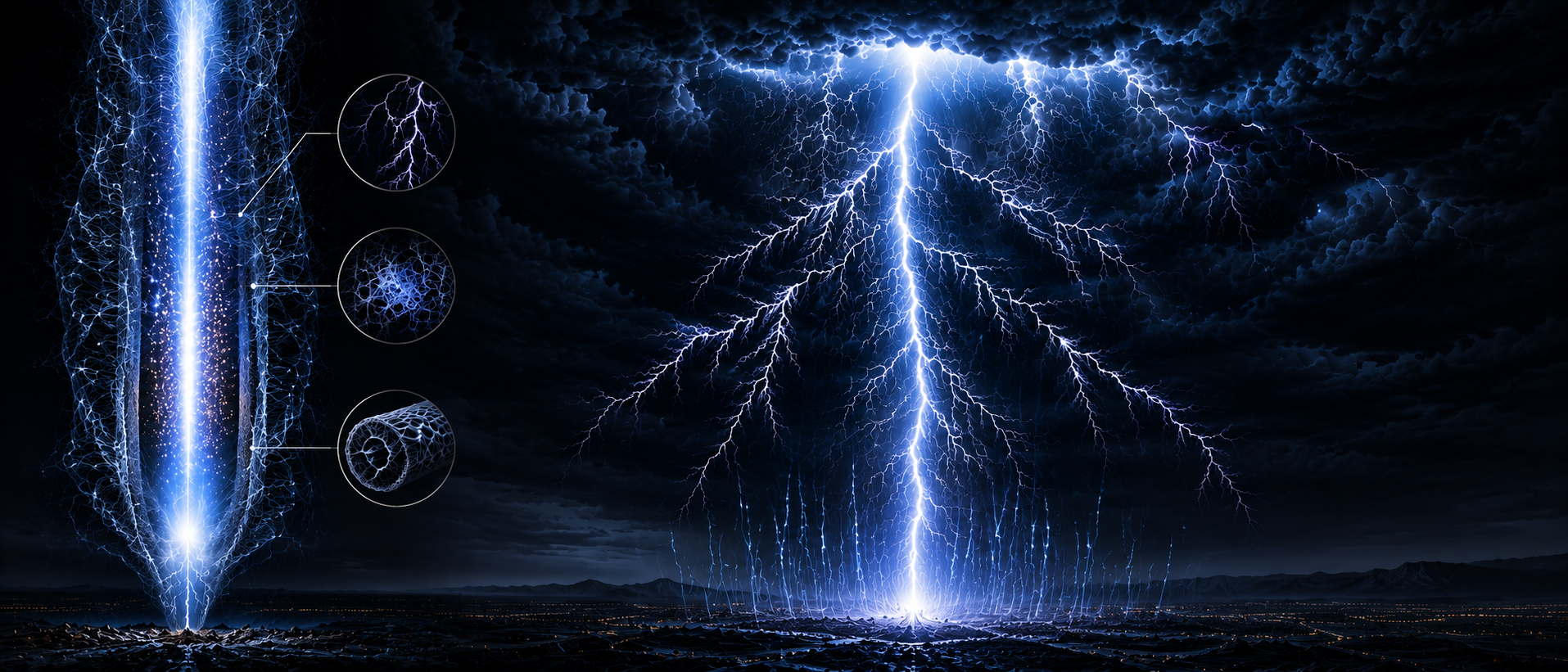
The channel of plasma through which a lightning bolt travels is roughly the width of a human thumb — about 2 to 3 centimetres in diameter. Through that narrow corridor, a current of around 20,000 amperes surges in a fraction of a millisecond. For reference, a standard household circuit breaker trips at 15 to 20 amps. A lightning bolt carries roughly a thousand times that. The voltage driving it can reach 300 million volts.
The lightning bolt temperature inside that plasma channel peaks at around 30,000 Kelvin — approximately five times hotter than the surface of the sun. Not the core of the sun, which is far hotter. But the outer surface, the photosphere, the part that produces all the light and heat that sustains life on Earth: a lightning bolt is five times hotter than that.
It lasts, in its primary discharge phase, for somewhere between 0.2 and 0.5 milliseconds.
In that brief window, the air inside the channel is transformed into plasma — a fourth state of matter in which electrons have been stripped entirely from atoms, leaving a soup of charged particles that conducts electricity essentially without resistance. The channel doesn’t just carry current. It becomes current. Light, heat, electromagnetic radiation, and an explosive pressure wave all radiate outward simultaneously.
That pressure wave is thunder.
The Stepped Leader: How a Lightning Bolt Actually Finds Its Path
Here’s the part that most people never learn, and that fundamentally changes how you picture lightning.
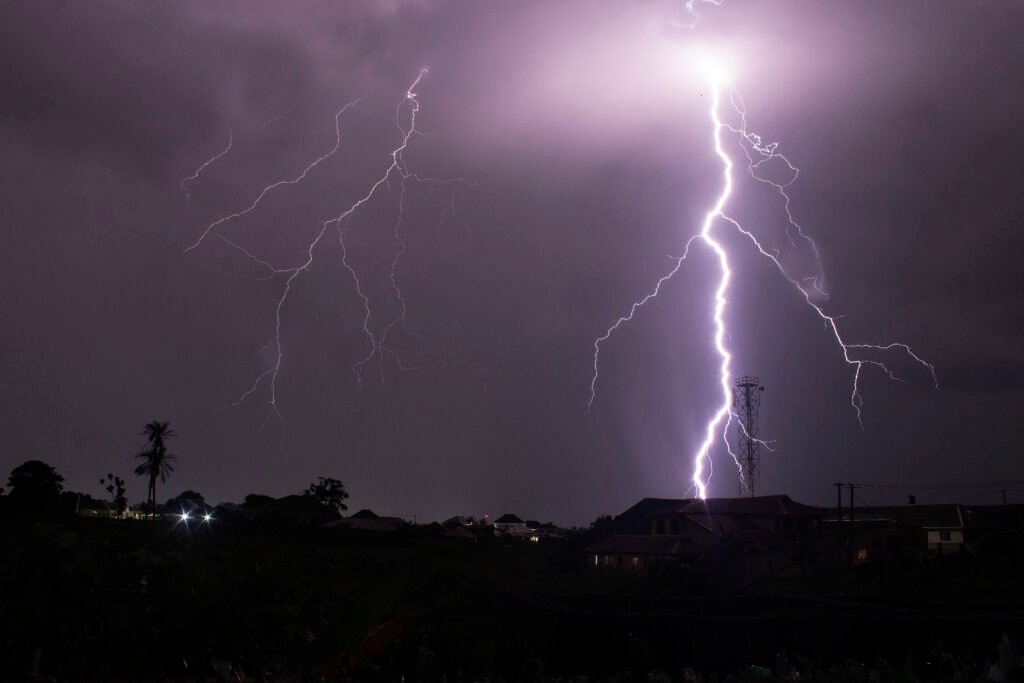
Lightning doesn’t travel in one continuous arc from cloud to ground. It doesn’t pick a destination and head for it. What actually happens is far stranger: lightning searches.
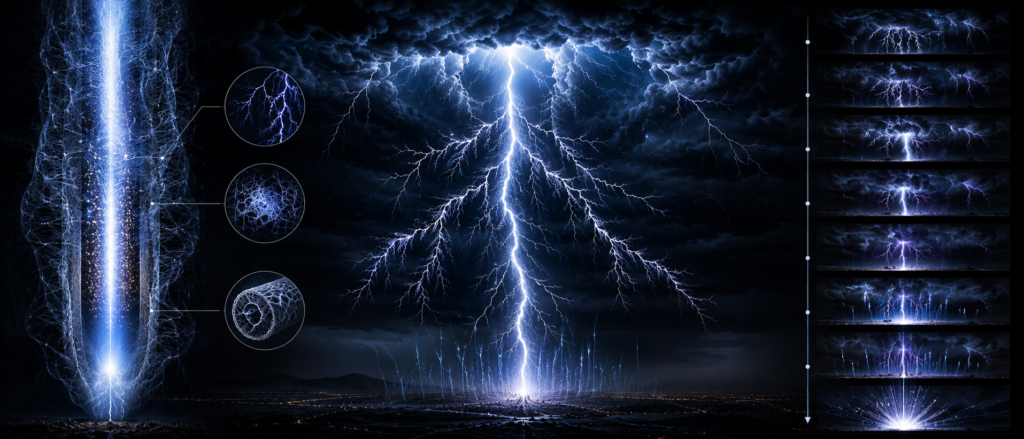
The process begins with a stepped leader — an invisible channel of ionised air that propagates downward from the cloud in discrete jumps, each roughly 50 metres long, each lasting about a microsecond, with a brief pause between steps. To get the stepped leader explained properly: it isn’t a single channel. It branches. It spreads in multiple directions simultaneously, like a fractal tree growing in fast-forward, each branch feeling its way through the air toward the path of least electrical resistance.
Meanwhile, from the ground — from tall trees, buildings, fences, anything that concentrates electric charge — invisible streamers are rising upward. These upward-moving leaders are quieter, shorter, most of them never connecting with anything. But when one upward streamer meets a downward stepped leader, the circuit closes.
That meeting point, usually somewhere between 10 and 100 metres above the ground, is where the return stroke begins.
The return stroke is what you actually see. It travels upward — from ground to cloud — at roughly one-third the speed of light. The bright channel of light that your brain registers as “lightning bolt going down” is in reality a violent discharge traveling in the opposite direction. The downward leader that made it possible was completely invisible to the naked eye.
This is one of the most counterintuitive facts in atmospheric physics. The lightning you see goes up.
Inside a Lightning Bolt: The Return Stroke in Microseconds
The return stroke unfolds on a timescale that makes human perception useless. The return stroke physics here is extreme by any measure — this is not a gradual discharge but an instantaneous, violent event.
At time zero, the circuit closes. The return stroke begins at the connection point and propagates upward at speeds between 100,000 and 300,000 kilometres per second — one-third to two-thirds the speed of light. The current surges through the newly established plasma channel, accelerating electrons that were already packed into the ionised path by the stepped leader.
In the first 50 microseconds, the peak current — that 20,000 amp figure — flows through a channel narrower than your wrist. The channel reaches its maximum temperature almost instantaneously. The surrounding air, which was at whatever ambient temperature before, is suddenly adjacent to something five times hotter than the sun’s surface.
That air doesn’t have time to move. It superheats and expands explosively, faster than the speed of sound, creating a supersonic shockwave: the sharp crack of thunder heard close to a strike. What you hear as a drawn-out rumble at distance is the arrival of sound from different parts of the lightning channel at slightly different times, strung together by the geometry of the bolt and the speed of sound across that distance.
The entire return stroke is over in about half a millisecond. But most lightning bolts you see aren’t single events — they’re sequences. After the initial return stroke, the channel may restrike multiple times, each reactivation called a dart leader following the still-ionised path. A typical lightning flash contains three to five return strokes. The flickering you notice in a lightning bolt is those multiple strokes firing in rapid succession. High-speed cameras have captured up to 26 return strokes in a single flash.
The Parts of Lightning Physics Still Not Understood
For all the physics described above, there are things happening inside a lightning bolt that scientists genuinely cannot explain yet.
The most striking unsolved problem is the initiation of lightning.
We know the broad picture of how lightning forms: charge separation builds up inside a thundercloud through the collision of ice crystals and graupel (soft hail) particles in strong updrafts. Lighter particles acquire positive charge and are carried upward; heavier particles acquire negative charge and sink. The resulting charge separation builds an enormous electric field. Eventually, something triggers the first discharge.
But the electric fields measured inside thunderclouds before lightning are consistently too weak to ionise dry air. By the conventional physics of dielectric breakdown — the process by which air stops being an insulator and becomes a conductor — the fields inside a thunderstorm shouldn’t be strong enough to trigger lightning at all. Yet lightning happens constantly.
One leading hypothesis involves cosmic rays — high-energy particles arriving from outside the solar system that collide with air molecules and produce showers of secondary particles, some of which may seed the initial ionisation that gets the stepped leader started. It’s called the cosmic ray runaway breakdown hypothesis, and there is growing observational evidence for it, including the detection of gamma-ray flashes associated with lightning from space-based instruments. Some thunderstorms appear to be producing gamma radiation — the same kind emitted by nuclear reactions — because of the extreme energetics inside the discharge.
There’s something genuinely strange about standing under a thundercloud and knowing that the crack of light and sound overhead is, in some theoretical models, being triggered by particles arriving from supernovae that exploded millions of years ago in distant galaxies.
Ball Lightning and the Other Anomalies
Any honest treatment of lightning physics has to mention ball lightning — one of the most persistent unexplained phenomena in atmospheric science.
Ball lightning is reported consistently across centuries and cultures: a luminous sphere, typically the size of a grapefruit to a football, that persists for several seconds after a lightning strike, moves slowly, sometimes passes through glass or walls, and then either vanishes silently or disappears with a small explosion. Thousands of credible eyewitness accounts exist, including from scientists and pilots. It has been photographed.
There is no accepted scientific explanation for it.
Proposed mechanisms include microwave radiation trapped in plasma bubbles, oxidising silicon nanoparticles produced when lightning strikes soil, vortex rings of plasma, and several quantum-mechanical models. None of them fully account for the behaviour reported. Ball lightning sits in that uncomfortable category of scientific anomaly — too well-documented to dismiss, too inconsistent with known physics to explain cleanly.
It’s a reminder that inside a lightning bolt, and in the atmospheric phenomena surrounding it, science is still working at the edges of what it understands. Just as the Wow! Signal remains unexplained despite decades of analysis, some natural phenomena resist clean resolution even under sustained scientific attention.
What Thunder Actually Is at the Physics Level
Most explanations of thunder stop at “sound caused by lightning.” But the mechanism is more specific and more interesting than that.
When the return stroke heats the plasma channel to 30,000 Kelvin in microseconds, the surrounding air is thermally shocked. It expands at supersonic speeds — faster than sound can propagate through the air ahead of it — creating a shockwave. The initial shockwave is a supersonic pressure discontinuity; this is the sharp crack you hear close to a strike. As it travels away from the channel, the shockwave decays into an ordinary sound wave, which is the rolling rumble you hear from further away.
The three-dimensional geometry of the lightning channel matters here. A long, branching bolt extends across several kilometres of sky. Sound from the nearest part of that channel reaches you first; sound from the far end arrives seconds later. Thunder’s distinctive rumble is partly a function of the bolt’s own shape arriving at your ears in sequence.
The five-second rule — count seconds between flash and thunder, divide by five to get distance in miles — is real and functional physics. Sound travels at roughly 343 metres per second at sea level. Five seconds means the bolt was about 1.7 kilometres away.
Lightning and its acoustic signature are the same event, separated only by the difference between the speed of light and the speed of sound. It’s one of the few places in everyday experience where that gap is viscerally, dramatically obvious. You see it instantly. You hear it seconds later. Why nothing can travel faster than light is usually an abstract physics concept — thunder makes it tangible.
Lightning as a Global Electrical Circuit
Zoom out far enough and lightning stops being a weather phenomenon and becomes something larger: a critical component of Earth’s global electrical circuit.
The atmosphere is not electrically neutral. At any given moment, roughly 40 to 50 lightning bolts are striking somewhere on Earth every second — about 1.4 billion strikes per year. This constant discharge is not random noise. It’s the mechanism by which charge is redistributed between the ground and the ionosphere, maintaining a weak but persistent global electric field that influences everything from fair-weather atmospheric chemistry to the fine structure of the magnetosphere.
Thunderstorms act as generators in this circuit, building up charge through the mechanical work of water vapour, ice, and updrafts. Lightning is the discharge side — the reset valve that keeps the circuit in balance. Without it, the global atmospheric charge differential would collapse within about an hour.
This is not widely taught, but it is one of the more startling facts about the planet’s electrical architecture: the storm you’re sheltering from isn’t just local weather. It’s part of the mechanism that keeps Earth’s atmosphere electrically functional.
There’s a broader pattern here that mirrors other Earth systems — like the great oxidation event, where a biological process quietly rewired the entire planetary atmosphere. Lightning is another case of a phenomenon that looks local, dramatic, and temporary, but is in fact a continuous, structural feature of how the planet operates.
Closer Than You Think
The next time you watch a storm roll in and see that first flash split the sky, the physics running underneath the spectacle is worth holding in mind.
An invisible fractal tree of ionised air is growing downward from the cloud in fifty-metre steps, branching, searching, feeling for a path. Invisible streamers are rising from the ground. When they meet, a channel of plasma hotter than the sun’s surface carries thirty times the current of a hospital’s electrical system through a gap the width of your thumb, in a discharge that travels upward at a third of the speed of light, triggered possibly by a particle that originated in a supernova explosion in another galaxy.
The flash is over before your nervous system fully registers it.
That’s what’s actually happening inside a lightning bolt. Ordinary weather. Extraordinary physics.