
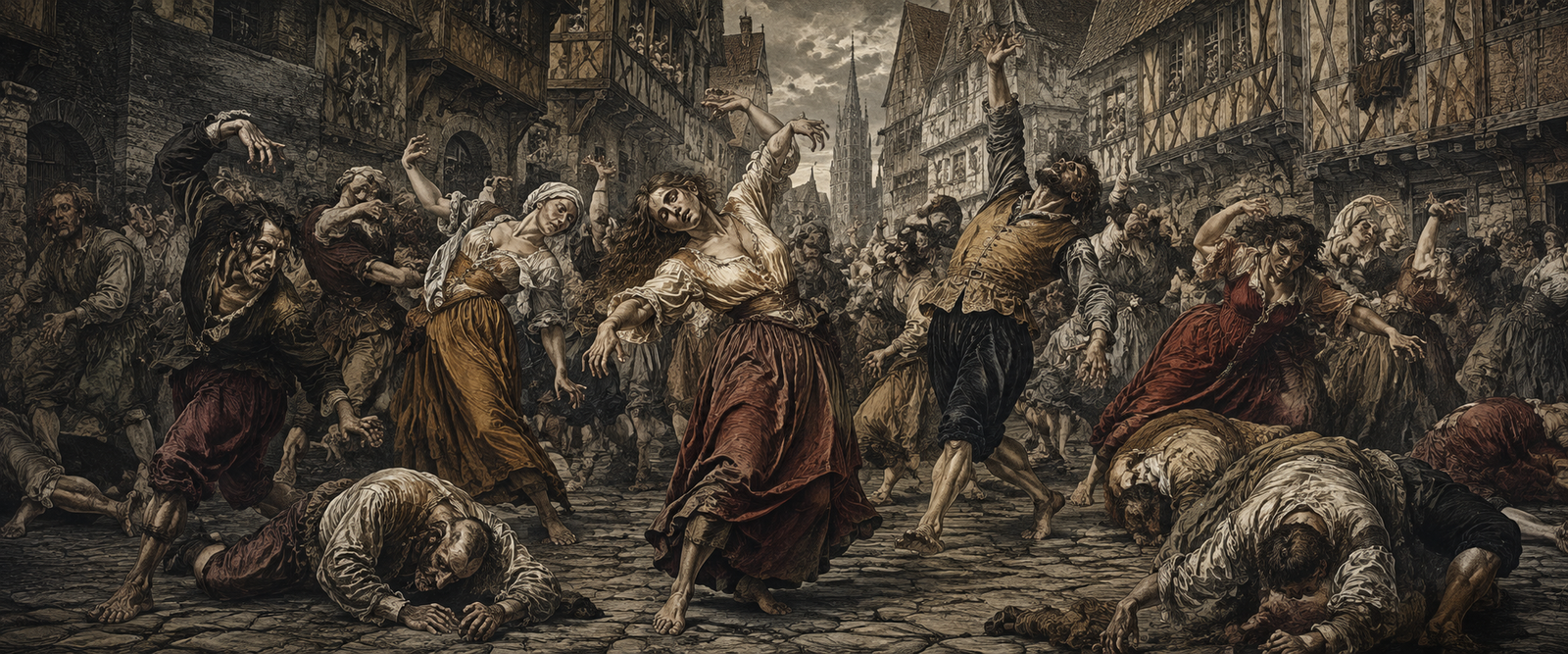
In July of 1518, a woman stepped into a narrow street in Strasbourg and began to dance. There was no music, no festival, no reason. She simply danced — and she did not stop. Not for hours. Not for days. Within a week, dozens more had joined her, their bodies jerking through the streets in a silent, exhausted frenzy. Within a month, the number swelled into the hundreds, and people began to collapse and die from stroke, heart attack, and sheer physical exhaustion. This actually happened. It’s one of the best-documented strange events in medieval history, recorded in physician notes and council minutes — the kind of episode that sits alongside other bizarre historical events that sound invented but aren’t. And five centuries later, the question of why an entire town danced until death remains one of the most fascinating unsolved puzzles in the history of the human mind.
Why an Entire Town Danced Until Death: What the Records Show
The historical account is unusually solid, which is part of what makes it so unsettling. This wasn’t a legend that grew in the retelling.
The outbreak began with a single woman, named in the records as Frau Troffea, dancing in the street in mid-July. Contemporary chronicles describe her continuing for days, and within a week around thirty-four others had joined. By August, historical estimates put the number as high as 400 people caught in the same compulsion. Alarmed authorities called in physicians, who ruled out astrological and supernatural causes and declared it a natural disease — a “hot blood” affliction. Even the experts of the day had no real grasp of why an entire town danced until death.
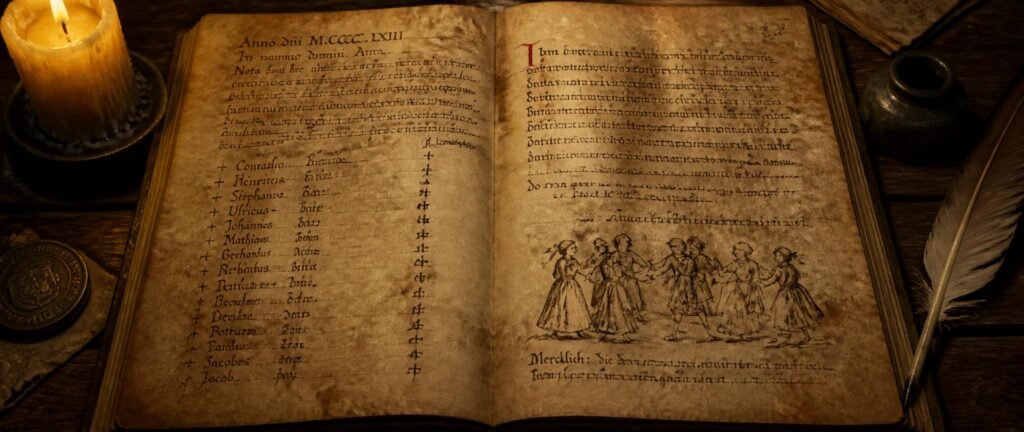
Their prescribed cure is the detail that stops you cold. Believing the afflicted simply needed to dance the sickness out of their systems, the town guilds actually encouraged more dancing. They hired musicians, built a wooden stage, and opened guildhalls to let the dancers continue. The result was predictable and grim: rather than exhausting the illness, they amplified it — a chilling early example of how crowds override individual judgment. Understanding why an entire town danced until death means reckoning with the fact that the official response poured fuel on the fire.
What Caused the Dancing Plague? The Leading Theories
For five centuries, people have tried to explain it, and no single answer is fully settled. So what caused the dancing plague? The candidates fall into a few camps, each revealing something different.
The oldest theory blamed poisoning. Ergot, a toxic mould that grows on damp rye, contains compounds chemically related to LSD and can cause convulsions, hallucinations, and spasms. It’s a tidy explanation with one fatal weakness: ergot poisoning restricts blood flow and often makes coordinated movement impossible, let alone days of sustained dancing. A person poisoned by ergot could not have danced for a week — the truth was psychological, closer to how expectation shapes feeling than to any toxin. As an answer to what caused the dancing plague, the mould theory largely collapses under scrutiny.
Others proposed a religious cult, or a deliberate ritual. But the records make the dancers’ agony plain — witnesses described terror and pleading, people begging for the movement to stop. This was not devotion. It was something happening to them, against their will.
The Strasbourg Dancing Epidemic as Mass Psychogenic Illness
The explanation most historians now favor is stranger than poison and more human than any cult. The Strasbourg dancing epidemic appears to be one of history’s most dramatic cases of mass psychogenic illness — physical symptoms, genuinely and involuntarily experienced, that spread through a population by psychological rather than biological means — the same principle behind how belief makes people sick, where dread alone translates into real physical symptoms.
The key is context. In 1517 and 1518, Strasbourg was drowning in misery: repeated famines, brutal cold, and outbreaks of disease, including syphilis and the plague itself. The population was starving, terrified, and pushed to the edge of collapse. Under that kind of unrelenting stress, the mind’s grip on the body can slip in ways that feel impossible from the outside.
Crucially, this region carried a specific cultural belief: a local legend held that Saint Vitus could curse sinners with a compulsion to dance. In a devout, petrified population primed to believe that uncontrollable dancing was a real supernatural punishment, that belief could become a kind of psychological trigger — a script the stressed mind was waiting to act out. It scaled a private psychological trigger up to an entire town.
How Mass Hysteria Spreads Through a Crowd
If one terrified, suggestible person could tip into an involuntary trance, why did hundreds follow? The answer lies in the strange contagiousness of human behavior in a crowd.

Understanding how mass hysteria spreads means recognizing that emotions and physical states can transmit socially, almost like an infection. Seeing others dance — especially within a shared belief system that framed the dancing as a real, catching affliction — could induce the same dissociative state in onlookers who were equally stressed and equally primed. The behavior of the group quietly rewrites what each person does, and even what their body does.
Modern parallels exist and keep the phenomenon from feeling safely medieval. Documented outbreaks of unexplained fainting, twitching, and laughing have swept through schools and factories in the 20th and 21st centuries, always under conditions of shared stress and social suggestion. The mechanism that danced Strasbourg to death has not disappeared. It has only changed costume.
Why This Story Still Matters
It’s tempting to file the dancing plague away as a bizarre medieval curiosity, a footnote about strange people in a strange time. That’s the wrong lesson.
The right one is more humbling: under enough stress, fear, and cultural suggestion, the human mind can drive the human body to do things it cannot consciously override — no poison, no trickery, no weakness of character required. The dancers of Strasbourg were not foolish or faithless. They were ordinary people crushed by circumstances, whose minds and bodies broke along a fault line that runs through all of us.
So the enduring answer to why an entire town danced until death isn’t found in a poisoned grain or a hidden cult. It’s found in the terrifying, fascinating truth that the boundary between mind and body is far thinner than we like to believe — and that under the right pressure, a whole community can cross it together, dancing all the way.