
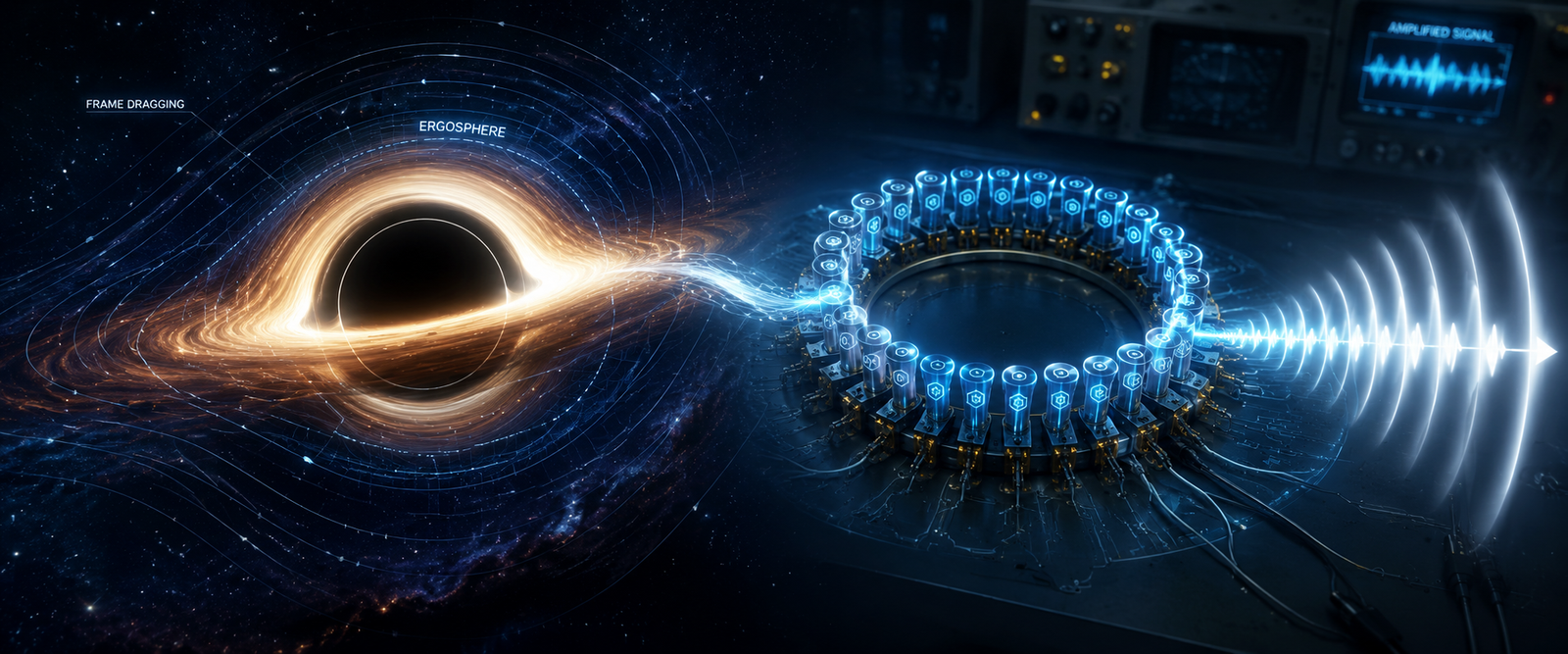
The most powerful battery in the universe isn’t a battery at all — it’s a black hole. Spin one fast enough and, in principle, you could draw off an astonishing amount of energy: a source so concentrated it makes every reactor humanity has ever built look almost trivial. For over fifty years that idea lived only in equations. Then, in July 2026, physicists in Manhattan did something remarkable: they recreated the physics of extracting energy from a black hole on a device small enough to fit on a lab bench — with no black hole anywhere in sight.
By the end of this article, you’ll understand the audacious 1969 idea that started it all, how a stationary gadget can convincingly imitate a spinning black hole, why nothing was ever actually drained of its power, and what a cosmic trick like this could mean for the tech in your pocket. In its own way, it’s a leap as bold as our quest for fusion.
Penrose’s Blueprint for Extracting Energy From a Black Hole
The idea dates to 1969, when Roger Penrose imagined a spinning black hole surrounded by a region called the ergosphere — a zone where the black hole’s rotation drags the very fabric of spacetime around with it, a vivid extension of how gravity warps spacetime. Penrose realised that a particle entering this zone could split in two: one half falls in, while the other escapes carrying more energy than it arrived with. The surplus is stolen straight from the black hole’s spin. This is the Penrose process, and because energy and mass are equivalent, the black hole literally loses a sliver of mass as it gives up that rotational energy.
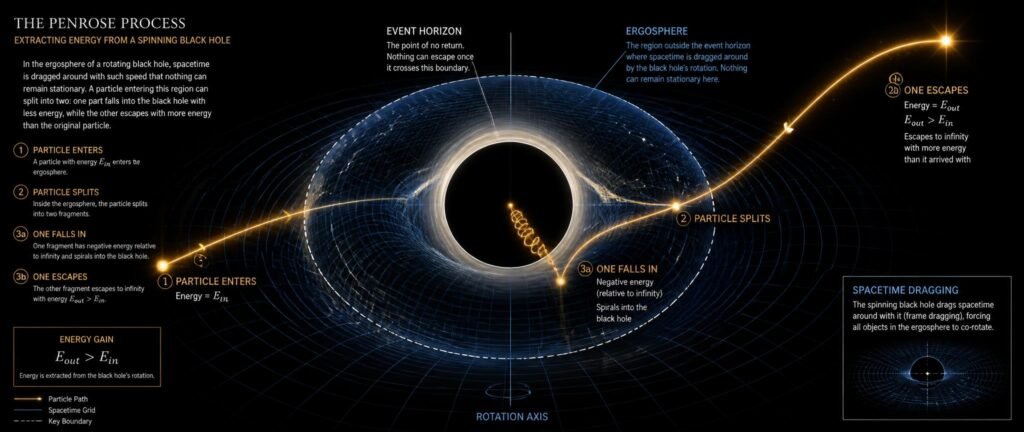
The numbers are absurd. A maximally spinning one could, in theory, surrender up to 29% of its entire mass as usable energy — a mechanism so efficient it makes even our best terrestrial power dreams, from fusion to a forgotten energy source like thorium, look almost quaint.
Recreating It Without a Black Hole
Obviously, you can’t keep a black hole in a laboratory. So the CUNY team, publishing in Nature, cheated brilliantly. Instead of spinning anything, they built a stationary ring of electronic resonators and rapidly modulated its properties in a timed sequence, so that incoming waves felt as though they were meeting a surface turning at impossible speed — even seemingly faster than the cosmic speed limit. They call this trick synthetic rotation.
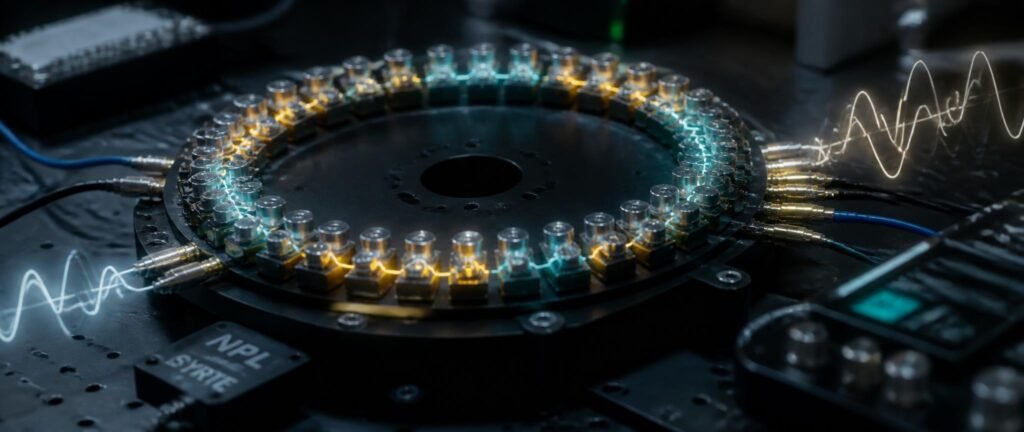
The result was exactly what theory predicted. Radio waves with the right twist drew energy out of the system and came out amplified — a wave-based version of Penrose’s idea first proposed by physicist Yakov Zel’dovich. Nothing physically span, yet energy was extracted and the waves grew stronger, reproducing black-hole physics at room temperature. In effect, the team had found a way of mimicking the act of extracting energy from a black hole without any black hole at all. This is not a power plant in disguise — it’s a window into extreme physics we could never otherwise reach.
Why a Lab Bench Beats a Black Hole
The point was never free energy. Real black holes sit millions of light-years away, and this device doesn’t harvest their power. What it offers is arguably more useful: a controllable, tabletop laboratory for studying physics that only otherwise happens near the most extreme objects in existence. Researchers can now dial the parameters up and down and watch how the amplification behaves — something impossible with a real, distant black hole.
Beyond pure curiosity, the same wave-amplifying trick could feed into better optics, wireless communications, and quantum technologies. A phenomenon Penrose dreamed up for the rim of a black hole may end up quietly improving the antenna in your phone.
From Equation to Experiment
For half a century, extracting energy from a black hole was a beautiful piece of mathematics with no way to test it up close. Now it has a home on a workbench in New York. The black hole itself stays untouched, spinning silently across the void — but its strangest secret has finally been coaxed into the lab, where we can study it, tune it, and perhaps one day put it to work.