
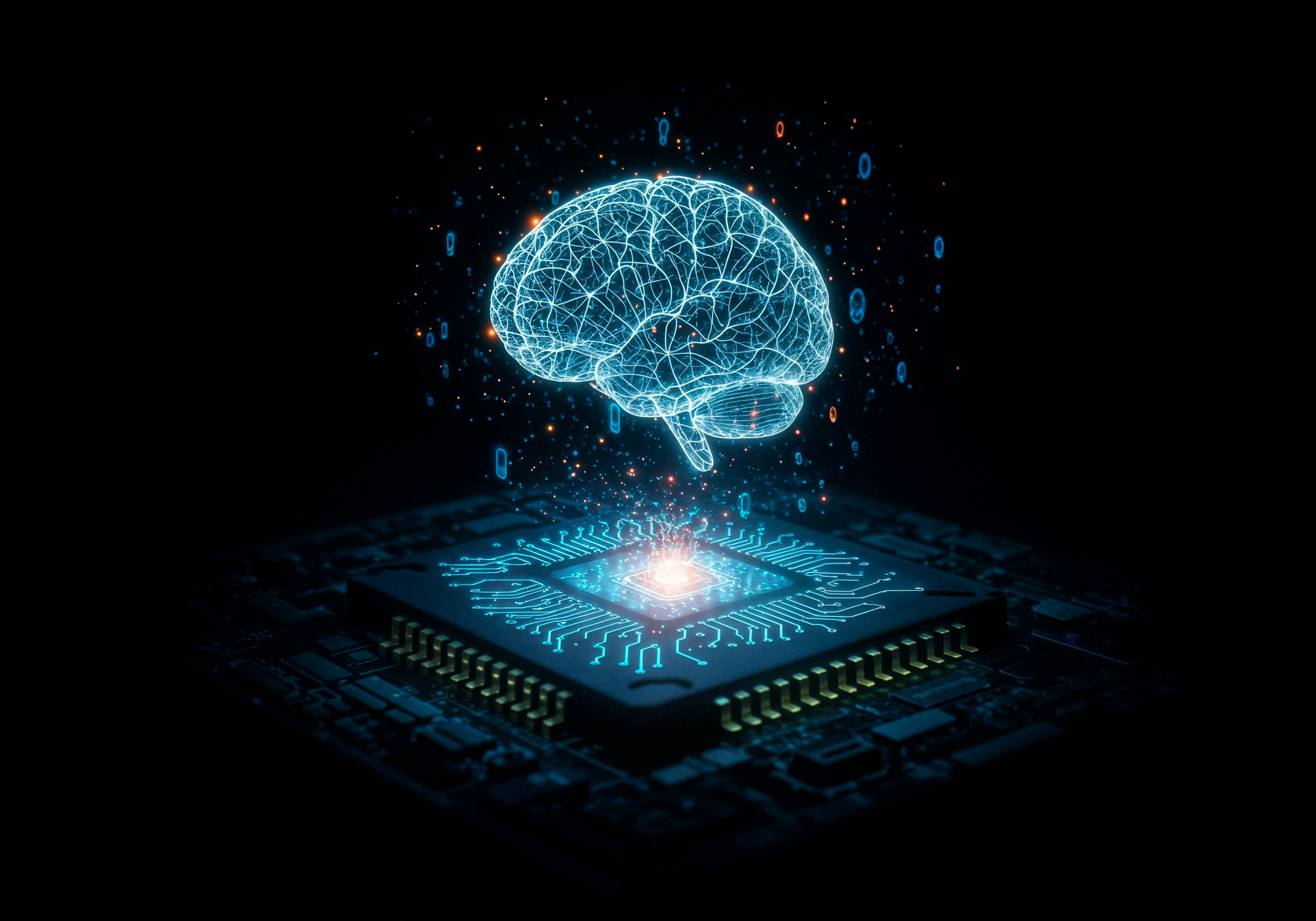
For decades, computers have followed the same rigid rhythm—processing numbers step by step, separating memory from logic, consuming energy like a machine that never learned to breathe. But inside research labs across the world, engineers have been chasing something radically different: machines that don’t just compute, but behave more like living brains.
This pursuit has given rise to neuromorphic chips, a new class of processors designed to mimic how biological neurons communicate. Unlike traditional processors that crunch data in sequence, neuromorphic chips fire electrical pulses—called spikes—in patterns inspired by neural activity. The result is hardware that doesn’t just process information; it learns, adapts, and reacts in ways that echo biological intelligence.
What once sounded like speculative science fiction is now firmly rooted in real engineering. And the momentum behind these brain-inspired chips suggests that computing itself may be approaching a turning point.
What Are Neuromorphic Chips and How Do They Work?
Neuromorphic chips are designed to replicate the structure and function of neural networks found in the human brain. Instead of relying on centralized processing units that move data back and forth between memory and computation, neuromorphic architectures integrate both functions into neuron-like units.
In the human brain, billions of neurons communicate through tiny electrical signals. Each neuron activates only when a specific threshold is reached, sending pulses to neighboring neurons. This event-driven communication is extraordinarily efficient. The brain operates on roughly 20 watts of power—less than many household light bulbs—yet it outperforms even the most advanced computers in pattern recognition and learning.
Neuromorphic chips attempt to recreate this efficiency through spiking neural networks (SNNs). These networks process data only when necessary, rather than running continuous operations. That difference alone can dramatically reduce energy consumption while enabling systems to respond instantly to new inputs.
Traditional computing architectures, often called von Neumann systems, move data between memory and processing units in constant cycles. This movement creates delays and consumes energy. Neuromorphic chips remove this bottleneck by allowing memory and computation to exist within the same structures, much like neurons storing and processing signals simultaneously.
The Early Foundations: How Neuromorphic Computing Began
The concept of neuromorphic engineering dates back to the late 1980s, when scientists began exploring hardware that mimicked biological neural systems rather than purely mathematical models.
One of the earliest milestones occurred in 1989, when American scientist Carver Mead introduced the term neuromorphic engineering. His work laid the theoretical foundation for building electronic circuits modeled after biological neurons and synapses. At the time, computing power was limited, and the idea remained mostly experimental.
Through the 1990s and early 2000s, progress continued slowly. Researchers developed small-scale neuron-like circuits, but large-scale systems remained out of reach due to hardware limitations. The turning point came in the 2010s, when advances in semiconductor technology made it possible to integrate millions of artificial neurons onto single chips.
This shift transformed neuromorphic computing from an academic curiosity into an active engineering frontier.
Major Breakthrough Neuromorphic Chips
Over the past decade, several landmark projects have demonstrated that neuromorphic systems are no longer theoretical concepts—they are functioning technologies pushing the boundaries of modern computing.
IBM TrueNorth: A Million-Neuron Milestone
In 2014, IBM unveiled TrueNorth, one of the first large-scale neuromorphic chips capable of simulating neural activity at unprecedented levels. TrueNorth contained 1 million artificial neurons and 256 million synapses, all operating with remarkable energy efficiency.
What made TrueNorth significant was not just its scale, but its power efficiency. It consumed dramatically less energy than traditional processors performing comparable tasks. This milestone demonstrated that brain-inspired architectures could operate at large scales without overwhelming power demands.
Intel Loihi: Learning in Real Time
In 2017, Intel introduced Loihi, a neuromorphic chip designed to support adaptive learning directly within hardware. Unlike many earlier systems that required external training, Loihi allowed networks to modify connections in real time—closer to how biological brains learn through experience.
Intel later expanded this architecture into Loihi 2, improving performance and scalability. These systems have been used in research involving robotics, sensory processing, and adaptive decision-making.
Loihi showed that neuromorphic chips could move beyond simulation and into practical experimentation, particularly in systems that require fast responses and continuous learning.
SpiNNaker: Simulating Brain Networks at Scale
Developed at the University of Manchester in the United Kingdom, SpiNNaker (Spiking Neural Network Architecture) represents one of the largest neuromorphic computing platforms ever constructed.
Completed in stages through the 2010s, SpiNNaker consists of millions of processing cores, designed to simulate massive neural networks in real time. The project was built specifically to model large portions of the human brain and understand how neural systems operate collectively.
Unlike standard supercomputers, SpiNNaker emphasizes parallel processing, mirroring the simultaneous firing of biological neurons. This makes it uniquely suited for neuroscience research and brain simulation studies.
Emerging Systems and Global Innovation
Neuromorphic research has expanded beyond a few laboratories and now spans institutions across the globe. Projects such as BrainScaleS in Germany and Darwin3 in China continue to push neuron counts higher while improving reliability and efficiency.
Meanwhile, startups and academic groups are exploring specialized neuromorphic processors designed for edge computing, robotics, and autonomous systems. This growing ecosystem suggests that neuromorphic computing is entering a stage of rapid experimentation and diversification.
Why Neuromorphic Chips Matter Now
The renewed interest in neuromorphic computing is not accidental. It is driven by fundamental challenges facing modern technology.
The Energy Crisis of Artificial Intelligence
Modern AI systems require enormous computational resources. Training large neural networks consumes vast amounts of electricity, sometimes comparable to the lifetime energy usage of multiple households.
Neuromorphic chips offer a path toward ultra-low-power computing, allowing intelligent systems to operate in environments where energy availability is limited. This includes mobile devices, remote sensors, and spacecraft operating far from Earth.
Reducing energy demand is not just an engineering advantage—it is becoming a necessity as global computing needs continue to expand.
The Slowdown of Moore’s Law
For decades, computing power increased steadily as engineers packed more transistors into smaller spaces—a trend known as Moore’s Law. However, physical limits are now slowing this progress.
As traditional scaling approaches its limits, researchers are exploring entirely new architectures rather than relying solely on smaller components. Neuromorphic computing represents one of the most promising alternatives, offering performance gains through design innovation, not just transistor density.
Real-World Applications of Neuromorphic Computing
Despite being an emerging technology, neuromorphic systems are already finding roles in specialized fields where traditional processors struggle.
In robotics, neuromorphic chips enable machines to react to environmental changes instantly, processing sensory data in real time. This allows robots to navigate dynamic environments more naturally and efficiently.
In autonomous vehicles, neuromorphic processors can help manage visual and motion data with lower energy consumption, improving response times and extending operational life.
In medical technology, neuromorphic systems are being explored for brain-computer interfaces and neural prosthetics. Their ability to process signals similarly to biological neurons makes them particularly suited for interpreting neural activity.
In space exploration, where energy and communication bandwidth are limited, neuromorphic chips allow spacecraft to make rapid decisions locally without constant instructions from Earth.
These applications highlight the practical advantages of brain-inspired computing beyond theoretical experimentation.
The Challenges Standing in the Way
For all its promise, neuromorphic computing still faces significant obstacles that prevent widespread adoption.
One of the largest barriers is the software ecosystem. Most programming tools are designed for traditional computing architectures. Developing software optimized for spiking neural networks requires new frameworks and specialized expertise.
Another challenge is manufacturing complexity. Building chips that mimic neural behavior demands advanced fabrication methods, increasing development costs.
Performance comparisons also remain complex. In some tasks, conventional GPUs still outperform neuromorphic systems, especially when handling large-scale mathematical operations.
These challenges do not negate the potential of neuromorphic computing—but they do explain why the technology remains largely experimental rather than mainstream.
How Neuromorphic Chips Could Shape the Future of Computing
The long-term implications of neuromorphic technology extend far beyond faster processors. If successful, these systems could fundamentally change how machines learn and interact with the world.
Future devices may rely less on centralized cloud computing and more on localized intelligence, where sensors analyze data instantly without transmitting it across networks. This shift could reduce latency, enhance privacy, and improve reliability in remote environments.
Neuromorphic architectures may also contribute to lifelong learning systems, capable of adapting continuously rather than relying on periodic retraining cycles.
Some researchers envision hybrid systems combining traditional processors with neuromorphic components, creating machines that leverage both numerical precision and adaptive learning.
While the timeline for widespread adoption remains uncertain, the trajectory is clear: computing is moving toward designs that resemble biological intelligence more closely than mechanical calculation.
The Quiet Revolution in Silicon
Neuromorphic chips represent more than just another technological upgrade. They signal a philosophical shift in how engineers think about intelligence itself.
Instead of forcing machines to imitate logic step by step, scientists are studying the biology of thinking and translating its principles into silicon. This blending of neuroscience and engineering marks one of the most interdisciplinary revolutions in modern technology.
The rise of neuromorphic computing is still unfolding, but its direction suggests a future where machines no longer resemble calculators—but echo the rhythms of living brains.
And if that future arrives, it will not happen with a sudden bang. It will emerge quietly, neuron by neuron, spike by spike, until computation itself begins to feel almost alive.