
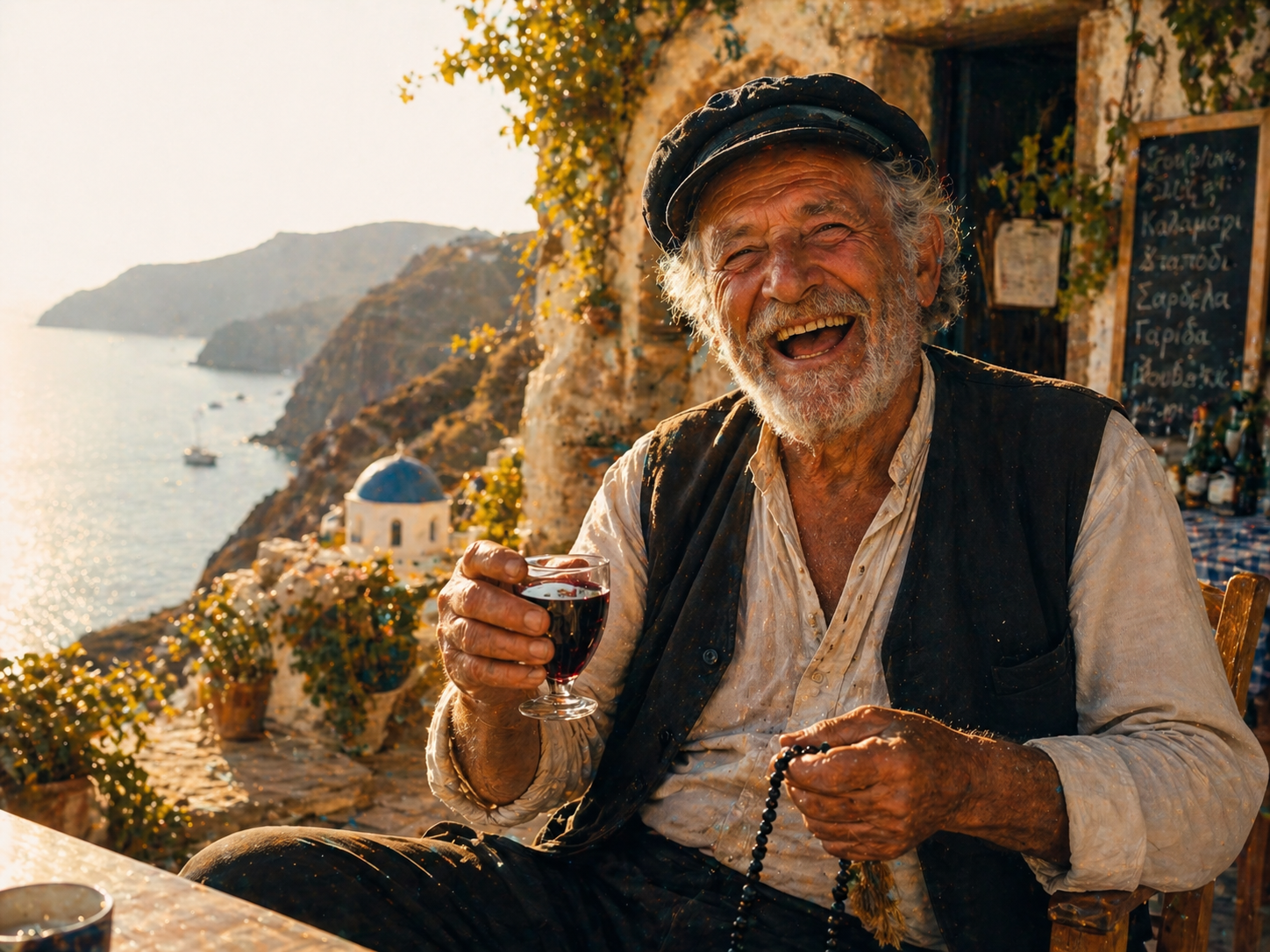
In 1943, a Greek man named Stamatis Moraitis was living in America when doctors gave him a terminal diagnosis. Lung cancer. Nine months to live, at best. He was in his mid-thirties.
He made a decision that the doctors thought was madness. He packed up his life in Florida, said goodbye to his career, and moved back to the tiny Greek island where he was born — Ikaria — to die among the olive trees, the wild herbs, and the people who had known him as a boy.
The months passed. He didn’t die.
He planted a garden. He started drinking wine with friends in the evenings. He slept when he was tired and woke when he felt like it. He reconnected with the Orthodox church of his childhood. His friends came to visit. They laughed. They argued. They stayed until midnight.
Stamatis Moraitis lived for another 45 years. He died in 2013 — at the age of 98 — having outlived every doctor who had ever given him a terminal prognosis.
What was in the water on Ikaria?
The Island the World Forgot — And That Forgot to Age
Tucked into the eastern Aegean Sea, roughly 30 miles off the coast of Turkey, lies a small, rugged, gloriously impractical island called Ikaria. It covers just 99 square miles. Its roads are narrow, winding, and terrifyingly close to cliff edges. Its villages are scattered across steep mountains that would exhaust a goat. Before the mid-1990s, most of the island had no paved roads at all. Residents climbed ancient footpaths to visit their neighbours, haul groceries, and check on family — every single day.
It has a population of roughly 10,000 people. And it is, statistically, one of the most extraordinary places on Earth.
The inhabitants of Ikaria live, on average, ten years longer than those in the rest of Europe and America. Around one in three Ikarians lives into their 90s. On this island, people suffer 80 percent less dementia, 50 percent less heart disease, and 20 percent less cancer than the rest of the world.
Let those numbers sit for a moment.
In America, if you reach the age of 85, you have roughly a 50 percent chance of developing some form of dementia. In Ikaria, when researchers went looking for dementia cases among everyone over 65, they found only three very mild cases.
This is not a myth. This is not wellness marketing. This is peer-reviewed data from the University of Athens, National Geographic research teams, and multiple longitudinal studies. The numbers are real. The question is: why?
The Blue Zone Discovery
The story of how Ikaria got the world’s attention begins with a demographer named Gianni Pes and a National Geographic Fellow named Dan Buettner.
In the mid-2000s, Buettner and a team of researchers were systematically studying regions of the world where people lived significantly longer than average — places where centenarians were not anomalies but neighbours. They called these places Blue Zones.
Ikaria is one of the world’s five Blue Zones, alongside Sardinia in Italy, Okinawa in Japan, Nicoya in Costa Rica, and Loma Linda in California. More than 30% of Ikarians live into their nineties, generally free from chronic illness and dementia, and many hit 100.
What distinguished Ikaria from a statistical curiosity to a genuine scientific puzzle was not just the length of life — it was the quality. Ikarians maintain a sex life into old age, remain physically active deep into their 90s, and have much lower rates of depression. These were not people lingering miserably past their time. These were people who were, by every measurable standard, thriving.
The media started calling Ikaria “the island where people forget to die.” The locals, characteristically unbothered by the attention, mostly just kept growing their vegetables and playing dominoes past midnight.
What Is Actually Different About Life on Ikaria?
Researchers have spent years trying to isolate the variables. What they found is not one magic ingredient but a dense, interwoven web of habits, culture, geography, and attitude that collectively produce something remarkable. Pull any single thread and it matters a little. The whole fabric, it turns out, matters enormously.
The Food — Grown, Not Bought
Ikarians eat a variation of the Mediterranean diet, with lots of fruits and vegetables, whole grains, beans, potatoes, and olive oil. But the Ikarian version is notably purer than the Mediterranean diet most Westerners try to replicate from a cookbook.
Most Ikarian families grow their own produce. Olive oil is pressed from trees they tend themselves. Wine is made from grapes grown in their own yards. Herbs — wild rosemary, sage, oregano, dandelian — are picked from hillsides and brewed into teas that, researchers discovered, also function as mild diuretics, helping regulate blood pressure naturally.
Scientists found that these herbal teas pack a significant antioxidant punch. Wild rosemary, sage, and oregano teas act as diuretics, which can keep blood pressure in check by ridding the body of excess sodium and water.
There is also the matter of what Ikarians are not eating. Processed food has had minimal presence on the island until recently. Sugar, preservatives, artificial ingredients — these simply were not part of the food supply for most of the 20th century. Their pantries were, by default, clean.
The Movement — Built Into Life, Not Added to It
Nobody on Ikaria has a gym membership. But the longest-lived Ikarians exercised mindlessly — just gardening, walking to a neighbour’s house, or doing their own yard work.
Here is the insight that Western wellness culture consistently misses: exercise that feels like exercise is much harder to sustain than movement that is simply how you live. Because the island is mountainous and historically had no roads, people constantly had to walk up and downhill. But here it was not exercise — it was life. A life wired for longevity.
Every trip to the neighbour involved a climb. Every morning in the garden involved bending, lifting, hauling. Every social call was a walk. The body stayed active not through discipline but through architecture.
The Sleep — Taken Seriously, Without Shame
This one surprises people most. People in Ikaria like to take a mid-afternoon break, and regular nappers have a reduced risk of dying from heart disease — up to 35 percent lower. This is likely because napping reduces stress hormones or restores heart function.
The island essentially shuts down in the afternoon. Shops close. Work pauses. People sleep. This is not laziness — it is physiology. The body needs recovery cycles that the modern world has mostly eliminated in the name of productivity. Ikarians kept them.
The Social Life — Deep, Daily, Genuinely Connected
Perhaps the most underrated variable in the Ikaria equation is also the hardest to replicate: the quality of human connection.
Social interactions on the island are not merely a matter of casual acquaintance — they are deeply rooted in a culture of communal living that greatly emphasises family ties and civic engagement. Elders are revered and frequently live with or near their younger family members, allowing for continuous intergenerational interaction.
There are no care homes on Ikaria. Elderly people do not disappear from community life — they remain central to it. They are consulted, included, and surrounded by people who genuinely know them. The research on loneliness and mortality is unambiguous: chronic loneliness is as damaging to health as smoking 15 cigarettes a day. Ikarians, almost by cultural default, do not experience chronic loneliness.
The evenings on the island are legendarily social. People gather at the local kafeneion — the village café — and stay for hours. They argue, joke, play dominoes and backgammon, drink wine, and talk. They do not watch the clock. They stay until they feel like leaving.
Most evenings, Ikarians play dominoes in the local bar past midnight. This is not a youthful behaviour. This is what the 85-year-olds do.
The Attitude Toward Time — Or the Lack of One
This cultural quirk is perhaps the hardest to quantify but the most philosophically interesting. Ikarians have a deeply relaxed relationship with time that visitors consistently note with a mixture of admiration and mild frustration.
Appointments are loose. Schedules are suggestions. No one rushes. In Ikaria, no one looks at the clock, and time moves in a slow, dreamlike way.
The chronic stress of modern life — the constant background noise of urgency, productivity pressure, the anxiety of being behind — is simply absent. And chronic stress, we now know, is one of the most potent accelerants of cellular ageing. It shortens telomeres, raises cortisol, suppresses immune function, and drives the inflammation underlying most chronic disease.
Ikarians remove this variable almost entirely from their lives. Not through meditation apps or mindfulness retreats — but through culture, through community, through a collective decision that urgency is not a virtue.
The Hot Springs No One Talks About
There is one strange footnote to the Ikaria story that researchers have not fully explained.
Certain areas of Ikaria contain naturally occurring radioactive elements, particularly radium and uranium. The island is listed among the world’s most radioactive places on Earth — however, the levels of radiation are considered safe for people.
The hot springs in Ikaria are superheated at temperatures between 31°C and 58°C and are among the world’s most radioactive. Bathing in them is cited as another contributing factor to the islanders’ longevity.
Whether the hot springs play a direct causal role or are simply another piece of an exceptionally healthy puzzle remains an open scientific question. But locals have been bathing in them for centuries — the Romans built baths there. Whatever they are doing, they do not appear to be hurting.
Stamatis Moraitis and What His Story Actually Tells Us
Let us return to the man who was supposed to die.
The story of Stamatis Moraitis has been told many times as a kind of fairy tale — man goes home to die, finds the magic island air, lives forever. But the details are more interesting than the headline.
What actually happened when Moraitis returned to Ikaria? He stopped trying to manage his death. He stopped being a patient and became a person again. He gardened. He slept in the afternoon. He drank wine with friends. He had purpose — the vegetables needed tending, the neighbours needed visiting, the vineyard needed attention.
He did not adopt a special protocol. He did not take supplements or join a wellness programme. He simply lived the way Ikarians lived — slowly, socially, purposefully, outside, with wine in the evenings and no particular interest in what time it was.
And his body, apparently, decided it could continue after all.
The medical establishment’s response to his survival was not gracious. When Moraitis reportedly returned to America decades later to visit, he claims he tried to find his original doctors — to ask them what they made of his continued existence. They had all predeceased him.
Can the Ikaria Model Be Exported?
This is the question everyone asks after learning about the Blue Zones, and the answer is complicated.
Some elements are readily adoptable. The Mediterranean diet is well-documented and accessible. Prioritising sleep and midday rest is behavioural, not logistical. Reducing processed food is a choice, not a geography.
But the deeper variables — the genuine community, the multi-generational households, the culture of unhurried time, the social architecture that means no elderly person ever eats alone — these are not things that can be downloaded or purchased. They are the accumulated product of centuries of shared living, isolation, and necessity.
Dan Buettner, who has spent his career studying Blue Zones and trying to help American cities replicate aspects of them, is honest about the limits. The interventions that work best are environmental and social — redesigning communities so that movement is built in, creating genuine social infrastructure, reducing the structural isolation of older adults.
Individual willpower, however sincere, does not produce a Blue Zone. Culture does.
The Quiet Lesson from the Mountain
There is something quietly devastating about the Ikaria story when you hold it against the backdrop of modern life.
We have built an entire civilisation around speed, efficiency, productivity, and individual achievement. We have largely dismantled the social structures — extended family, village community, shared religious practice, unscheduled evening gatherings — that appear to be the actual substrate of human longevity. And then we spend billions trying to find a pharmaceutical or a supplement that will give us back what we gave away.
Ikaria is not a paradise. It is a poor island with rough roads and limited infrastructure. Its healthcare access has historically been difficult. Its economy is modest. Its winters are harsh.
And yet the data is unambiguous: the people there live longer, healthier, more cognitively intact lives than almost anyone else on the planet.
Not because of money. Not because of medical technology. Because of how they spend their days — outside, moving, eating what they grow, sleeping when they are tired, drinking wine with people they love, and playing dominoes until midnight without once looking at the time.
The island does not have a secret.
The island has a life.
And the real question — the one that should keep us awake at two in the morning rather than our phones — is whether we still know how to live one.