
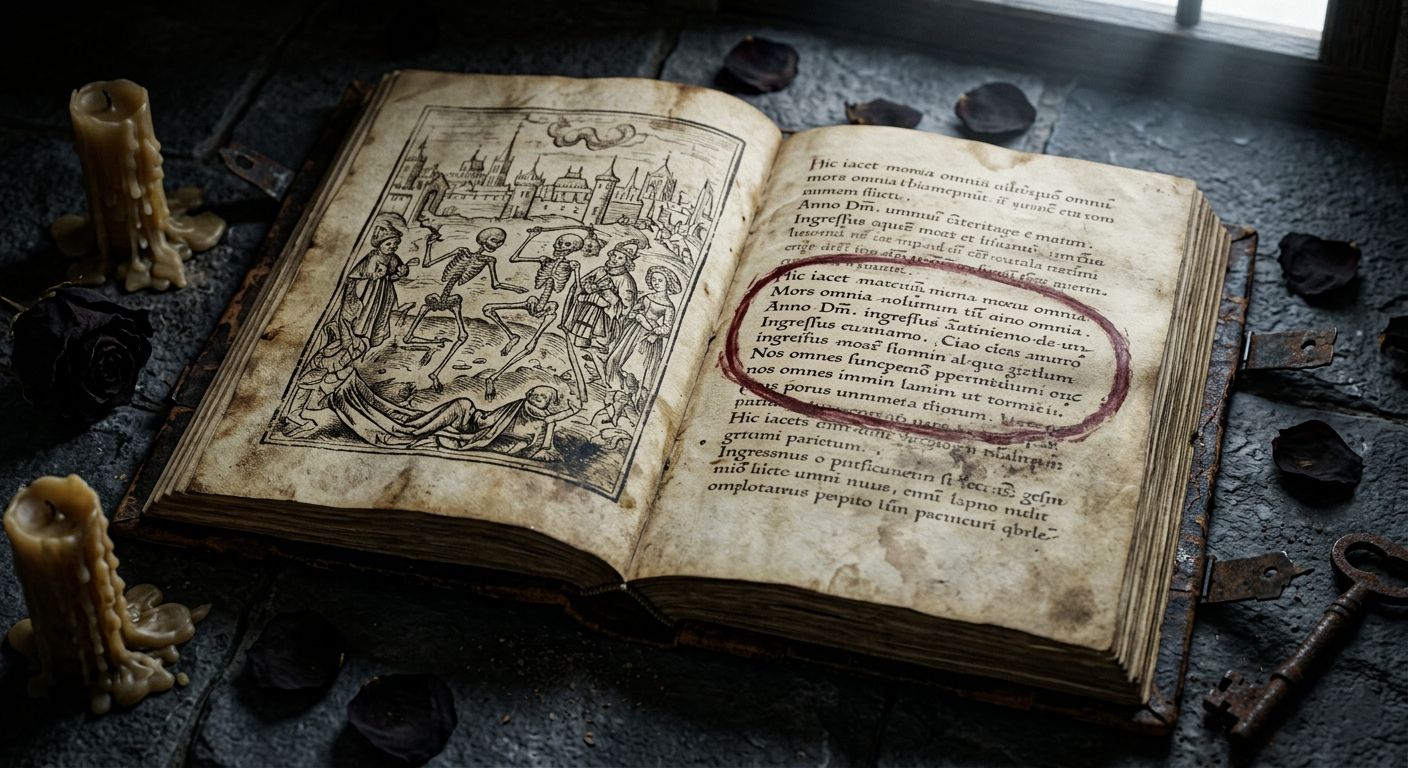
In 1348, a man named Giovanni Boccaccio sat in a city full of corpses and wrote.
Florence had lost more than half its population to the plague. But what Boccaccio recorded in the aftermath — the social ruptures, the worker revolts, the collapse of religious authority, the scapegoating of minorities — were not just observations. They were, with hindsight, the most accurate Black Death predictions of the modern world ever committed to paper.
He was not writing prophecy. He was writing testimony. But the world he described — the social ruptures, the worker revolts, the collapse of religious authority, the desperate flight from cities, the scapegoating of minorities — maps onto the modern world with an accuracy that is either remarkable coincidence or evidence that human beings, under sufficient pressure, always break and rebuild in the same ways.
The Black Death killed between 75 and 200 million people across Europe and Asia between 1346 and 1353. It erased, by most estimates, 60 percent of Europe’s entire population. And in doing so, it did not merely thin the ranks of the living. It dismantled an entire civilisation and replaced it — slowly, painfully, over centuries — with something that looks, in its broad outlines, startlingly like the world we inhabit today.
The Predictions Hidden in Plain Sight
The Black Death predictions most worth examining are not the mystical kind. They do not come from oracles or almanacs. They come from something more disquieting: the observed logic of what happens to human societies when a catastrophe of sufficient magnitude removes enough people, quickly enough, that the existing order can no longer maintain itself by force of habit.
Boccaccio’s Decameron — written in the immediate aftermath of the plague that struck Florence in 1348 — is the most detailed account of what that collapse looked like from inside. His introductory chapter describes the plague’s physical devastation, but what makes it genuinely extraordinary is the social observation beneath it. He describes physicians abandoning patients. He describes the wealthy fleeing to country estates while the poor died in the streets. He describes the complete breakdown of the norms that had structured Florentine society for generations.
And then, without intending to, he describes something that would define the next six centuries of European history: the moment ordinary people stopped obeying.
The First Workers’ Revolution
Before the Black Death, Europe operated under feudalism — a system in which peasants were bound to land, bound to lords, and possessed almost no negotiating power over the conditions of their own labour. They worked. They paid. They were not consulted.
The Black Death ended that arrangement with a speed no political movement could have achieved. Because of illness and death, workers became exceedingly scarce. So even peasants felt the effects of the new rise in wages. The demand for people to work the land was so high that it threatened the manorial holdings. Serfs were no longer tied to one master — if one left the land, another lord would hire them.
English accounts from the period describe workers who could scarcely be persuaded to serve the eminent unless for triple wages. Triple. The same labour that had commanded subsistence rates before the plague now commanded a premium that the ruling class had no choice but to pay, because the alternative was fields left unplanted and harvests left to rot.
This was not a revolution anyone planned. It was a revolution that demography performed on economics. And its consequences were felt for centuries — in the Peasants’ Revolt of 1381, in the gradual collapse of serfdom across Western Europe, in the slow emergence of what we would eventually call workers’ rights. What the Black Death predictions of modern labour movements show us is not that medieval peasants were ahead of their time. It is that sufficient scarcity of labour produces, reliably and mechanically, the conditions for workers to demand better treatment.
Sound familiar? It should. The labour disruptions following COVID-19 — the Great Resignation, the surge in worker bargaining power, the sudden leverage of employees in sectors that had treated workers as interchangeable for decades — followed a logic that Boccaccio’s contemporaries would have recognised immediately.
The Collapse of Institutional Authority
One of the most consequential things the Black Death did to European society was not kill people. It was destroy confidence in the institutions that were supposed to explain why people were dying.
The Catholic Church, at the time the dominant organising force of European life, had an explanation for everything. Illness was divine punishment. Suffering was God’s will. The Church’s authority rested, in part, on its capacity to mediate between ordinary people and the terrifying uncertainties of existence.
The plague arrived and killed priests alongside sinners. It took the devout alongside the dissolute. It respected no prayers and responded to no sacraments. The Church, which had promised a cosmos ordered by divine justice, could offer no explanation for a catastrophe this indiscriminate.
The result was a profound and lasting fracture in religious authority. The widespread fear of a death one had not earned, could not see coming, and could not escape inspired people to rethink the way they were living previously and the kinds of values they had held. By the middle of the 15th century, radical changes — unimaginable only one hundred years before — were taking place throughout Europe. The Protestant Reformation, which shattered the Church’s monopoly on spiritual authority, drew directly on a century of accumulated doubt that the plague had seeded.
The Black Death predictions of institutional collapse follow a consistent pattern: when institutions fail visibly and catastrophically at the moment they are most needed, they do not simply lose credibility temporarily. They lose it permanently. And the void they leave gets filled, eventually, by something new.
The Scapegoating Pattern That Never Changes
History records, with depressing consistency, what happens to minority communities during mass catastrophes. The Black Death was no exception, and its pattern of minority scapegoating is one of the most direct and uncomfortable Black Death predictions of the modern world.
As the plague spread and no explanation satisfied, communities across Europe turned their fear into blame. Jewish communities were accused of poisoning wells, spreading disease deliberately, engineering the catastrophe for reasons that the frightened and the grieving did not feel obliged to make coherent. Pogroms swept through hundreds of European cities. Thousands of Jewish people were murdered on the basis of accusations with no evidence — accusations that spread, ironically, faster and further than the actual plague.
The mechanism is not mysterious. It is documented by social psychologists, observable across centuries and cultures, and entirely predictable given what we know about how human beings process uncontrollable fear. Catastrophes that lack satisfying explanations generate explanations regardless. And the explanations that spread fastest are the ones that give fear a face — preferably a face that already bore the weight of existing prejudice.
The Black Death did not invent antisemitism. It weaponised it. And the same weapon — fear plus plague plus scapegoat — has been deployed again and again, in different configurations, across the centuries since.
What Boccaccio Saw That We Are Still Learning
Boccaccio’s most distinguished critic, Vittore Branca, called The Decameron a masterpiece for its psychological approach to a decisive period in history. What makes Boccaccio’s account extraordinary is not its horror — though the horror is real and plainly rendered. It is his observation that the plague did not simply reveal the worst of human nature. It revealed all of human nature, compressed and accelerated.
He saw people abandon the dying and flee to country estates. He also saw people who stayed, who cared for strangers, who maintained dignity in circumstances that excused its abandonment. He saw institutions collapse and informal communities form in their place. He saw the old hierarchies crack and new arrangements emerge from the rubble.
Boccaccio’s insight — that catastrophe is not merely destructive but transformative, that it reorganises rather than simply destroys — is the most important of all the Black Death predictions the 14th century offers. The plague did not end European civilisation. It ended one version of it and began another. By the middle of the 15th century, the Renaissance was underway — a flowering of art, science, philosophy, and individual inquiry that drew directly on the scepticism, the energy, and the rearranged social structures that the plague had produced.
Catastrophes do not always leave rubble. Sometimes they leave room.
The Mirror the Plague Holds Up
When COVID-19 arrived in 2020, scholars reached for Boccaccio almost immediately. Millicent Marcus, a professor who had spent her career studying The Decameron, described seeing uncanny parallels between Boccaccio’s time and our own — parallels that went beyond the obvious fact of pandemic, into the subtler territory of how societies respond, fracture, adapt, and eventually reconstitute themselves.
The wealthy retreating to second homes while essential workers kept the cities running. Institutions offering explanations that failed to satisfy. Workers discovering unexpected leverage. Minorities facing blame for the disease. Communities forming outside the structures that had organised life before.
None of these were new phenomena in 2020. They were 700 years old, documented by a man sitting in a dying city with a quill and a determination to record what he saw.
The Black Death predictions were not mystical. They were structural. They described what human societies do under pressure — reliably, repeatedly, across centuries and cultures — because human nature does not change as quickly as the world around it.
The plague of 1348 is over. Its patterns are not.