
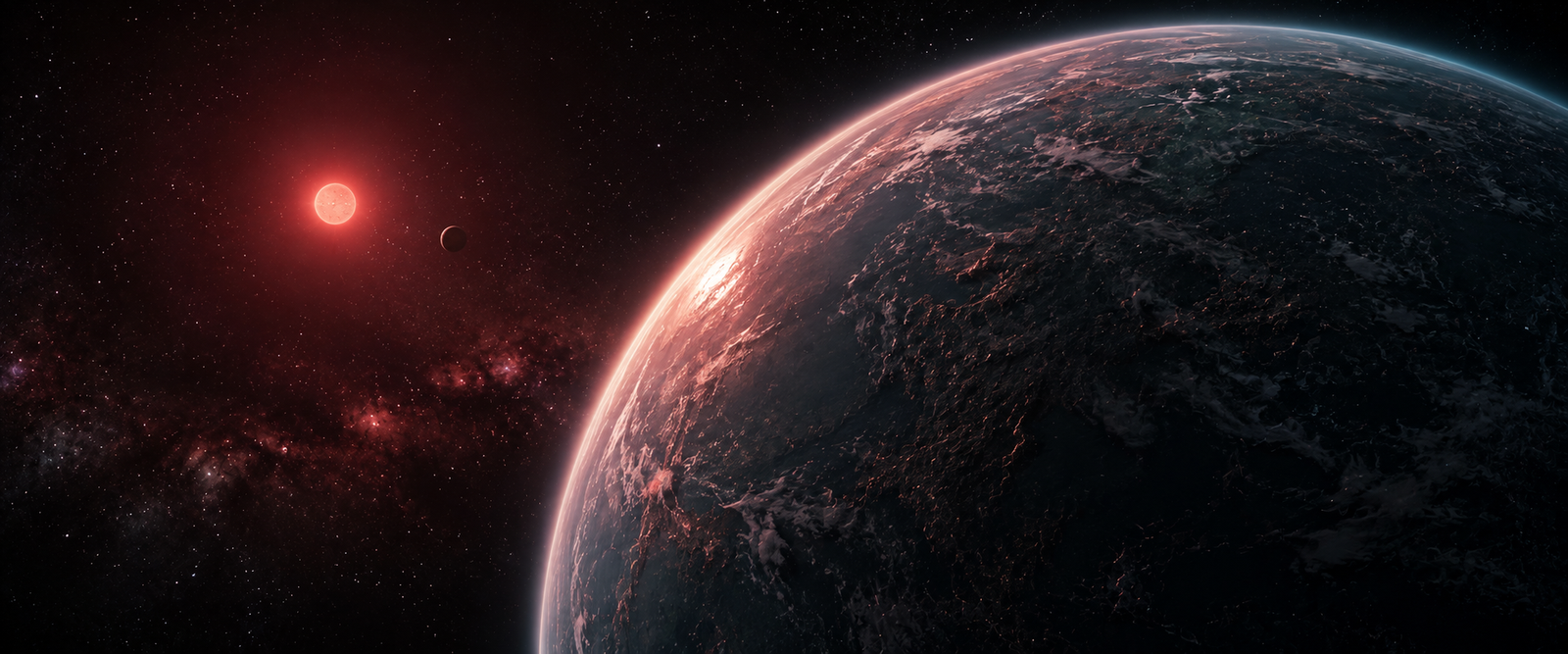
For thirty years, astronomers have found planet after planet orbiting other stars — thousands of them — yet one question kept slipping through their fingers: does any of these distant worlds actually have air? In July 2026, that changed. A team led by Harvard scientists announced they had confirmed the first atmosphere on a habitable zone planet beyond our solar system, and they did it in the strangest way imaginable — by watching a gas quietly leak into space.
The planet is LHS 1140 b, and it may be the most promising address for life we’ve found yet. Worlds that defy prediction turn up constantly in modern astronomy, but this one did something we’d been hoping to witness for decades.
A Super-Earth 48 Light-Years Away
LHS 1140 b is a rocky exoplanet roughly 48 light-years away in the constellation Cetus. It’s a “super-Earth” — about 5.6 times our planet’s mass — circling a cool, ancient red dwarf star every 25 days. Because that star is small and dim, its warm zone sits close in, and LHS 1140 b receives just 42% of the sunlight Earth does. That places it squarely in the temperate band where a surface could stay warm enough for liquid water rather than freezing solid or boiling away. This is no hellscape like a distant world raining molten glass — it’s a temperate, possibly watery place, which is exactly why it matters.
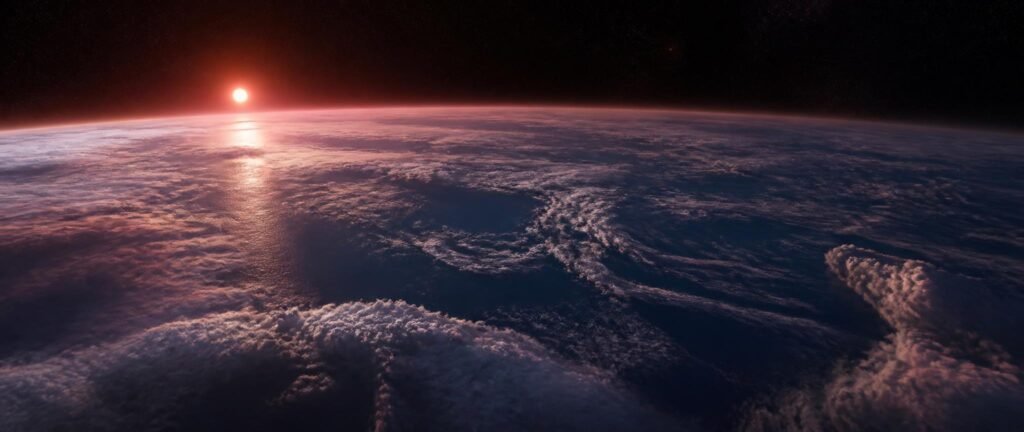
That combination — rocky, temperate, possibly ocean-covered — has made it a prime target for the new planet-hunting telescopes now scanning the sky. But sitting in the right place means nothing if the air has been stripped away, and red dwarfs are notorious for blasting their planets with radiation.
How Do You Find the First Atmosphere on a Habitable Zone Planet?
Here’s the clever part — and it cuts to the biggest question we have, the one behind our galaxy’s eerie silence. You can’t photograph an atmosphere 48 light-years away, so the team — publishing in Science — watched LHS 1140 b pass in front of its star and hunted for a telltale fingerprint of helium escaping from the planet’s upper layers. Detecting the first atmosphere on a habitable zone planet came down to a faint, precise dip in starlight.
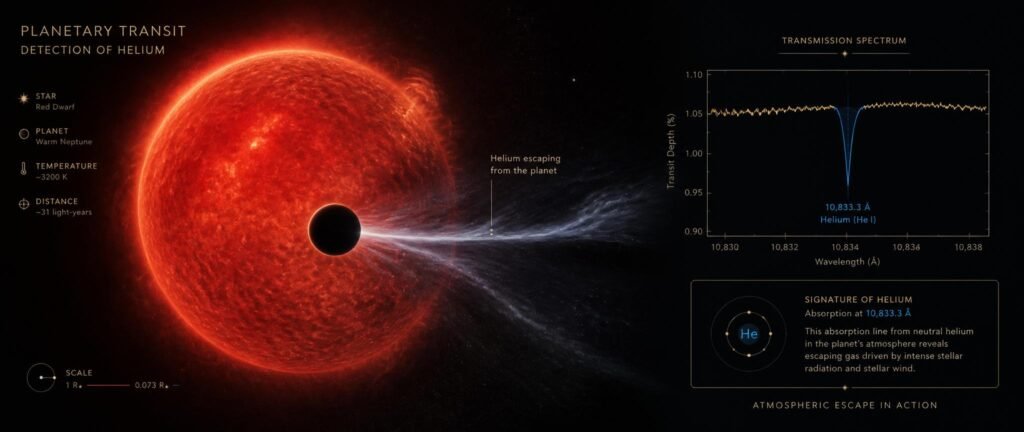
When the planet transited, helium heated and pushed outward by the star’s radiation absorbed a sliver of that starlight, dimming it by roughly 1.2%. Its neighbor, LHS 1140 c, sits closer to the star and showed nothing at all — exactly as models predicted, since light hydrogen escapes fastest while heavier helium lingers behind. This planet gave up its secret in the faintest of whispers.
Why This Rewrites the Search for Life
An atmosphere isn’t a nice extra — it’s the precondition for everything. No air, no weather, no water pooling on the surface, no chemistry for life as we know it. For years we knew rocky worlds sat in habitable zones; we just couldn’t tell whether any had held onto their air. Now we know at least one has — and it appears to have kept its atmosphere for more than three billion years.
There’s a catch worth being honest about. The detection is indirect: nobody has measured conditions near the surface, and the escaping helium confirms that an atmosphere exists without revealing its full recipe. What comes next is working out what that air is actually made of, and whether an ocean survives beneath it.
The Beginning of an Answer
The first atmosphere on a habitable zone planet won’t tell us whether anyone is out there looking back. But it moves the question from “could such a world even exist?” to “what is that world actually like?” — and that shift is enormous. Somewhere in the constellation Cetus, a heavy, watery planet is quietly breathing helium into the dark, and for the first time, we’ve heard it exhale.