
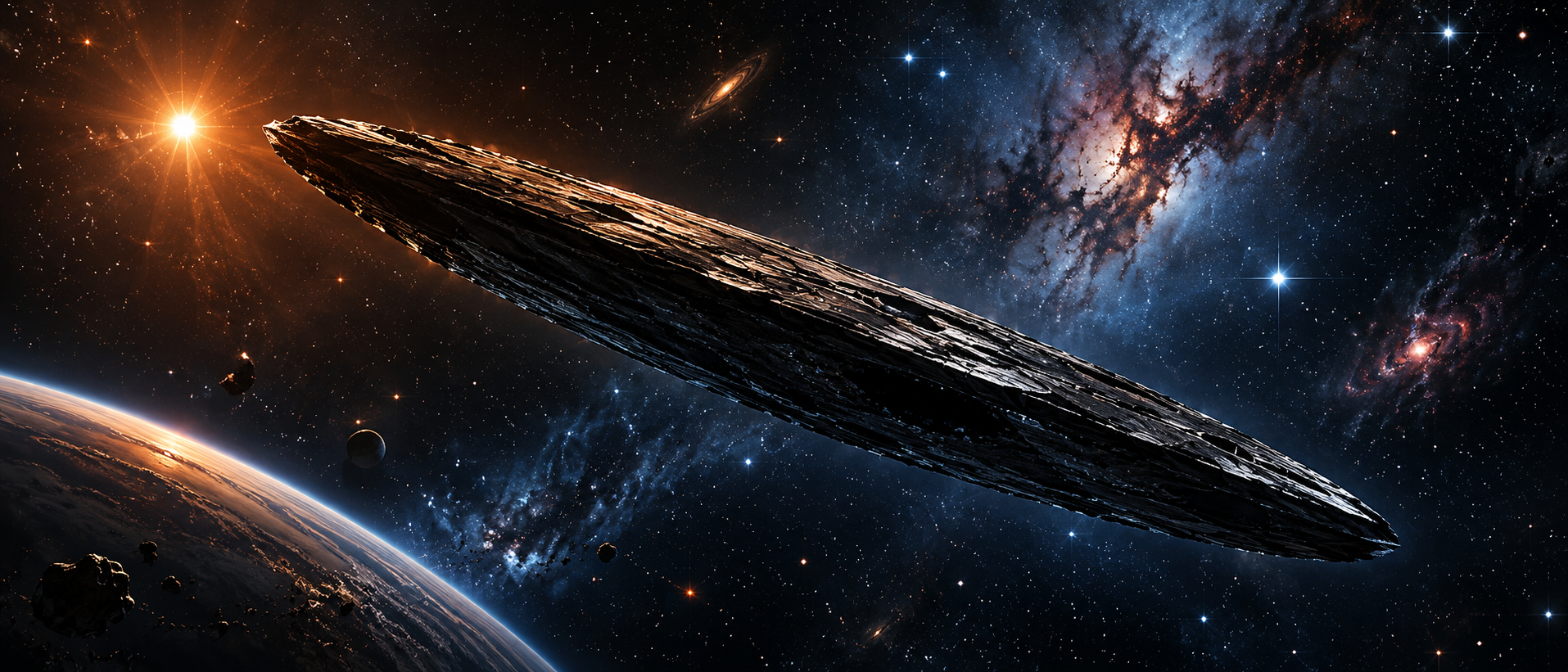
In October 2017, astronomers at the Haleakalā Observatory in Hawaii spotted something that had never been seen before. The Oumuamua interstellar object — the first confirmed visitor from outside our solar system — was already leaving by the time they noticed it. They had a few weeks to observe it. And in those weeks, it managed to violate nearly every assumption planetary scientists had about what an object moving through space should look like and how it should behave.
It has not been explained. Not really. Not satisfactorily. And the more carefully scientists look at the data, the stranger it gets.
What the Oumuamua Interstellar Object Actually Was
The name comes from Hawaiian: ʻOumuamua roughly translates to “scout” or “first distant messenger.” It was discovered on 19 October 2017 by astronomer Robert Weryk using the Pan-STARRS telescope, and it was already on its way out of the solar system — inbound trajectory tracked back to the direction of the constellation Lyra, passing closest to the Sun on 9 September 2017, six weeks before anyone even knew it existed.
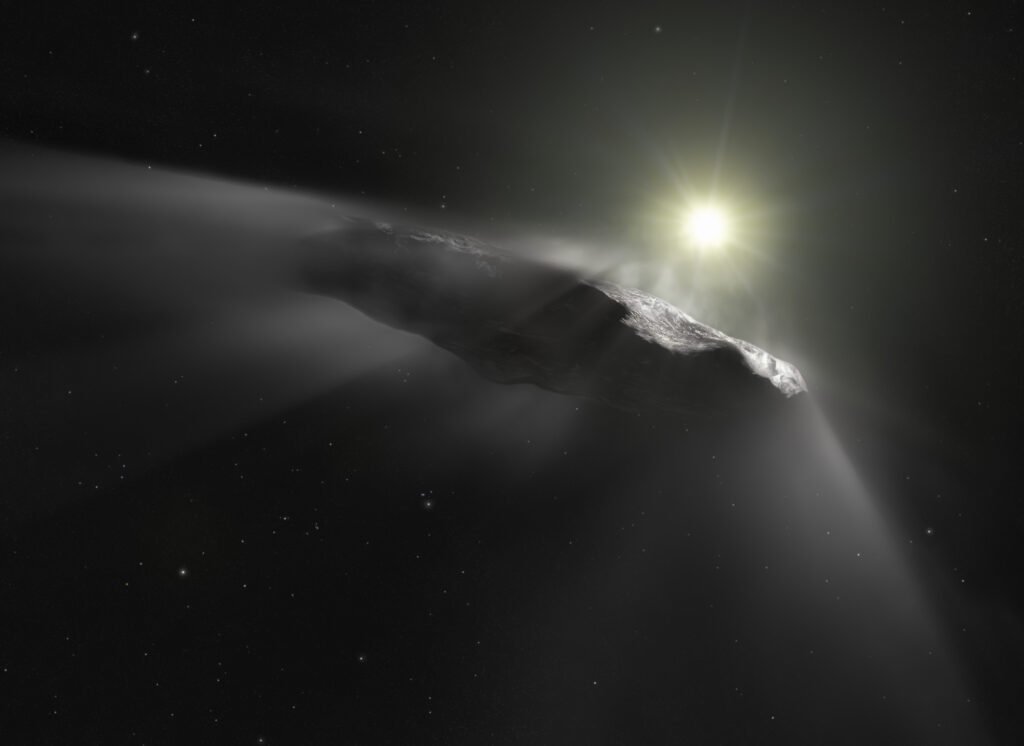
From the very first observations, it was anomalous. Its brightness varied dramatically — by a factor of ten — as it tumbled through space. That kind of variation implies an object with an extreme shape: either extremely elongated, like a cigar, or extremely flat, like a pancake. The ratio of its longest to shortest dimension was estimated at somewhere between 5:1 and 10:1. Nothing in our solar system — no asteroid, no comet, no known natural object — comes close to those proportions. The most elongated natural objects we know of have ratios of maybe 3:1. Oumuamua looked, by any prior framework, wrong.
But that was just the beginning. The shape was strange. What it did next was stranger.
The Acceleration That Changed Everything
As the Oumuamua interstellar object receded from the Sun, astronomers tracked its trajectory with extraordinary precision. And they found something that should not have been there: excess acceleration. Oumuamua was speeding up more than gravity alone could account for.
This is not unusual for comets. Comets are made partly of volatile ices — water, carbon dioxide, carbon monoxide — that sublimate when heated by the Sun, releasing jets of gas that act as a natural thruster. This outgassing produces a measurable, predictable non-gravitational force. Astronomers know exactly how to model it and account for it.
Oumuamua showed no outgassing. No coma — the fuzzy halo of gas and dust that surrounds an active comet’s nucleus. No tail. No detectable release of gas or particles of any kind, despite multiple sensitive telescopes looking for exactly that. The Spitzer Space Telescope, designed specifically to detect infrared signatures of cometary activity, found nothing. If Oumuamua were a comet behaving like a comet, the outgassing responsible for its acceleration would have produced an infrared signal easily within Spitzer’s detection range.
There was no signal. There was only the acceleration — unexplained, persistent, and growing stronger as it moved away from the Sun, exactly as you’d expect from solar radiation pressure rather than cometary jets.
The physics of light-speed travel constrains what’s possible for any object moving through space — but it says nothing about what an object must be made of for light pressure to push it. And it was the light-pressure hypothesis that opened the door to the most controversial explanation anyone had put forward.
Avi Loeb and the Lightsail Hypothesis
In 2018, Harvard astronomer Avi Loeb — one of the most credentialed astrophysicists in the world — co-authored a paper suggesting that Oumuamua’s anomalous acceleration was consistent with it being a lightsail: a thin, flat, artificial structure propelled by solar radiation pressure. The paper did not claim Oumuamua was alien technology. It said the hypothesis was worth taking seriously, and that the available data was consistent with it.
The scientific community reacted with a mixture of interest and fierce scepticism. Critics argued that Loeb had committed the classic error of invoking an extraordinary explanation without exhausting ordinary ones. Several alternative hypotheses were proposed: that Oumuamua was a shard of nitrogen ice, sheered off a Pluto-like body in some distant planetary system; that it was a fractal dust aggregate, loosely bound and with an extreme surface-area-to-mass ratio; that it was a hydrogen iceberg, a type of object theorised but never observed.
Each of these hypotheses was proposed specifically to explain the anomalous properties. And each one has significant problems. Nitrogen ice objects of the required size would be extraordinarily rare — so rare that statistical models of the galaxy suggest they couldn’t explain the observed frequency of interstellar objects. The hydrogen iceberg hypothesis requires the ice to survive intact across interstellar space, which thermodynamic modelling suggests is nearly impossible. The fractal aggregate idea explains the acceleration but struggles with the extreme brightness variations.
None of the natural explanations are obviously correct. None are obviously wrong, either. The problem is that Oumuamua left before anyone could get a better look, and no spacecraft was anywhere near its trajectory. By the time the implications of the data were fully processed, it was already beyond reach.
The Wow! Signal left astronomers in a similar position — a data point so anomalous it demanded explanation, gone before it could be followed up, and still unresolved decades later. Oumuamua is that experience at cosmological scale.
Oumuamua Interstellar Object: What the Shape Implies
Let’s sit with the shape problem for a moment, because it doesn’t get enough attention.
An object with a brightness variation factor of ten, tumbling as it moves, is an object with an extreme aspect ratio. The two shapes that fit the data are a cigar — roughly ten times as long as it is wide — or a pancake — roughly ten times as wide as it is thick. Subsequent modelling, including work that accounts for how such an object would survive the tidal stresses of interstellar travel, actually favours the pancake. A very thin, flat, wide disc.
Natural processes that produce rocky or icy bodies — planetary accretion, collisional fragmentation, tidal disruption — do not produce pancake-shaped objects. They produce roughly spherical or moderately elongated shapes. The physical processes that shear rock or ice apart don’t produce thin discs. There is no well-understood natural mechanism that generates an object with the geometry implied by Oumuamua’s light curve.
That is not proof of anything. Absence of a known mechanism is not the same as impossibility. But it adds to the pile of properties — the shape, the acceleration, the absence of outgassing, the trajectory from interstellar space — that each individually might have a natural explanation, but that together form a profile with no clean natural parallel.
What we observe falling into a black hole reveals how extreme physical processes can produce objects and phenomena with no earthly analogue. Oumuamua may be another such case — or it may be something else entirely.
The Fermi Paradox Angle
It is impossible to discuss Oumuamua seriously without addressing the question it points toward, even if you think the alien hypothesis is a stretch.
If technological civilisations exist elsewhere in the galaxy — and the statistical arguments for their existence are genuinely compelling — then at some point they would likely launch probes, lightsails, or other structures into interstellar space. The galaxy is old enough that even a civilisation that launched probes millions of years ago would have them drifting through interstellar space today. We would expect a background population of artificial objects moving through the galaxy.
We would not necessarily recognise them when we saw them. We might see them and assume they were natural, because we have no framework for what an artificial interstellar object should look like. We might see something deeply anomalous, file away the data, argue about natural explanations for a few years, and never find out the truth because the object was already gone.
The Fermi Paradox asks where all the aliens are — and one uncomfortable answer is that the evidence might already be in our telescopes, filed under “unexplained anomaly.”
This is not the same as saying Oumuamua was a spacecraft. It is saying that the prior probability of encountering artificial interstellar objects is not zero, that we would not necessarily recognise one if we saw it, and that Oumuamua had enough anomalous properties that dismissing the hypothesis without resolution is less intellectually honest than its critics often imply.
What We’ve Learned — and What We’ve Built Since
The scientific legacy of the Oumuamua interstellar object is real, regardless of what it actually was. It triggered the creation of the Galileo Project — an initiative founded by Avi Loeb specifically to systematically search for anomalous objects using wide-field sky surveys and dedicated instruments, rather than depending on accidental discovery after the fact.
It also drove a reassessment of how common interstellar objects might be. Models derived from Oumuamua’s trajectory suggest that if objects like it are typical, the solar system is being traversed by interstellar visitors constantly — perhaps one passing through at any given time, invisible to us because we simply haven’t been looking. When the Vera C. Rubin Observatory — the Large Synoptic Survey Telescope — achieves full operation, it is expected to detect many interstellar objects per year. We will no longer be relying on chance.
James Webb’s deep field observations are rewriting what we know about the early universe. The Vera Rubin Observatory may do something equally significant closer to home — giving us a proper statistical sample of interstellar objects, so we can finally know whether Oumuamua was a bizarre outlier or the first confirmed example of something we simply hadn’t been watching for.
The Object That Forced the Question
Oumuamua did something that very few discoveries in the history of astronomy have managed: it forced a credible, senior, peer-reviewed scientist to put the words “artificial origin” in an academic paper without being dismissed outright. That is not nothing. The history of science is full of anomalies that were explained away until they couldn’t be anymore.
The Oumuamua interstellar object may be a nitrogen shard, an exotic type of comet, a fractal dust aggregate, or some other class of natural object we simply haven’t encountered before. That is the most likely explanation. Natural phenomena have surprised us before and will again.
But the honest position — the scientifically rigorous position — is that we don’t know. We had weeks with a once-in-a-generation object, and we watched it leave with our best questions still unanswered. Whatever Oumuamua was, it passed through the entire solar system and departed without explanation, and the universe has not yet bothered to offer one.