
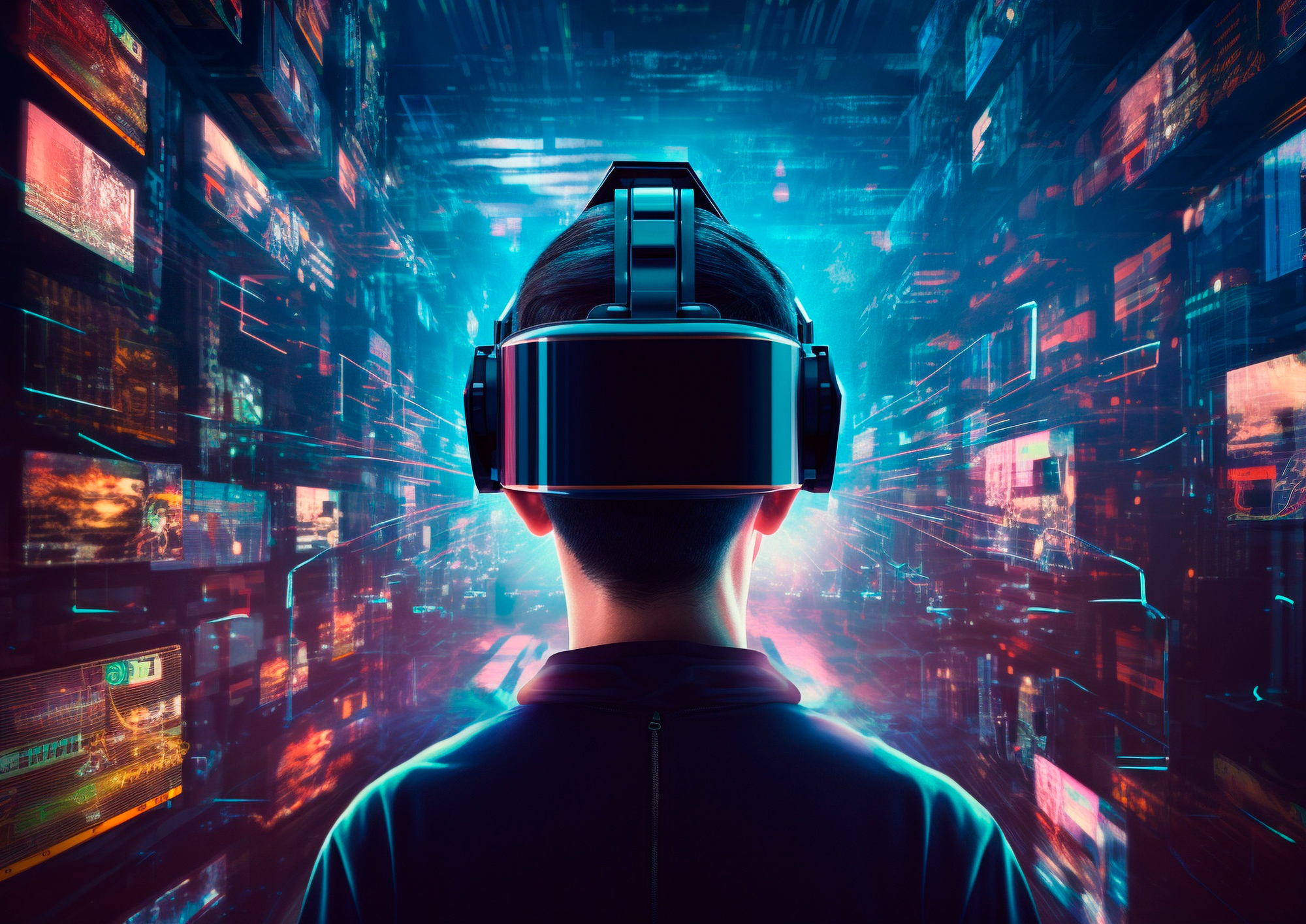
For most of human history, reality was simple: the world existed, matter behaved, and the universe followed rules we slowly learned to understand. But in the early 21st century, a startling idea moved from science fiction into serious academic discussion—the possibility that reality itself may be artificial.
Not artificial in the sense of illusion or hallucination, but something far stranger: a fully simulated universe, generated by advanced intelligence. While the idea sounds like the plot of movies such as The Matrix, its modern scientific roots began not in Hollywood, but in philosophy departments and physics labs.
Today, the simulation hypothesis remains unproven, controversial, and deeply unsettling—but it is also one of the most fascinating thought experiments modern science has produced.
The Birth of the Simulation Hypothesis
The modern scientific conversation about simulated reality began in 2003 with philosopher Nick Bostrom at the University of Oxford.
In a now-famous academic paper titled Are You Living in a Computer Simulation?, Bostrom proposed a logical argument that shocked both philosophers and scientists. His reasoning did not claim that we are living in a simulation—but rather that if certain technological assumptions hold true, the probability becomes surprisingly difficult to ignore.
Bostrom outlined three possible futures for advanced civilizations:
First, civilizations may go extinct before reaching the technological level required to simulate conscious beings. Catastrophic wars, environmental collapse, or cosmic disasters could prevent advanced societies from ever building reality-scale simulations.
Second, civilizations might survive and develop powerful technologies—but choose not to create detailed simulations of conscious ancestors. Ethical concerns alone could stop such experiments.
Third, civilizations could reach advanced computing levels and create vast numbers of simulated worlds. If this happens, simulated realities would vastly outnumber real ones. In that case, statistically speaking, it becomes more likely that we are living in one of the simulated versions rather than the original reality.
That third possibility transformed the simulation idea from science fiction into a philosophical probability puzzle.
Why Technology Makes the Idea Feel Less Impossible
One of the strongest reasons the simulation hypothesis is taken seriously today is the breathtaking pace of technological advancement. Humanity has already begun creating virtual environments that grow more convincing every year.
Modern video games simulate weather, gravity, shadows, and ecosystems. Virtual reality systems immerse users in digital worlds that trick the brain into accepting artificial environments as real. Artificial intelligence now generates faces, voices, and entire landscapes that never existed before.
Only decades ago, even simple simulations required enormous computing power. Today, entire cities and weather systems are modeled using supercomputers. Climate simulations, particle simulations, and biological simulations allow scientists to study systems too large or complex to observe directly.
If computing power continues to grow for centuries—as many technological models predict—future civilizations may possess machines capable of simulating entire universes down to the atomic scale.
The question then becomes less about imagination and more about engineering limits.
The Strange Mathematical Nature of Reality
Physics has revealed that the universe behaves in ways that often resemble computational systems. At the deepest levels, matter is not continuous but quantized—broken into smallest measurable units.
Quantum mechanics, one of the most successful scientific theories ever developed, suggests that particles behave in discrete steps rather than smooth flows. Space and time themselves may also be composed of smallest possible units, sometimes referred to as Planck-scale structures.
Some physicists studying Quantum Mechanics have noted that the universe appears to operate according to strict mathematical rules, almost like an enormous calculation unfolding moment by moment.
Information theory has also influenced this discussion. Certain theories suggest that information—not matter—may be the fundamental building block of reality. If the universe is fundamentally informational, then the analogy to computation becomes difficult to ignore.
Still, these parallels remain suggestive rather than conclusive.
Famous Supporters and Public Discussion
Although many scientists remain skeptical, the simulation hypothesis has received attention from several influential figures in technology and physics.
Entrepreneur Elon Musk famously suggested that the probability of living in base reality could be extremely small if advanced civilizations continue developing simulations. His reasoning was simple: if simulated worlds become common, the number of artificial realities could vastly exceed natural ones.
Physicist Neil deGrasse Tyson has also acknowledged the possibility, noting that the idea cannot easily be dismissed, though he remains cautious about treating it as a scientific conclusion.
Their public statements did not prove the hypothesis—but they helped move it into mainstream scientific conversation.
Could There Be Evidence of a Simulated Universe?
One of the biggest challenges facing the simulation hypothesis is the lack of testable predictions. Science depends on observation and measurement, and so far, no direct evidence suggests that reality is artificial.
Still, some scientists have proposed creative ways to search for possible signs.
One suggestion involves looking for resolution limits in the universe—similar to pixels in digital images. If reality were simulated, space might have a smallest measurable unit beyond which detail cannot exist.
Another idea focuses on computational efficiency. Large simulations often reduce detail in regions that are not being observed. If our universe behaved similarly, unexpected physical shortcuts might appear in complex systems.
Researchers studying cosmic radiation and particle physics have explored whether unusual patterns might hint at underlying computational structures. However, no confirmed results have emerged.
Reality, frustratingly, continues to behave as expected.
The Strong Scientific Criticism
Despite its popularity, the simulation hypothesis faces strong criticism from scientists who argue that it may not qualify as science at all.
One major objection is that the idea may be impossible to test. If a simulation were perfectly designed, it might produce observations indistinguishable from natural reality. In that case, proving or disproving the hypothesis could be fundamentally impossible.
Another criticism is that the theory does not explain new physical observations. Whether the universe is simulated or natural, the laws of physics remain the same from our perspective. Gravity still works. Chemistry still works. Biology still evolves.
From this viewpoint, the hypothesis becomes philosophical rather than scientific—a thought experiment rather than a measurable theory.
Many researchers insist that until measurable predictions emerge, the simulation hypothesis should remain an intellectual curiosity rather than a scientific conclusion.
The Role of Future Technology
The long-term future of computing may ultimately determine whether the simulation hypothesis gains credibility.
Advances in artificial intelligence, quantum computing, and high-performance computing are pushing technological boundaries at astonishing speed. Systems that simulate weather, biology, and planetary environments are becoming more sophisticated every year.
Some futurists believe that if civilizations survive long enough, they will inevitably build simulations capable of modeling conscious minds. Such simulations might allow researchers to study history, predict societal outcomes, or explore alternate timelines.
If that future arrives, the possibility that similar civilizations already exist elsewhere—or existed before us—becomes difficult to ignore.
And that leads to the deepest philosophical question of all: if simulated worlds are possible, how would anyone know whether they are living in one?
The Existential Implications
Perhaps the most unsettling aspect of the simulation hypothesis is not scientific—it is philosophical.
If reality were simulated, would life lose meaning? Would experiences become less real?
Many thinkers argue that the answer is no.
Pain would still hurt. Joy would still feel meaningful. Relationships would still matter. Whether reality is physical or digital, conscious experience remains genuine from the perspective of the observer.
In practical terms, daily life would remain unchanged.
Yet the possibility that reality could be engineered forces humanity to confront uncomfortable questions about consciousness, existence, and identity. It blurs the boundary between creator and creation, observer and environment.
And perhaps most unsettling of all—it challenges the assumption that reality is fundamentally simple.
Why the Simulation Hypothesis Still Captures Scientific Imagination
Even without proof, the simulation hypothesis continues to fascinate scientists because it sits at the intersection of multiple disciplines—physics, computer science, philosophy, and cosmology.
It reflects humanity’s growing technological power and our increasing ability to simulate complex systems. As our digital tools become more sophisticated, the boundary between simulation and reality becomes harder to define.
Whether the idea is ultimately proven false, proven true, or forever untestable, it represents a shift in how humanity thinks about existence itself.
For centuries, people believed the universe was mechanical. Today, some wonder whether it might be computational.
And if future civilizations truly gain the power to simulate conscious worlds, then the question may not be whether simulations exist—but how many exist, and which one we occupy.