
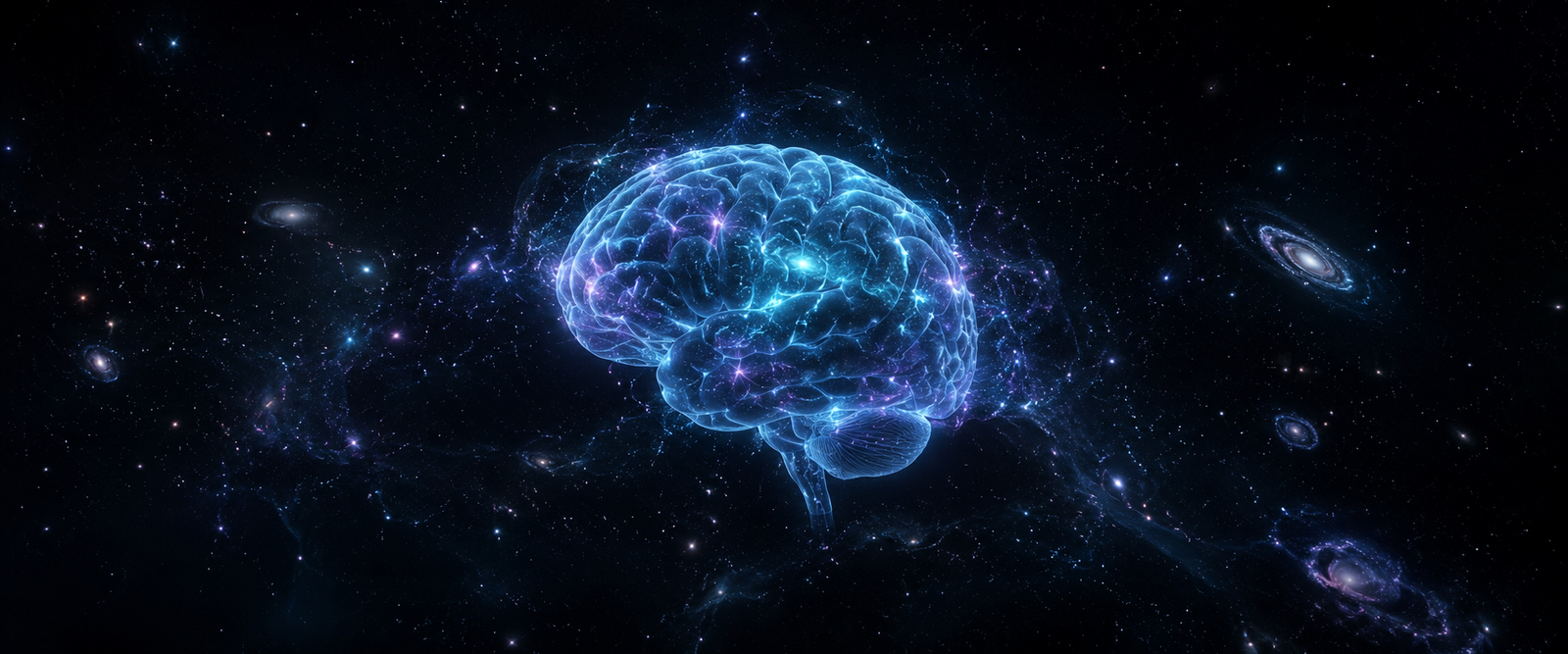
Here is a thought that has genuinely troubled some of the most serious physicists alive: right now, floating somewhere in the cold dark of space, there may be a fully formed conscious brain that popped into existence by pure chance — complete with memories it never actually lived, convinced it is a person reading an article. And the disturbing part isn’t that this is possible. It’s that, by the cold logic of probability, it may be far more likely than you.
That’s the Boltzmann brain paradox explained in a sentence, and it’s not fringe speculation. It’s a genuine crack in our understanding of the universe, and physicists have spent real effort trying to explain why a floating brain is more likely than you — because if they can’t, something in our picture of reality is badly broken.
Why a Floating Brain Is More Likely Than You: The Core Argument
Start with a strange fact about probability and disorder. To build you — a person embedded in a functioning planet, orbiting a star, inside a galaxy, in a universe that spent 13.8 billion years cooling from an incredibly ordered beginning — the universe had to arrange an almost unimaginable amount of structure. That’s expensive, in a statistical sense. It requires an enormous, improbable run of low-entropy conditions.
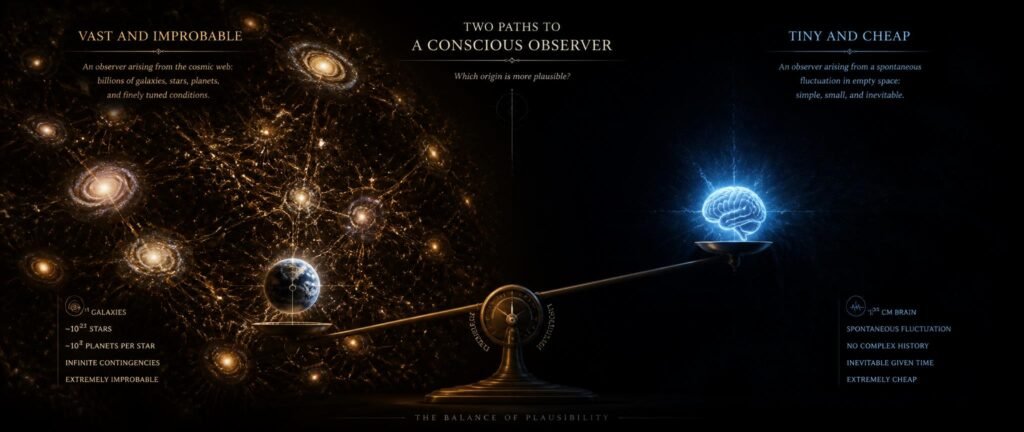
Now compare that to the cheapest possible conscious observer: not a whole person and planet, but just a single brain, fluctuating into existence for a moment, with false memories baked in. In a universe governed by random fluctuations over infinite time, small accidents are vastly more common than large ones. A lone brain is a much smaller fluke than an entire ordered cosmos — which forces an uncomfortable question about why we trust our senses at all.
So if observers can arise by random chance, the math says the overwhelming majority of them should be these minimal, momentary, memory-loaded brains. That is the heart of why a floating brain is more likely than you: making a whole realistic universe is statistical overkill, when a single deluded brain would do.
What Is a Boltzmann Brain, Exactly?
The name comes from Ludwig Boltzmann, the 19th-century physicist who helped build the foundations of thermodynamics. So what is a Boltzmann brain in precise terms? It’s a hypothetical, self-aware entity that arises not through evolution or biology, but from a spontaneous random fluctuation in a system at thermal equilibrium — a brief, accidental pocket of order in a sea of chaos.
Boltzmann was wrestling with a real problem: why does the universe have so much order at all? His era’s physics suggested that, given enough time, a system in equilibrium would occasionally throw up random dips into orderliness by sheer chance. Someone else took that idea to its unsettling conclusion — if order can appear by fluctuation, the smallest sufficient fluke, a bare conscious brain, should dominate. It’s the kind of reasoning that feels like a glitch in reality itself, where following the logic forward leads somewhere your intuition refuses to go.
Why the Universe Has Low Entropy Is the Real Clue
Here’s the twist that keeps physicists up at night. The Boltzmann brain scenario isn’t something they believe — it’s a problem they’re trying to escape. It functions as a reductio, and it’s the cleanest way to see why a floating brain is more likely than you under certain models: if your cosmological theory predicts that most observers are floating brains with fake memories, then your theory is probably wrong, because it undermines its own evidence.
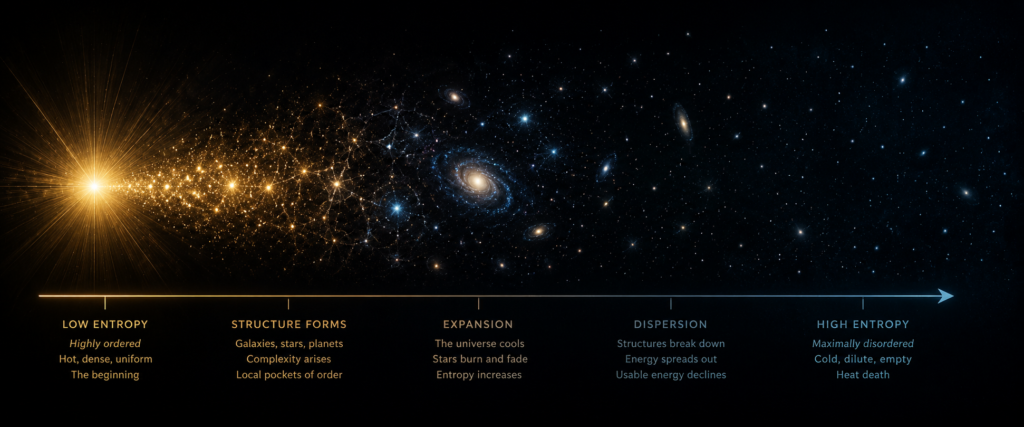
Think it through. If you are statistically most likely to be a Boltzmann brain, then your memories are fake, your observations are random noise, and the very physics you used to reach that conclusion can’t be trusted. A theory that predicts you can’t trust it has quietly detonated — a self-defeating loop close to why some questions stay unanswerable from inside the system that raised them. So the real question buried underneath is why the universe has low entropy in the first place — why we appear to live in a genuinely ordered cosmos with a real, consistent past, rather than a momentary hallucination.
That question about why the universe has low entropy connects to the deepest puzzle in physics: the arrow of time itself, and why time only moves forward rather than backward. Our whole ordered reality traces back to the astonishingly low-entropy state of the early universe, and nobody fully knows why it started that way.
How Cosmologists Try to Escape the Paradox
The good news is that most modern cosmologists think we are not Boltzmann brains — but proving it rigorously is hard, and the attempts are revealing.
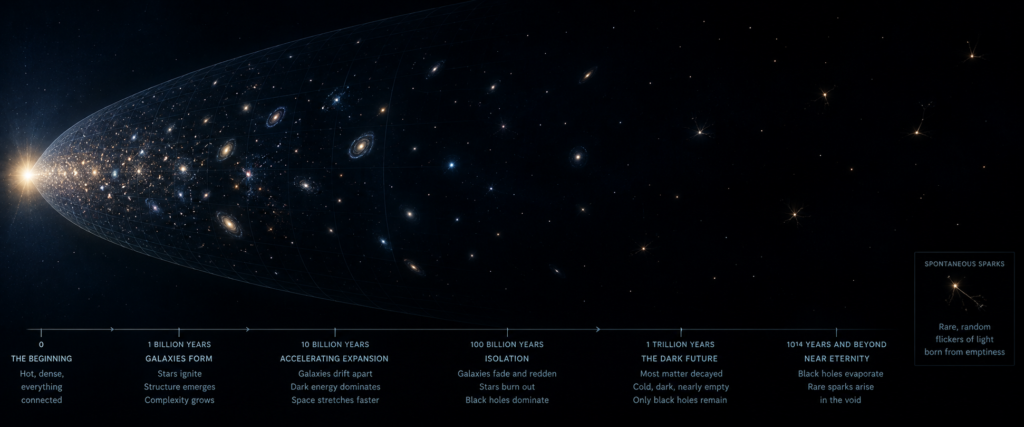
One line of argument focuses on cosmic expansion. If the universe keeps accelerating apart forever, eventually settling into a cold, empty state, then over infinite time random fluctuations might indeed produce vastly more Boltzmann brains than real observers. That outcome is considered so absurd that many physicists treat it as evidence against those particular models — the theory disqualifies itself.
Other approaches argue that fluctuations of the required kind may not actually happen the way the naive picture assumes, or that the vacuum decays before it can spawn enough brains. The debate remains genuinely open, which is itself remarkable — a serious frontier of physics hangs partly on whether or not you are a hallucinating clump of particles.
Boltzmann Brain vs Observable Universe
It’s worth being clear about what’s really being weighed here, because the Boltzmann brain vs observable universe comparison is the whole game.
On one side: a vast, structured, law-abiding cosmos, with galaxies and history and a coherent past — costly to produce, but consistent with everything you see. On the other: a single flickering mind, cheap to produce, but whose every perception is a lie. The unsettling elegance of the paradox is that both can “explain” your current experience equally well. You feel like you’re reading an article either way.
The reason we lean toward the real universe isn’t that it’s more probable in raw fluctuation terms — it’s that betting on it is the only stance that doesn’t destroy its own foundations. Choosing to trust your memories is less a proof than a wager, one you have to make to think coherently at all. It’s a wager you have to make to think at all.
Why This Strange Idea Actually Matters
It would be easy to dismiss all this as physicists playing games. It isn’t. The Boltzmann brain paradox explained properly is really a stress test — a way of pointing a theory at itself and asking whether it survives contact with its own predictions. When a model of the cosmos implies that most conscious observers are deranged flickers of chance, that model has failed a basic sanity check, and cosmologists take that failure seriously as a filter for which theories to keep.
So the takeaway isn’t that you should worry you’re a floating brain. You almost certainly aren’t. The takeaway is subtler and stranger: the fact that you can trust your own existence at all turns out to depend on deep, unsolved questions about entropy, time, and why the universe began in such an exquisitely ordered state.
You are, in all likelihood, exactly who you think you are. But the reason you can be confident of that is far less obvious than it feels — and somewhere in the working-out of why a floating brain is more likely than you, physics brushes up against the very limits of what it can explain about why anything is here at all.