
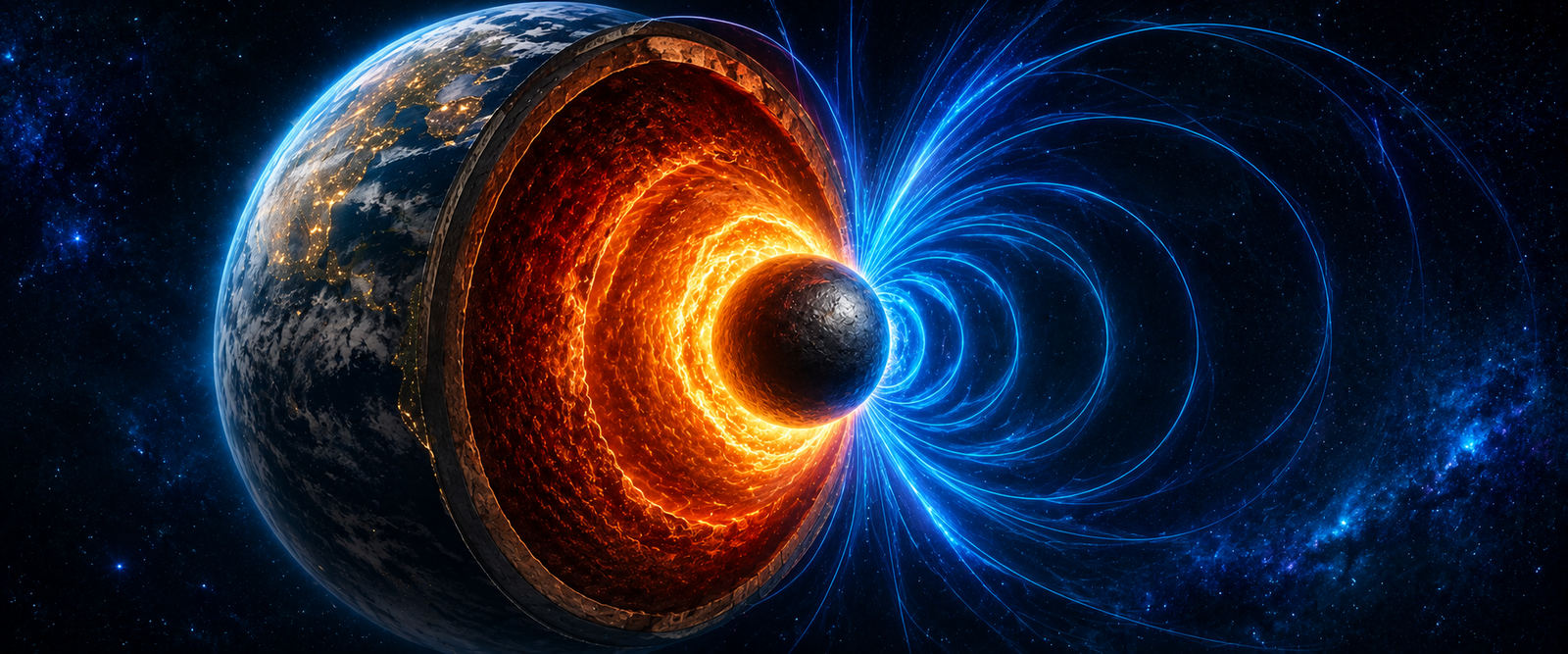
Roughly 5,000 kilometres below your chair, a ball of solid iron the size of the Moon spins inside an ocean of molten metal. For years, geophysicists assumed it turned in one steady direction, like a flywheel that never tires. Then the data did something strange. The question scientists are now chasing is not whether it slowed, but why earths core reversed direction — and the honest answer is that nobody can say for certain.
It’s a humbling reminder that some of the biggest mysteries aren’t light-years away. Science is still full of familiar things it can’t fully explain, from the Sun’s baffling corona to the very ground beneath our feet.
A Reversal 5,000 Kilometres Down
Forget the cartoon of a fiery centre. Earth is layered like an onion — a rocky crust, a thick mantle, then the molten iron core, a churning sea of liquid metal, and at the very heart a solid inner core. That inner ball floats freely, gripped and dragged by the currents around it, so its spin can drift slightly faster or slower than the planet above it.
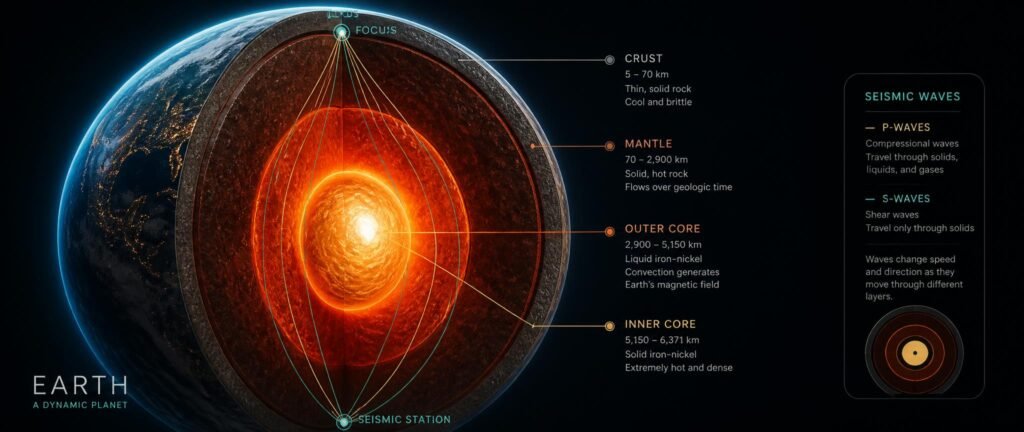
We can’t drill down to look, so scientists read the centre indirectly, using earthquake waves that pass straight through it. Decades of seismic records showed the inner core rotation gradually outpacing the surface. But around 2009 that lead appears to have stalled — and then flipped — so the core began, relative to the mantle, to turn the other way. That reversal is the puzzle at the heart of why earths core reversed direction, and pinning down its cause has proven maddeningly hard.
Our planet is restless in ways we rarely notice. With the Moon slowly inching away and the continents drifting over eons, nothing about Earth is truly fixed.
A shifting core is just the deepest expression of that restlessness — the same slow machinery that, across billions of years, has reshaped the surface and even the air we breathe, as it did during Earth’s ancient oxygen crisis.
Why Earths Core Reversed Direction — And Why Nobody Can Say
Here’s where certainty runs out — this is one of those deep puzzles, a bit like an unseen cosmic pull we can measure but not name. The leading idea is a slow tug-of-war. The liquid metal outside the centre flows in vast electromagnetic currents that push and pull the solid ball, while the gravity of the dense mantle tugs it back. If those forces trade dominance on a roughly 70-year cycle, the core could swing gently one way and then the other — and what we saw was a single turning point in a rhythm older than any record. For now, why earths core reversed direction sits beside the universe’s other great, honest shrugs.
But a model isn’t a verdict. Nobody has measured the forces at that depth, and rival teams read the same seismic data differently — some see a real, cyclical reversal, others suspect a subtler signal or the limits of our instruments. What’s not in doubt is that these buried rhythms matter far more than their tiny scale suggests.
What a Turning Core Means for You
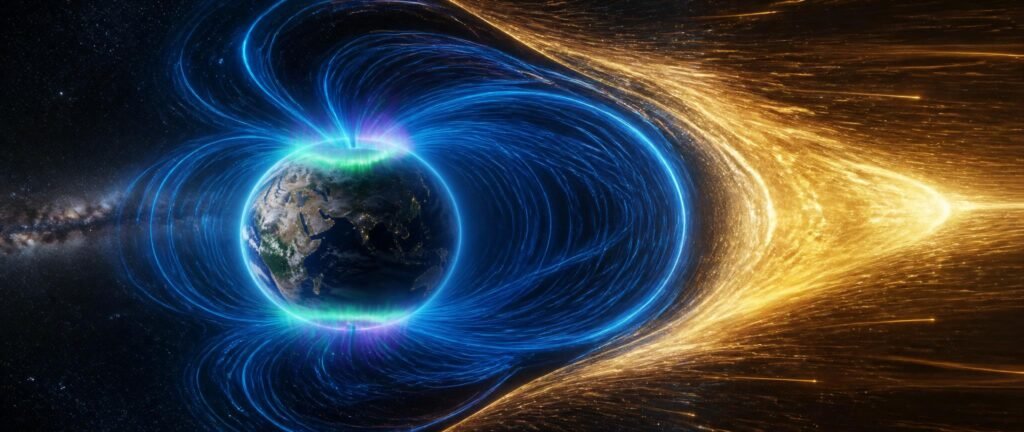
Should you worry? Not really — this isn’t a disaster movie. The core’s far more important job is to generate earths magnetic field, the invisible shield that deflects solar radiation and keeps our atmosphere from being stripped away. That field is powered by the churning liquid outside the inner ball, not by the ball’s precise spin, so a gentle reversal doesn’t switch off our protection. Still, field and core are bound together by the same physics, which is why a subtle change in the deep interior is worth taking seriously even when it changes nothing you will ever feel.
The Comfort of Not Knowing
There’s something reassuring about a mystery this close to home. We’ve mapped distant galaxies and photographed black holes, yet the largest object beneath our feet still keeps its secrets. Next time you feel solid ground, remember it sits atop a spinning heart of iron doing something we’ve only just noticed and can’t fully explain. Why earths core reversed direction may take a generation of fresh data to answer — and that lingering question is exactly what makes our own planet worth studying.