
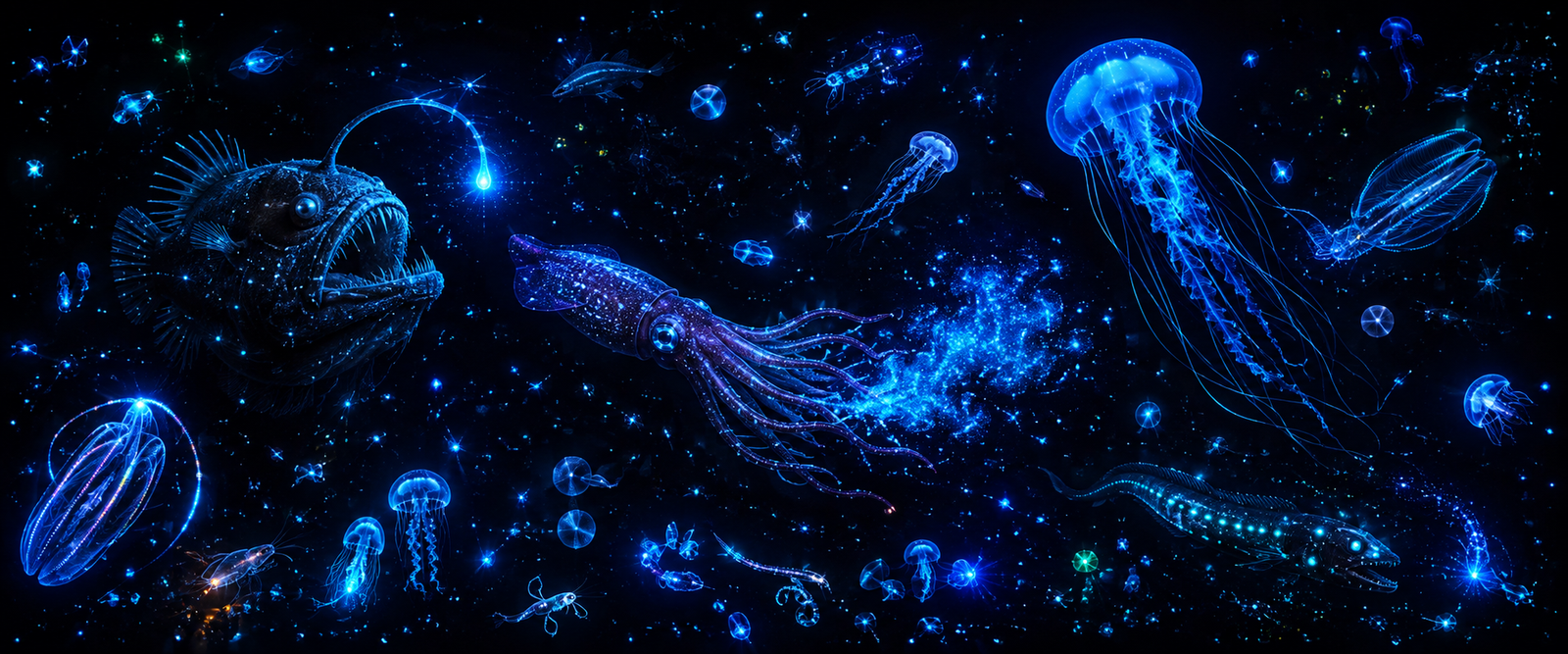
Somewhere in the deep ocean right now, more animals are producing their own light than aren’t. Below about 700 metres, where sunlight never reaches, glowing is not the exception — it’s the default. And here’s the part that unsettles biologists: this ability didn’t evolve once and spread. It was invented, from scratch, over and over again, by creatures that share almost nothing.
That’s the real puzzle behind why so many animals glow in the dark. Not the chemistry of the light itself, but the strange fact that life kept arriving at the same solution independently, as if the answer were simply too obvious to miss.
Why So Many Animals Glow in the Dark: The Convergence Problem
When the same trait appears repeatedly in unrelated lineages, biologists call it convergent evolution — and few convergent evolution examples show it as dramatically as living light. So how many times did bioluminescence evolve independently? It’s a genuine question, and the honest count keeps climbing as we look closer. The current best estimate is staggering: at least 90 separate times, and possibly more than 100, across bacteria, fungi, insects, jellyfish, squid, fish, and beyond.
Compare that to something like the eye, one of the most famous cases in biology, which arose independently a few dozen times. Bioluminescence, like strange strategies for survival in general, blows past even that. This is the core of why so many animals glow in the dark: the trait is evolutionarily easy to stumble into, provided the environment rewards it — and in the lightless deep, it almost always does.
The Chemistry That Makes It Cheap to Reinvent
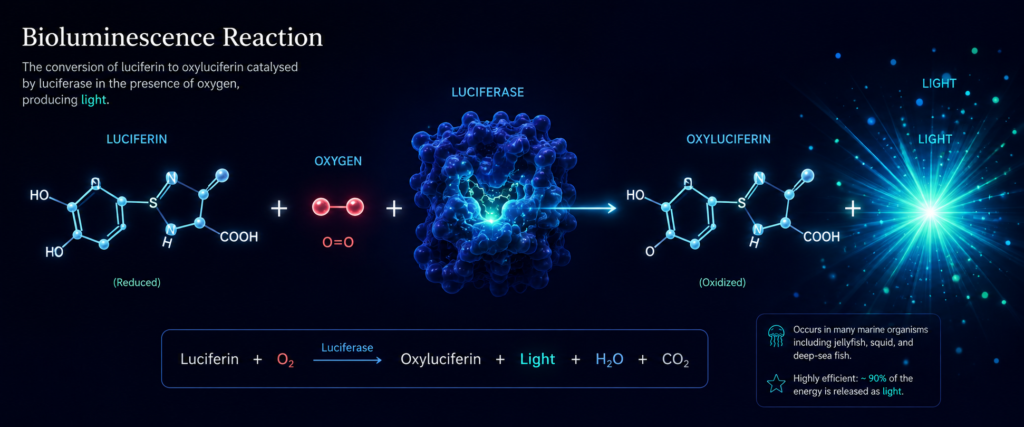
To understand the biology of bioluminescence, you only need two ingredients — and the simplicity of that chemistry is central to the biology of bioluminescence appearing so often. A molecule called luciferin, and an enzyme called luciferase. The enzyme helps the luciferin react with oxygen, and the reaction releases energy as light instead of heat — a process so efficient that nearly all the energy becomes visible glow, with almost none wasted as warmth — the near-opposite of how a lightning bolt works, where energy erupts mostly as heat.
Crucially, “luciferin” and “luciferase” aren’t single specific molecules. They’re job titles. Different lineages use chemically different luciferins, which is the smoking gun for independent origins — if everyone had inherited the trait from one ancestor, they’d all be using the same chemistry. They aren’t. That diversity is exactly why so many animals glow in the dark through what look like completely separate evolutionary experiments.
What Is Bioluminescence Used For?
If the mechanism is cheap, the payoffs are enormous — and this is where the “why” gets interesting. So what is bioluminescence used for? Almost everything an animal might need — hunting, defence, and communication, the last of which runs on hidden channels not unlike how forests communicate underground.
Some use it to hunt, dangling glowing lures that draw prey close before a decisive strike. Others use it defensively — a flash to startle a predator, or a cloud of glowing particles ejected as a decoy while the animal escapes into the dark. Anglerfish light their lures; certain squid squirt luminous ink instead of black.
Then there’s communication. Fireflies are the famous case, flashing species-specific patterns to find mates. And some deep-sea fish use red light — invisible to most of their neighbours — as a private wavelength, a searchlight only they can see by.
Counter-Illumination: The Cleverest Trick
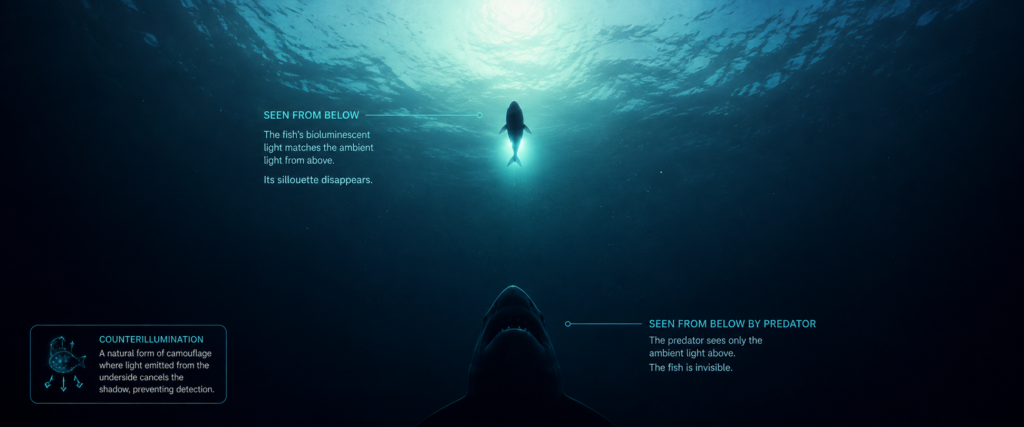
The most elegant use is also the least obvious. Many mid-water animals glow downward, on their bellies, matching the faint light filtering from the surface above. To a predator looking up, the animal’s silhouette simply vanishes into the background glow. It’s camouflage made of light — hiding not by being dark, but by being exactly as bright as the water behind you.
This is the sort of solution evolution finds again and again. Once a tool is easy to build and useful in a dozen ways, its repeated appearance stops being a coincidence and starts looking inevitable.
The Bigger Lesson in the Glow
The deep sea is the largest habitat on Earth, and it is lit almost entirely by the animals living in it. That fact reframes the whole question. We tend to think of glowing as exotic. Statistically, across the volume of the living world, it’s ordinary — sunlight is the weird local exception, confined to a thin bright skin at the top of the ocean.
Why so many animals glow in the dark, in the end, isn’t really a question about light. It’s a question about how evolution works: give life a cheap tool and a strong reason to use it, and it won’t invent that tool once. It’ll invent it ninety times, and act like that was the obvious thing to do all along.