
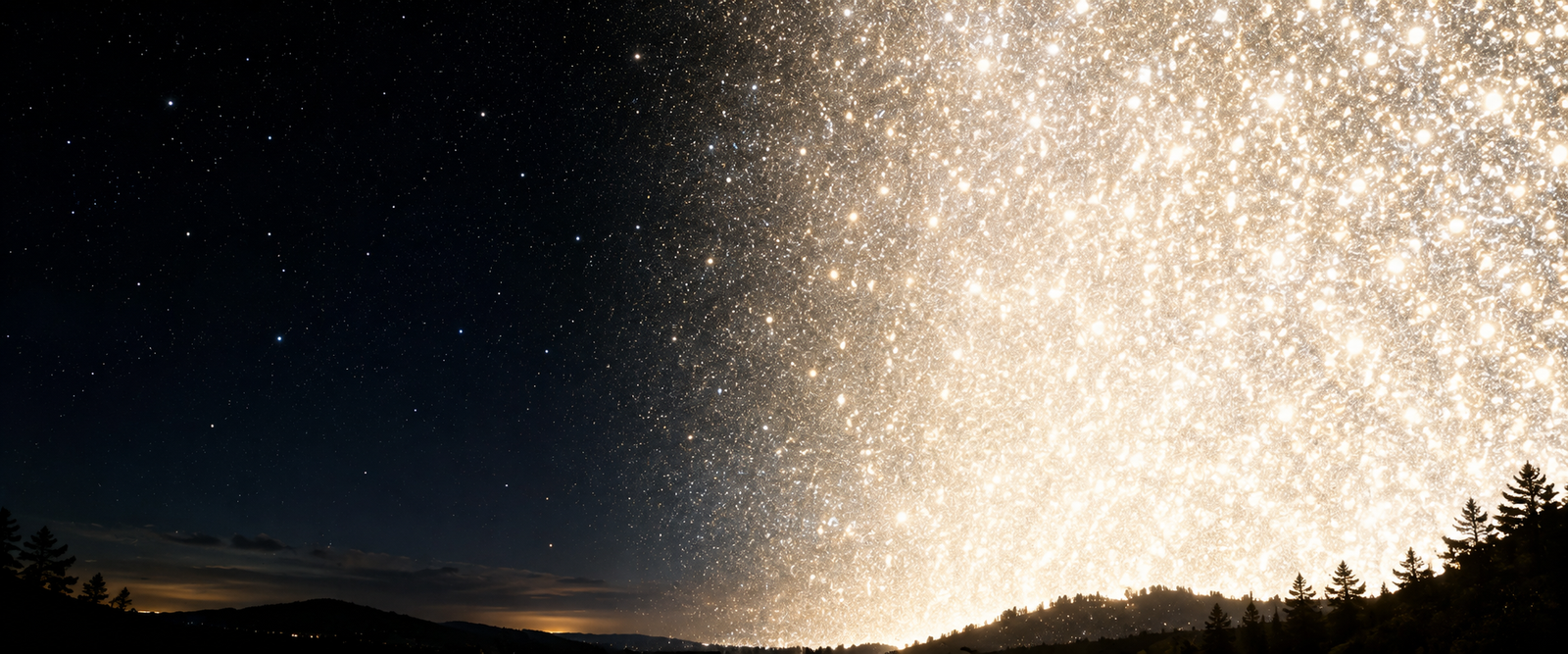
Step outside on a clear night and look up. The sky is mostly black, dotted with a scattering of stars. This feels so obvious, so unremarkable, that almost nobody stops to ask the strange question hiding inside it: if the universe is infinite and filled with an endless number of stars, why isn’t every single point in the sky ablaze with starlight? Why isn’t the night sky as blindingly bright as the surface of the sun?
That question has a name — Olbers’ paradox — and the answer to why the night sky is dark turns out to be one of the most profound things a person can learn while doing nothing more than standing in their backyard. The darkness overhead is not empty. It’s evidence.
Why the Night Sky Is Dark: The Paradox Explained
Let’s build the puzzle properly, because its force only lands once you see how reasonable the wrong expectation is.
Imagine, as astronomers once did, that the universe is infinite, eternal, and roughly evenly filled with stars in every direction. Under those assumptions, draw an imaginary line outward from your eye in any direction at all. If space goes on forever and stars are everywhere, that line must eventually land on the surface of a star. Every possible sightline ends on something glowing.
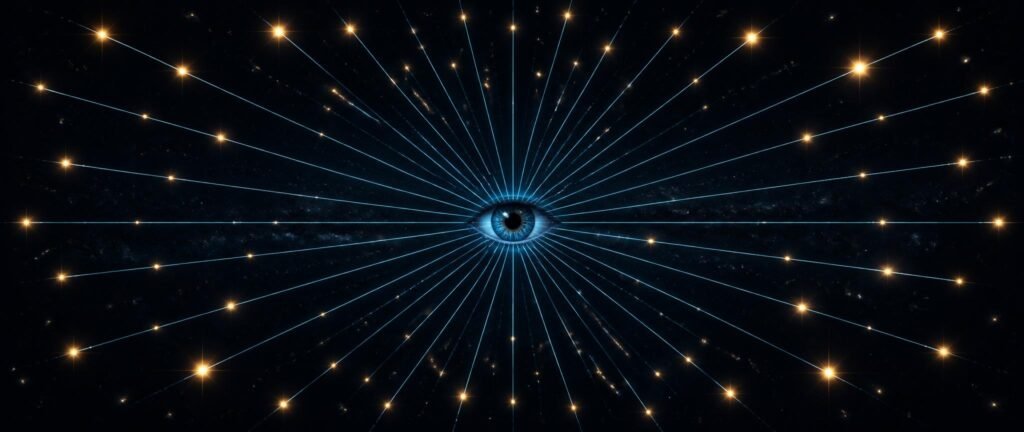
If that were true, the entire sky would be a seamless wall of starlight — no gaps, no blackness, every point as bright as a stellar surface. The night wouldn’t exist. And yet it plainly does. That gap between prediction and reality is the whole of the Olbers paradox explanation: a simple, almost childlike chain of logic that arrives at a conclusion the sky flatly contradicts.
So one of those reasonable-sounding assumptions has to be wrong — a bit like the questions physics can’t answer from inside their own framework. Figuring out which one is where things get beautiful.
What Is Olbers’ Paradox Actually Telling Us?
For a long time, people reached for tidy fixes that don’t work. So what is Olbers’ paradox really ruling out, and what does the Olbers paradox explanation leave standing? Start with the tempting wrong answers.
Maybe dust clouds block the distant starlight? No — over infinite time, that dust would absorb so much radiation it would heat up and glow just as brightly as the stars behind it. Maybe the stars are simply too far to see? That fails too: yes, a distant star looks dimmer, but in an infinite universe there are proportionally more stars at greater distances, and the two effects cancel out exactly. Farther away means fainter, but also means more of them, and the math balances on a knife’s edge — a reminder of how little we perceive without the math to guide us.
The paradox is remarkably stubborn. Every intuitive escape route seals itself off, which is what makes the real resolution so telling: the obvious moves all fail, and the truth lies somewhere less comfortable.
The Real Reason Why the Night Sky Is Dark
The resolution rewrites one of those original assumptions entirely: the universe is not infinitely old. It had a beginning — the same fact underlying why time flows forward.
The cosmos is roughly 13.8 billion years old — a figure we pin down using the same logic behind measuring the whole cosmos — which means light has only had 13.8 billion years to travel. Beyond a certain distance, the light from the most remote stars and galaxies simply has not reached us yet. There is a horizon to what we can see — not because space ends, but because time does, running back to the moment the universe began. This finite age of the universe is the single most important piece of why the night sky is dark: there hasn’t been enough time for the sky to fill up with light.
The finite age of the universe caps how much starlight can possibly be arriving at your eye right now. The sightlines that should have ended on a star instead end in regions whose light is still on its way, or was emitted before any stars existed at all. The blackness is a record of the universe’s youth. A cosmos with a definite beginning is exactly what carves a past out of the dark.
How Redshift Explains the Dark Sky
There’s a second act to the resolution, and it deepens the first. Even the light that has had time to reach us often arrives drained of its energy.
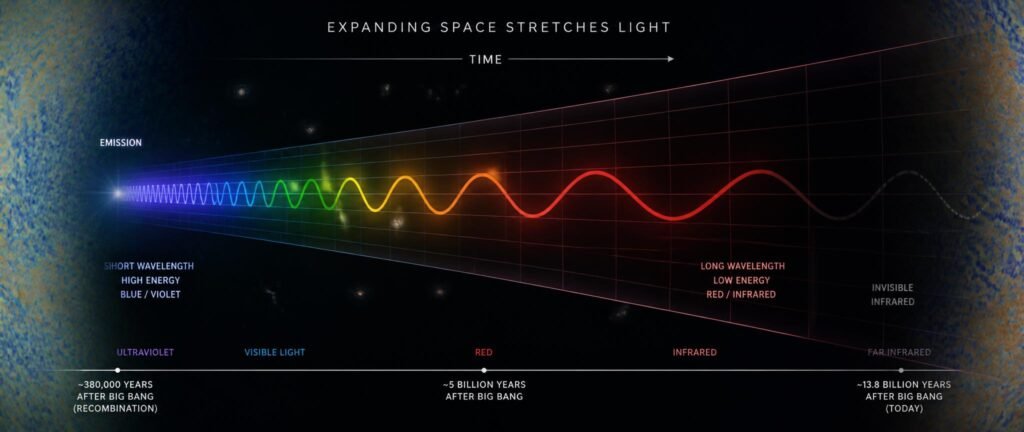
Understanding how redshift explains the dark sky requires one more fact: the universe is expanding, stretching the very space that light travels through. As that space stretches, the light waves crossing it get stretched too, shifting toward longer, redder, lower-energy wavelengths — and often stretching right out of the visible range altogether, into infrared and microwave light your eyes can’t detect.
So even the ancient glow that fills the entire sky — the cosmic microwave background, the faint afterglow of the early universe — is genuinely there, in every direction, exactly as the old paradox demanded. We just can’t see it with the naked eye, because expansion has redshifted it into invisibility. In a strange sense, Olbers was right: the whole sky is aglow. It’s simply glowing in a light our eyes were never built to catch, a reminder of how narrow our vision really is.
Why a Simple Question Became a Milestone
What makes Olbers’ paradox so celebrated isn’t its difficulty — it’s the size of the conclusion you can reach from such a modest starting point. A person in the 1800s, reasoning carefully about why the night sky is dark, could in principle have deduced that the universe must have had a beginning, decades before the Big Bang theory or the discovery of cosmic expansion gave us the machinery to prove it.
That’s the quiet lesson buried in the darkness overhead. The most ordinary observation imaginable — that night is dark — carries inside it the age of the cosmos, the finite speed of light, and the expansion of space itself. It’s one of those cases where the everyday quietly encodes the enormous.
So the next time you look up and see a black sky scattered with stars, remember what that blackness is actually telling you. It isn’t emptiness. It’s the fingerprint of a universe that began — a cosmos still too young, and stretching too fast, to have filled its own night with light.