
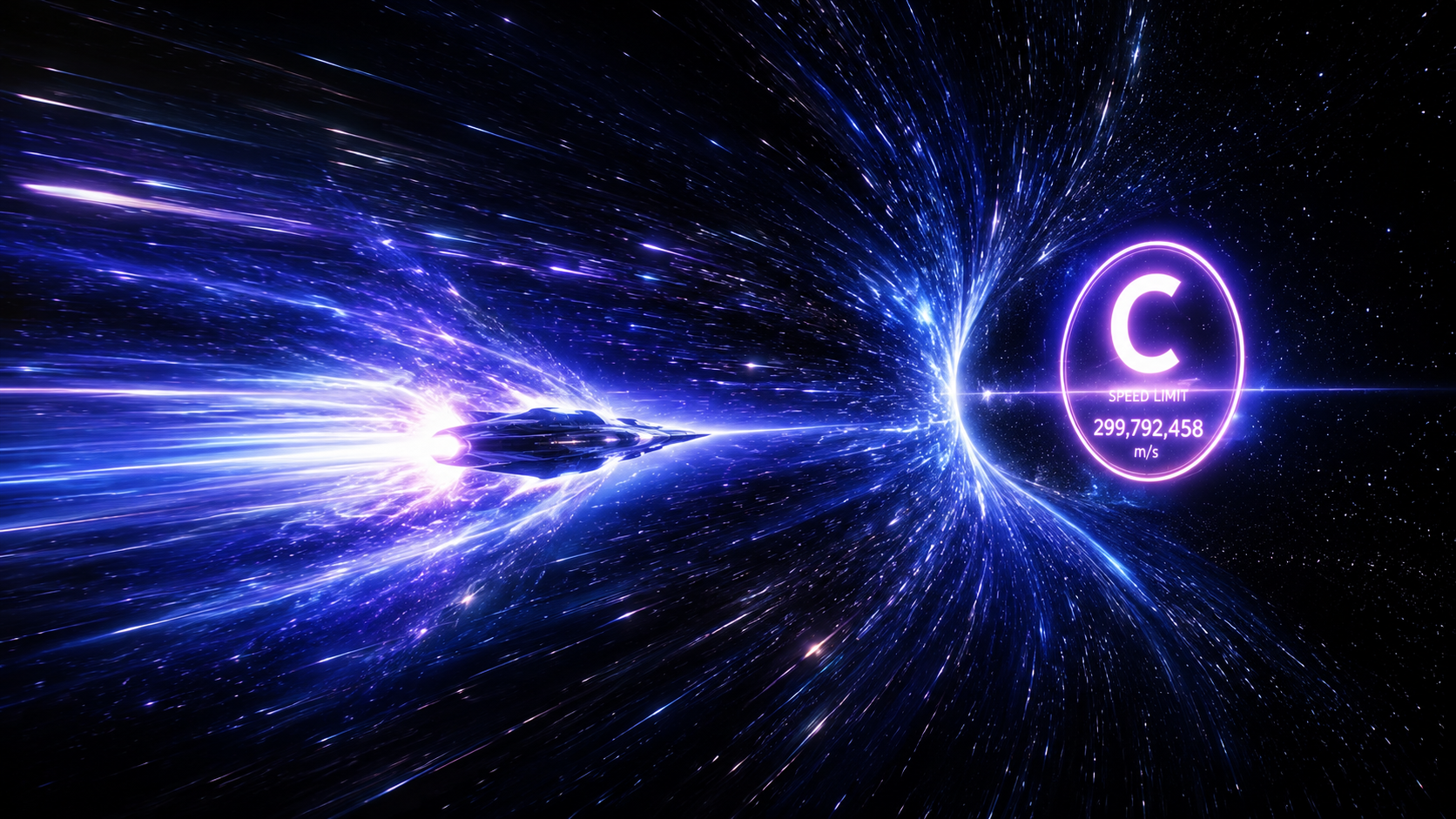
Nothing can travel faster than light. You’ve probably heard that before. Maybe in a physics class, maybe in a documentary, maybe from someone who said it with the quiet confidence of a person who doesn’t fully understand why.
But the “why” is the interesting part. It isn’t an arbitrary speed limit imposed by the universe out of stubbornness. Understanding why nothing can travel faster than light means understanding the deep, structural consequence of how space and time are woven together — and the closer you look at it, the stranger and more beautiful it becomes.
Let’s find out what happens when you actually try.
Light Speed Isn’t Just Fast — It’s a Cosmic Constant
The speed of light in a vacuum is approximately 299,792 kilometres per second. That’s roughly 186,000 miles per second. In one second, light travels a distance equivalent to circling Earth more than seven times.
But here’s what makes it truly unusual: it doesn’t matter how fast you’re moving when you measure it. If you’re standing still and I’m flying past you at half the speed of light, and we both measure the speed of a photon passing between us — we get the same number. Exactly the same. Not approximately. Not close enough. Identical.
This was Einstein’s starting point for special relativity. He took what seemed like an experimental anomaly — the Michelson-Morley experiment’s failure to detect variation in light’s speed — and treated it as a fundamental truth about the universe. If the speed of light is constant for all observers, he asked, what else has to change?
The answer was: almost everything.
What Special Relativity Actually Says
Einstein’s special relativity, published in 1905, begins with two postulates: the laws of physics are the same for all observers moving at constant velocities, and the speed of light in a vacuum is the same for all observers.
From these two seemingly modest claims, the entire bizarre machinery of relativistic physics unfolds.
Time slows down for moving objects. Lengths contract in the direction of motion. Mass increases with velocity. These aren’t illusions or approximations — they’re geometric consequences of living in a four-dimensional spacetime where space and time trade off against each other.
The key equation linking energy, mass, and momentum is what most people misquote as simply E=mc². The full version, E² = (mc²)² + (pc)², tells you something crucial: an object with mass always has some rest energy, and as it gains momentum (p), its total energy increases. The “c” — the speed of light — appears as a conversion factor between the two.
This connects naturally to the physics of the multiverse theory, where the laws of spacetime geometry themselves may differ between universes. The speed of light as a constant is a property of this spacetime’s geometry — not necessarily a universal invariant across all possible ones.
Why Nothing Can Travel Faster Than Light: The Mass Problem
Here’s the core reason why nothing can travel faster than light: as your speed increases, so does your relativistic mass.
At low speeds, the effect is negligible. At 10% of light speed, your mass is only about 0.5% greater than at rest. But the relationship is non-linear. At 90% the speed of light, your mass has roughly doubled. At 99%, it’s increased by a factor of about seven. At 99.9%, it’s more than twenty-two times your rest mass.
The formula is γm₀ — where γ (the Lorentz factor) equals 1/√(1 – v²/c²). As v approaches c, the denominator approaches zero, and γ approaches infinity.
Infinite mass would require infinite energy to accelerate. No finite energy source in the universe can produce infinity. So you can get arbitrarily close to light speed — but you can never reach it. The light barrier isn’t a wall you crash into; it’s an asymptote you approach forever, burning exponentially more fuel for smaller and smaller gains in speed.
This is the same mathematical structure that makes the singularity inside a black hole so troubling: equations that produce infinities are usually telling you that something about your model has broken down.
What Happens to Time and Space as You Approach Light Speed
While you’re burning that exponential fuel and getting nowhere near c, something remarkable is happening to your perception of the universe.
Time dilation means that your clock runs slower relative to a stationary observer. The faster you travel, the more extreme the effect. At 99.9% of light speed, your clock ticks about 22 times slower than a stationary clock. If you spent a year travelling at that speed from your perspective, more than 22 years would have passed back home.
Length contraction means that space itself compresses in your direction of travel. At very high speeds, the distance between your origin and destination, as you experience it, shrinks dramatically. A journey of 100 light-years at 99.99% of the speed of light would feel, to the traveller, like it took only about 1.4 years — even though 100 years would pass at the destination.
This is not a trick. It’s not a perceptual illusion. It’s the real geometry of spacetime. And it means that while you can’t travel faster than light, you can effectively “compress” the distances involved to make vast cosmic journeys feel far shorter.
The James Webb telescope has revealed galaxies so far away that their light has taken over 13 billion years to reach us. Under special relativity, a hypothetical traveller heading toward those galaxies at near-light speed could theoretically arrive within a human lifetime — while billions of years passed on Earth.
What About Tachyons?
Physicists have a name for hypothetical particles that travel faster than light: tachyons.
In the mathematics of special relativity, tachyons would have imaginary mass — their mass squared would be negative, a concept that makes sense algebraically but has no known physical interpretation. They would lose energy as they speed up, approaching infinite speed as their energy dropped to zero. And if they existed, they would travel backward in time relative to some observers — creating causality violations that most physicists consider fatal to the idea.
No tachyon has ever been detected. Most physicists believe they don’t exist. But the concept reveals something important: why nothing can travel faster than light isn’t just a constraint on matter and energy — it’s a boundary for causality itself, the principle that causes precede effects.
If you could send information faster than light, you could, under certain reference frames, send a message to the past. This leads to grandfather paradoxes, causal loops, and the kind of logical inconsistencies that suggest the universe may enforce its own consistency by making faster-than-light signalling impossible. The question of whether reality is a simulation sometimes invokes exactly this point: a simulated universe might build in causality protection as a computational necessity.
The Loopholes Physics Actually Allows
Here’s where it gets interesting: while objects cannot exceed light speed, space itself is not bound by the same rule.
Cosmic expansion is the most dramatic example. The universe is expanding, and the most distant regions are receding from us faster than the speed of light. This doesn’t violate relativity because space is expanding between us, not matter moving through space. The light from those regions will never reach us — they are beyond our cosmological horizon. The cosmic Boötes void and structures like it exist in a universe whose geometry is actively growing.
The Alcubierre warp drive is a theoretical solution to Einstein’s field equations — proposed by physicist Miguel Alcubierre in 1994 — that describes a “bubble” of flat spacetime surrounded by regions of contracted space ahead and expanded space behind. An object inside the bubble isn’t moving through space; it’s being carried by the bubble. The space itself does the moving. The object, locally, never exceeds light speed. Globally, it arrives faster than a light beam travelling the same distance.
The problems: the energy requirements are ludicrous (early estimates required a Jupiter-mass worth of exotic negative energy), the bubble would likely be causally disconnected from its interior (you couldn’t steer it), and negative energy at the required densities may not exist. But it hasn’t been mathematically ruled out.
Quantum entanglement also seems to involve correlations that are instantaneous across arbitrary distances. Measure the spin of one entangled particle and the other “collapses” to the opposite spin immediately — faster than any light signal could have connected them. But this correlation cannot be used to transmit information. You can’t choose what measurement result you get, so you can’t encode a message in it. The universe, again, protects causality.
The Fermi Paradox and the Light Speed Cage
There’s a melancholy consequence worth sitting with.
Even if civilisations exist across the galaxy — and the Fermi Paradox presses hard on why we haven’t heard from them — the speed of light imposes a fundamental isolation on the cosmos. The nearest star system, Alpha Centauri, is 4.2 light-years away. At the fastest spacecraft we’ve ever built, it would take roughly 70,000 years to reach it.
Even at 99% of light speed, a return trip takes over eight years ship-time, with nearly a decade passing on Earth. At galactic scales, the numbers become almost meaningless. The Milky Way is 100,000 light-years across. The nearest large galaxy, Andromeda, is 2.5 million light-years away.
The speed of light doesn’t just make travel difficult. It means that all communication across interstellar distances is inherently historical. When we look at stars, we see them as they were years, decades, or millennia ago. The universe as it is right now is forever beyond our perception. We live in a light cone — a bubble of spacetime that expands at c in all directions from our position in time and space, beyond which no information can reach us.
Why Nothing Can Travel Faster Than Light: It’s the Shape of Reality
There’s a deeper way to understand why c is the universal speed limit, and it has nothing to do with photons specifically.
In relativity, the speed of light is better understood as the conversion factor between space and time — a kind of exchange rate built into the structure of spacetime. Every object moves through four-dimensional spacetime at the same total “speed”: c. Objects at rest move entirely through time at c. Objects moving through space trade some of their temporal motion for spatial motion — which is why moving clocks run slow. A photon, which has no mass and moves at c through space, has no motion left for time — which is why, from a photon’s reference frame, it experiences no time at all. It is emitted and absorbed simultaneously.
The speed of light is not a limit imposed on things. It’s a description of how spacetime is shaped. Mass is what ties objects to the slow end of the spectrum. Massless particles like photons are the other extreme.
Why nothing can travel faster than light comes down to this: you can’t travel faster than the universe is structured to allow. It’s not a rule. It’s geometry.