
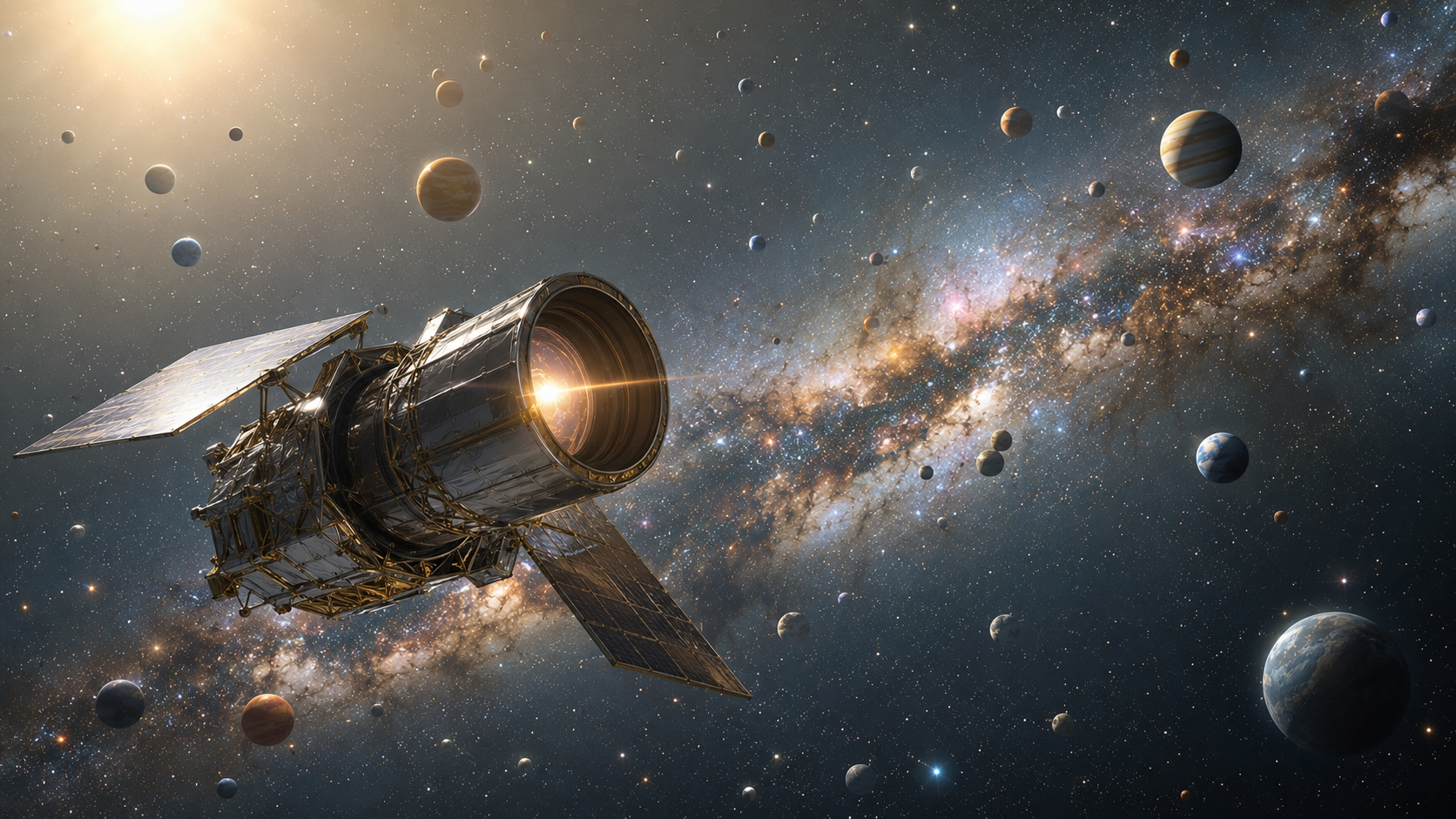
Every planet ever confirmed outside our solar system — every hot Jupiter, every super-Earth, every ocean world, every nightmare planet where it rains glass — was found one at a time. Astronomers built instruments, pointed them at individual stars, waited for the faint flicker of a planet crossing in front, and noted it down. Over three decades of painstaking work, humanity has confirmed around 5,700 exoplanets.
The NASA Roman Space Telescope is about to make that number look like a rounding error.
Scheduled for launch in late 2026, Roman carries a camera with a field of view more than 100 times wider than Hubble’s. In a single pointing, it can image an area of sky that would take Hubble months to cover. Applied to planet-hunting, Roman Space Telescope exoplanets science isn’t just an improvement on what came before — it’s a fundamentally different kind of science. Astronomers estimate the NASA Roman Space Telescope could discover around 100,000 exoplanets over this exoplanet survey mission. Some will be found orbiting in the habitable zones of their stars. Some will be rogue planets drifting alone in interstellar darkness, untethered to any sun. Some may be unlike anything in current planetary science models.
For Roman Space Telescope exoplanets science, this is what a paradigm shift looks like before it happens.
Why 100,000 Changes Everything
To appreciate what the NASA Roman Space Telescope is about to do, it helps to understand the scale problem that has defined exoplanet science since its beginning.
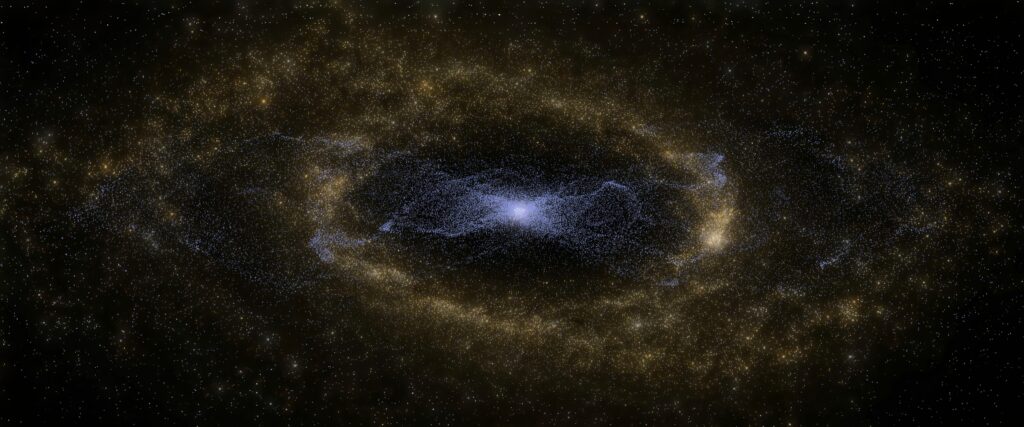
As this NASA new space telescope 2026 mission prepares to launch, it is worth understanding the scale problem it was built to solve. The Milky Way contains somewhere between 200 billion and 400 billion stars. Astronomical surveys suggest that, on average, every star hosts at least one planet. Conservative estimates put the number of planets in our galaxy alone at several hundred billion. Yet as of 2026, humanity has confirmed just over 5,700 of them — a fraction so small it barely registers.
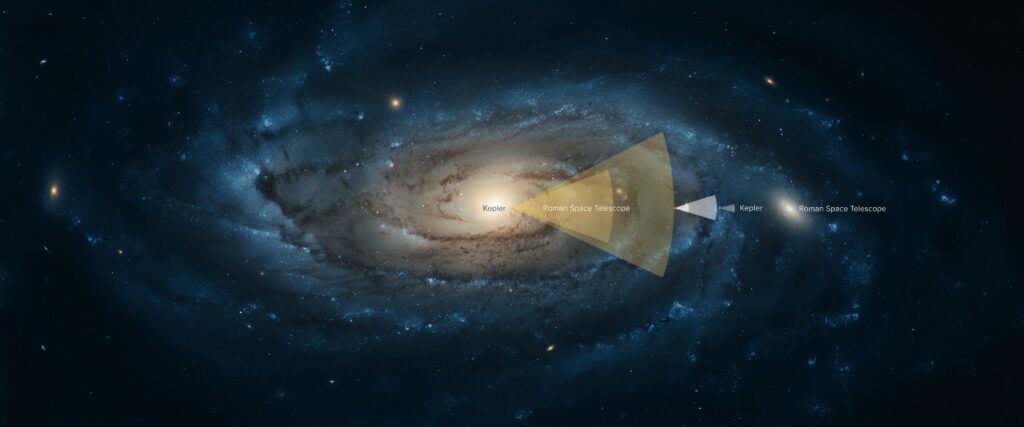
The reason is method. The transit method — watching a star dim slightly as a planet crosses in front — requires precise, sustained observation of individual stars. Kepler, the most prolific planet-hunting telescope before Roman, surveyed around 150,000 stars over nine years and found roughly 2,600 confirmed planets. It was transformative. It was also, by the standards of what Roman promises, narrow.
Roman’s 300-megapixel detector — the largest ever flown in space — can monitor hundreds of millions of stars simultaneously. It can catch transits happening right now, across a vast swath of the Milky Way’s galactic bulge, all at once. Where Kepler saw a narrow beam of the galaxy, the NASA Roman Space Telescope sees a floodlight. The 100,000 figure isn’t an optimistic projection — it’s a conservative estimate based on known stellar densities and planetary occurrence rates.
The philosophical weight of this number is difficult to absorb. We are not talking about finding a few more planets to add to a list. We are talking about a dataset large enough to do statistics on the universe — to ask, for the first time with real data, what kinds of planets are common, what kinds are rare, and what conditions for life might look like across a significant slice of the galaxy.
What the NASA Roman Space Telescope Will Actually Find
The NASA new space telescope 2026 mission carries a second major instrument goal alongside exoplanet hunting. The NASA Roman Space Telescope is not a one-trick instrument. Its primary exoplanet survey mission uses a technique called gravitational microlensing rather than the transit method — and this distinction matters enormously for what it can find.
This exoplanet survey mission uses microlensing — watching what happens when a massive object passes in front of a distant star. Gravity bends and amplifies the starlight, creating a brief, characteristic brightening. If the massive object has a planet orbiting it, that planet creates its own secondary brightening signal — a spike within a spike. The technique can detect planets at almost any orbital distance, including planets far from their stars where the transit method goes blind.
This means Roman will find planets that no previous telescope could have detected: cold worlds in wide orbits, planets at Earth-like distances from sun-like stars, and — crucially — free-floating rogue planets that drift through the galaxy without any stellar host. Current estimates suggest there may be more rogue planets in the Milky Way than there are stars. Roman should find hundreds or thousands of them.
The catalog will also extend into territory currently occupied by only a handful of confirmed worlds. Much like the impossible planets already catalogued — worlds that defy formation models and exist in configurations that shouldn’t work — Roman’s haul will almost certainly include objects that break the current frameworks of planetary science. A survey of 100,000 worlds is a survey of the universe’s full creative range. Not all of it will be familiar. Worlds like the planet that rains glass were once considered impossible — Roman will find thousands more like it.
Roman and the Search for Life
The question that sits beneath all of this — the one that drives funding, public interest, and the careers of thousands of astronomers — is whether any of these 100,000 worlds might harbor life.
Roman won’t answer that question directly. It isn’t designed to study planetary atmospheres, which is where the biosignatures of life would appear. That task belongs to future instruments — particularly the next generation of extremely large ground-based telescopes now under construction. But what Roman does is build the foundation those instruments require.
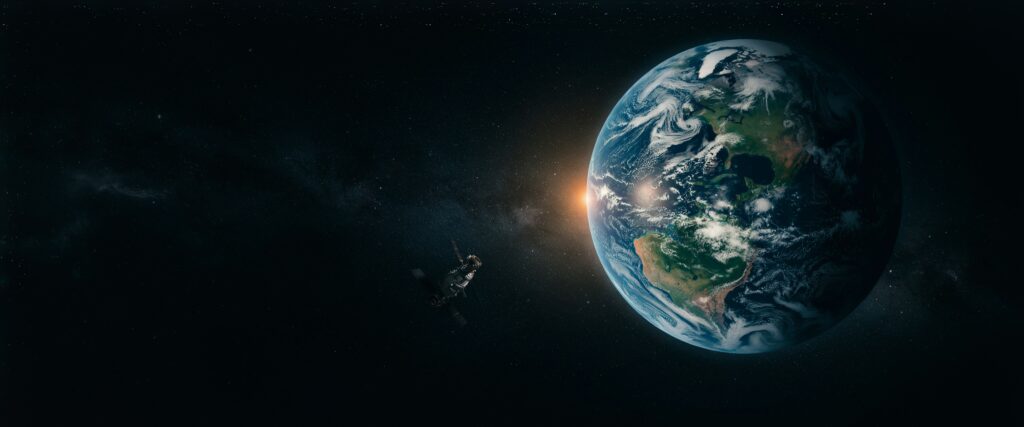
Finding a potentially habitable planet is only the first step. The next step is pointing a more powerful telescope at it and studying its atmosphere for oxygen, methane, water vapor — the chemical signatures that life produces. But you can only do that second step if you know where to look. Roman’s 100,000-planet catalog will provide the most comprehensive map of potentially interesting targets ever assembled.
It also changes the probability calculus in a deeper way. The question the Fermi Paradox asks — if life is common, where is everybody — has always been hobbled by our ignorance of how common suitable planets actually are. Roman won’t find life. But it will tell us, with real data rather than theory, how many places life could plausibly exist. That number — whatever it turns out to be — will either deepen the mystery or begin to dissolve it.
The Secondary Mission That Might Matter More
Exoplanets are Roman’s most attention-grabbing goal, but they are not its only one. The telescope was designed with a second major scientific objective — Roman telescope dark energy mapping — that, depending on who you ask, may be even more consequential than the exoplanet survey.
Dark energy — the force driving the accelerating expansion of the universe — is the most abundant thing in existence, accounting for roughly 68% of everything. Dark matter accounts for another 27%. Together, they constitute 95% of the universe. Neither has ever been directly detected. Everything we know about them comes from their gravitational effects on the matter we can see. Much like void that strains cosmological models, dark energy leaves its signature in the large-scale structure of the universe — in the patterns of how galaxies cluster and how those clusters move apart over time.
Roman will map the shapes, positions, and distances of hundreds of millions of galaxies across billions of light-years. From this map, cosmologists can extract the signature of dark energy with unprecedented precision — measuring how the universe’s expansion rate has changed over time, and whether it matches the predictions of current theory. If it doesn’t, physics needs new ideas.
This is the kind of science that doesn’t make headlines when you describe it, but whose implications reverberate through every other field. Understanding dark energy is understanding the fate of the universe — how long it continues expanding, whether that expansion accelerates toward a Big Rip, or whether some subtlety in the physics changes the picture entirely.
How Roman Compares to What Came Before
The NASA Roman Space Telescope exists in a lineage of increasingly ambitious space observatories, and understanding where it sits helps clarify what makes it genuinely new rather than merely incremental.
Hubble, launched in 1990, gave humanity its deepest and most detailed optical view of the universe. It was not designed for exoplanet detection but contributed to the field through precise stellar photometry. Its field of view — the amount of sky it could image at once — was its fundamental limitation for survey science.
Kepler and its successor TESS were purpose-built planet hunters. Kepler found thousands of planets but was limited to a small patch of sky. TESS expanded the survey to cover most of the sky but focused on bright, nearby stars rather than the galactic population at large. Both telescopes relied on the transit method.
James Webb revealed earliest stars when it launched in 2021, and it remains Roman’s closest contemporary — still fully operational. Webb is optimized for infrared observation and atmospheric characterization. It can study individual planets in extraordinary detail, but it cannot survey large areas of sky quickly. Webb goes deep. Roman goes wide.
The relationship between the two telescopes is complementary rather than competitive. Roman Space Telescope exoplanets become Webb’s target list — Roman finds 100,000 planets; Webb follows up on the most interesting ones. Roman telescope dark energy mapping covers billions of light-years; Webb studies the individual galaxies within it. Together, they represent the most powerful combination of space observatories in history — instruments designed not just to answer existing questions but to reveal the questions we haven’t thought to ask yet.
The Launch Window and What Comes After
This NASA new space telescope 2026 mission is scheduled to launch no earlier than October 2026, aboard a SpaceX Falcon Heavy rocket, bound for the second Lagrange point — the same gravitational sweet spot where Webb operates, about 1.5 million kilometers from Earth on the Sun’s far side.
Its primary mission runs for five years, with the possibility of extension. In those five years, its microlensing survey of the galactic bulge will run for several 72-day windows — each one monitoring hundreds of millions of stars for the characteristic brightening signatures of planets. Its dark energy survey will run in parallel, building a three-dimensional map of the large-scale structure of the universe that no prior instrument could have attempted.
What comes out the other end is not just data — it is the largest catalog of worlds the NASA Roman Space Telescope could have assembled. It is a new picture of the universe — more complete, more statistically grounded, and more humbling than anything that preceded it. A hundred thousand new worlds, each one a data point in the largest survey of planetary reality ever conducted.
Some of those worlds will be barren rocks. Some will be gas giants the size of a thousand Earths. Some will orbit in the habitable zones of their stars, with liquid water on their surfaces, waiting to be studied more closely by instruments not yet built. A few might be something we haven’t imagined. And one — possibly — might not be waiting at all.