
The Great Oxidation Event explained simply is this: 2.4 billion years ago, tiny microbes accidentally flooded Earth’s atmosphere with oxygen — and nearly destroyed all life on the planet in the process. It wasn’t a meteor strike. It wasn’t a volcanic supereruption. The most catastrophic transformation in Earth’s history was caused by organisms too small to see, doing nothing more than staying alive. To understand how that’s even possible, you have to travel back to a planet that looks nothing like home.
What Was Earth Like Before the Great Oxidation Event?
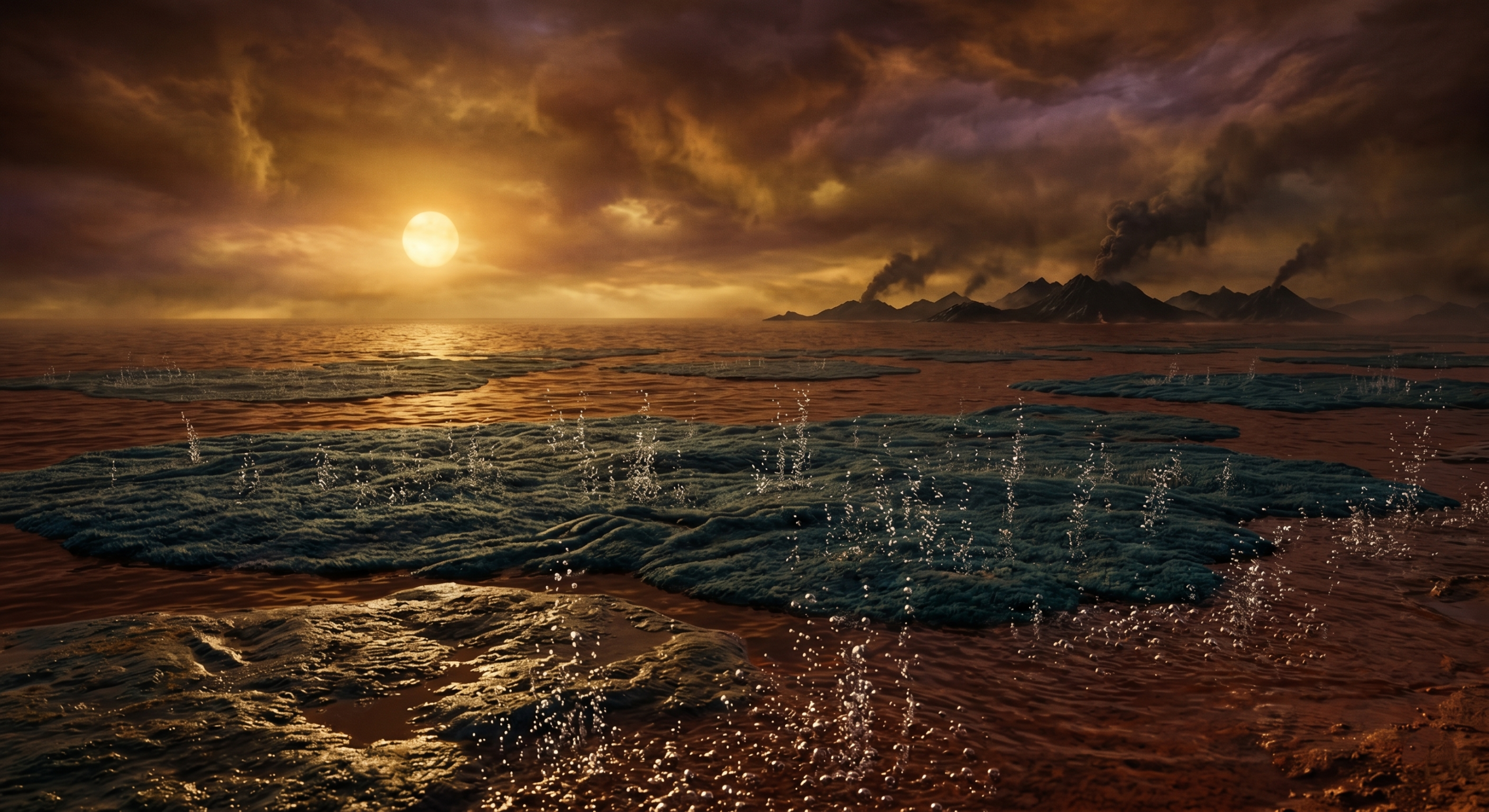
For the first two billion years of its 4.5-billion-year life, Earth’s atmosphere contained virtually no free oxygen. Instead, it was a thick, hostile blend of nitrogen, carbon dioxide, methane, and ammonia — gases that would be lethal to almost every living thing today. The sky wasn’t blue; it was likely a murky orange-pink, coloured by methane haze.
The oceans were warm and full of dissolved iron. The land was bare, volcanic rock. There was no ozone layer, meaning ultraviolet radiation from the Sun bombarded the surface unchecked.
And yet — life existed. Not complex life, not animals or plants, but microbial life. Single-celled organisms called anaerobes thrived in this oxygen-free environment. For them, oxygen wasn’t life-giving — it was poison. They had evolved in a world without it, and they had absolutely no use for it.
That was about to change.
The Unlikely Culprits: Cyanobacteria
Around 2.7 billion years ago, a new type of microorganism appeared: cyanobacteria. These tiny, blue-green bacteria evolved a remarkable trick — photosynthesis. They could harvest energy directly from sunlight, using water and carbon dioxide to fuel themselves.
The byproduct of this process? Oxygen.
At first, it didn’t matter much. The early oceans were loaded with dissolved iron, and oxygen reacts powerfully with iron. Every molecule of oxygen that cyanobacteria produced was immediately mopped up by the iron in the seawater, forming iron oxides — rust — which sank to the ocean floor. This is where the world’s enormous banded iron formations come from — those ancient striped rock deposits that geologists study and mine today as iron ore. They are, essentially, the fossil record of oxygen being absorbed before it could accumulate.
For hundreds of millions of years, the oceans acted as a giant oxygen sink, keeping atmospheric levels near zero. Cyanobacteria kept producing. The iron kept absorbing. The balance held.
And then the iron ran out.
When the Oxygen Flood Began
Around 2.4 billion years ago, the dissolved iron in the oceans was exhausted. There was nothing left to absorb the oxygen being churned out by billions upon billions of cyanobacteria. With nowhere to go, oxygen began accumulating in the atmosphere for the first time in Earth’s history.
This was the Great Oxidation Event — and for the dominant life forms of the time, it was an apocalypse.
To the anaerobic microbes that had ruled Earth for over a billion years, oxygen was catastrophically toxic. It reacted with their cellular machinery, destroyed their enzymes, and disrupted the chemistry they depended on for survival. As oxygen levels climbed, the vast majority of anaerobic life on Earth was wiped out — the first mass extinction in the planet’s history, and arguably the largest proportionally, since nearly all life at the time was anaerobic.
The organisms responsible for this extinction didn’t set out to cause one. Cyanobacteria were simply doing what they had always done — converting sunlight into energy. They had no awareness of what they were unleashing. It was, without question, evolution’s most consequential accident.
To fully appreciate the Great Oxidation Event explained at this scale, consider this: no single volcanic eruption, no asteroid, no climate shift has ever altered the fundamental chemistry of this planet’s atmosphere as completely and permanently as these invisible microbes did.
The Snowball Earth Connection
The consequences of the Great Oxidation Event didn’t stop at mass extinction. The rising oxygen also destroyed something else: methane.
Methane is a powerful greenhouse gas — far more effective at trapping heat than carbon dioxide. Earth’s early atmosphere was rich in it, and it was responsible for keeping the planet warm enough to sustain liquid water despite the Sun being significantly dimmer than it is today (younger stars burn cooler). When oxygen flooded the atmosphere, it reacted with and destroyed most of the atmospheric methane.
Without its methane blanket, Earth lost its warmth rapidly. Global temperatures plummeted. Ice spread from the poles toward the equator. Some researchers believe Earth entered a phase of extreme glaciation — Snowball Earth — where ice sheets may have extended all the way to the tropics. The planet was, briefly, a frozen marble hurtling through space.
It took millions of years for volcanic activity to pump enough carbon dioxide back into the atmosphere to thaw the planet out.
And Then Came Complexity
Here’s the extraordinary twist in the Great Oxidation Event explained fully: the very catastrophe that killed most life on Earth set the stage for everything that came after.
Oxygen is not just a byproduct of life — it’s a supercharger for it. Aerobic metabolism, the kind that uses oxygen to generate energy, is dramatically more efficient than anaerobic metabolism. Organisms that could harness oxygen gained access to far more energy than their anaerobic ancestors. That energy surplus is what eventually made complex, multicellular life possible — animals, plants, fungi, and ultimately, us.
Without the Great Oxidation Event, Earth might still be a world of anaerobic microbes. The mass extinction it caused was, paradoxically, the prerequisite for everything complex that followed.
Some anaerobic microbes survived, retreating into oxygen-free niches — deep ocean sediments, the guts of animals, hot springs. Their descendants are still with us today. But the world above the surface had changed forever.
How Do We Know Any of This?
The Great Oxidation Event happened long before any life left fossils we could easily read. So how do scientists reconstruct an event from 2.4 billion years ago?
The evidence is geochemical. Those banded iron formations — the rust-striped rock layers found on every continent — record the period when the oceans were absorbing oxygen before it reached the atmosphere. They stop abruptly around 2.4 billion years ago, which is precisely when the iron ran out and oxygen began escaping to the air.
Sulfur isotopes provide another powerful clue. Before the Great Oxidation Event explained in chemical terms, UV radiation split sulfur compounds in the atmosphere in a way that left a distinctive chemical signature in ancient rocks. After the event, that signature disappears — because an oxygen-rich atmosphere blocks UV from reaching the lower air where the splitting occurred. The disappearance of this signature is essentially a timestamp for when oxygen arrived.
Together, these chemical records in ancient rock give scientists a surprisingly precise and detailed account of an event that happened nearly two and a half billion years ago — long before eyes existed to witness it.
The Accidental Architects of Our World
The Great Oxidation Event explained in full is ultimately a story about unintended consequences on a planetary scale. The atmosphere you breathe right now — every lungful of oxygen sustaining you as you read this — exists because of microorganisms that had no plan, no intention, and no awareness of what they were doing. They didn’t set out to transform a planet. They were just alive.
And in being alive, they triggered a mass extinction, froze the Earth, and accidentally created the conditions for every complex living thing that would ever exist.
Much like how the science of déjà vu reveals surprising truths about how the brain works, the Great Oxidation Event reveals something equally humbling about life itself — that the most world-changing events in history often have the most ordinary origins.
The cyanobacteria didn’t save the world. They ended one world — and made ours possible.