
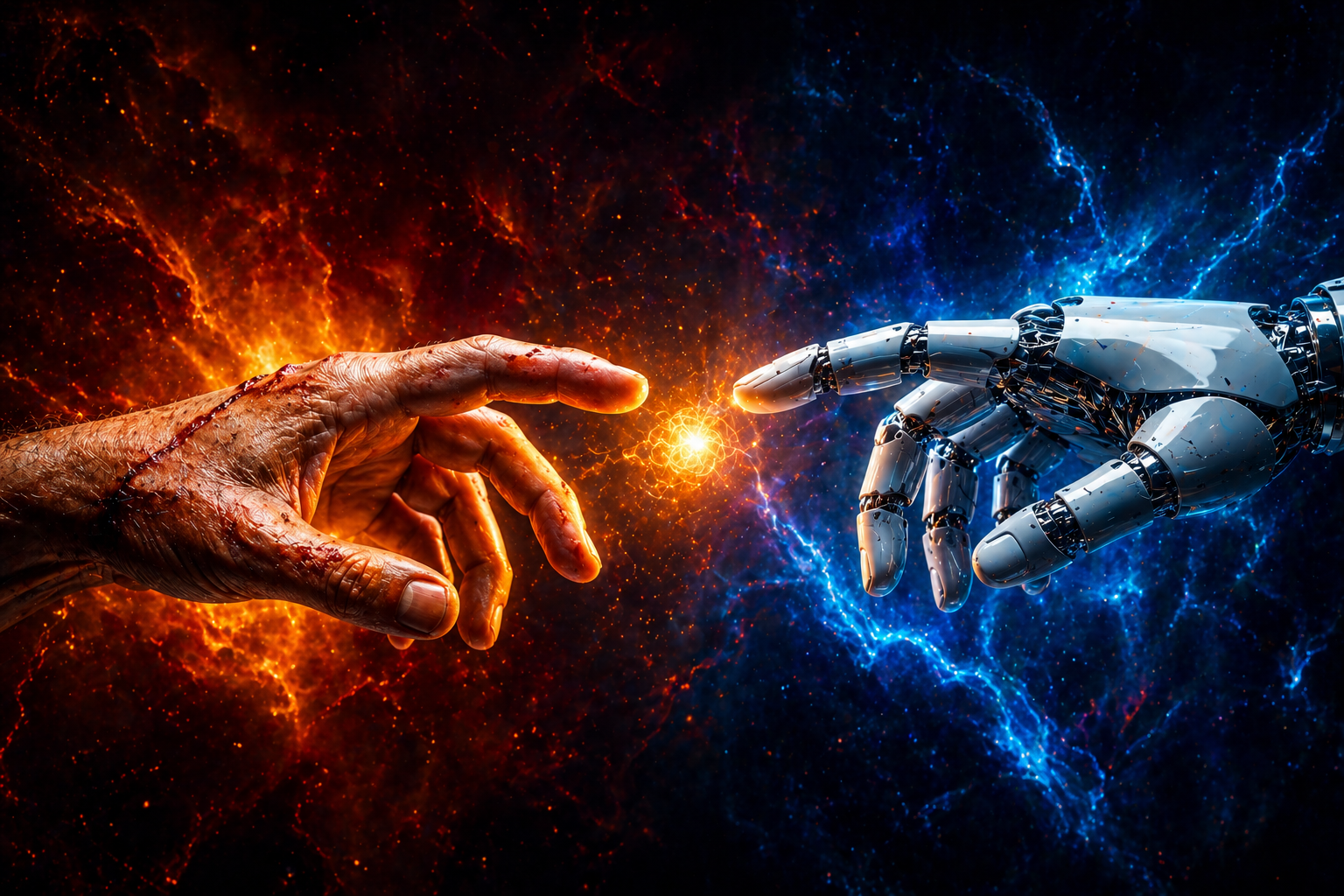
The World Economic Forum predicts 92 million jobs will disappear by 2030. Most headlines stop there. Nobody talks about the 170 million new ones — or more importantly, which humans get to have them.
Every generation has had its version of this panic. The printing press was going to make scribes obsolete. The industrial revolution was going to end skilled craftsmanship. The ATM was going to eliminate every bank teller in America. Each time, the headlines were half right. Jobs changed. Some vanished. Entirely new categories of work appeared that nobody had a word for yet.
But this time feels different. And it is — in one very specific, very important way.
Previous automation replaced human muscle. This one is coming for human thought. And that changes the calculation entirely.
So the real question is not whether AI will take jobs. It already is. The question is which human capabilities sit so deep in our biology, our relationships, and our lived experience that no algorithm — however sophisticated — can reach them. That list is shorter than optimists claim and longer than doomsayers admit. But it is real. And if you are on it, the future of work looks very different than the headlines suggest.
The Question Everyone Is Really Asking
Let’s not pretend this is a purely academic topic. When people search for “jobs AI can’t replace,” they are not curious. They are anxious. They are wondering whether their career — the thing they trained for, the thing that pays their mortgage, the thing that gives their days structure and meaning — is going to survive the next decade.
It is a fair question. A genuinely important one. And it deserves a genuinely honest answer rather than either breathless panic or breezy reassurance.
Here is the honest answer: AI will replace a large number of jobs. It is already doing so. Routine data entry, basic legal research, junior copywriting, customer service scripts, simple image creation, financial report generation — these are not safe, and pretending otherwise is a disservice.
But here is the equally honest other half: there is a set of human capabilities that AI does not merely struggle to replicate — it structurally cannot replicate them with current or near-future technology. Not because the engineers aren’t trying. Because the nature of those capabilities resists the architecture of how AI actually works.
Understanding the difference is not just professionally useful. It is the map for navigating the next twenty years of work.
What AI Actually Is (And Why That Matters)
Most people have a vague sense that AI is very clever. What fewer people understand is precisely how it is clever — and therefore, precisely where it breaks.
Current AI systems, including the most powerful large language models, are fundamentally pattern-matching engines operating on statistical relationships in training data. They are extraordinarily good at predicting what comes next in a sequence, at identifying which outputs have historically been rewarded, and at generating text, images, and code that resembles what humans have produced before.
What they are not doing — at all — is understanding. There is no comprehension behind the output. No intention. No model of the world that exists independently of the training data. When AI hallucinates a court case that doesn’t exist, it is not lying. It is doing exactly what it always does — predicting plausible output — and in that instance, plausible output happened to be false.
This is not a bug that will be patched in the next update. It is an architectural reality that shapes everything about where AI can and cannot replace human workers.
The Jobs That Are Actually Safe — And Why
1. Mental Health Professionals
Therapy is the clearest example of a role that AI cannot replace — not because the technology isn’t impressive, but because the entire mechanism of therapy depends on something AI cannot provide: genuine human presence.
Therapeutic progress is built on trust developed over time, on the therapist’s ability to read micro-expressions and body language, on the nuanced silence that communicates safety, on the shared human understanding that says “I have felt what you are feeling.” McKinsey’s research identifies social and emotional skills as both the hardest to automate and the fastest growing in demand.
AI chatbots can provide information about mental health. They can offer coping strategies. They can be available at 3 a.m. when no human is. But the relationship — the actual therapeutic relationship — cannot be simulated. Ethical responsibility, clinical judgment, and liability must stay with licensed professionals.
The automation risk for mental health roles is estimated to be extremely low, while demand is surging globally as the mental health crisis deepens.
2. Skilled Trades — Electricians, Plumbers, Surgeons
This one surprises people. The assumption is that physical work is simple and therefore automatable, while knowledge work is complex and therefore safe. The reality is nearly the opposite.
Robots handle structured, predictable physical tasks well — assembly lines in controlled factory environments, for example. They struggle dramatically in unstructured physical environments. A plumber entering a 100-year-old house with unique piping, an electrician troubleshooting a wiring problem in a building that has been modified seven times by seven different owners, a surgeon encountering unexpected findings mid-operation — these require fine motor skill, real-time improvisation, and the ability to reason from incomplete information in a novel physical space.
Robotics cannot match this in real-world conditions. Skilled trades show automation risk as low as 16 percent. And as a pleasant side effect, the people in these trades are often extremely well-compensated.
3. Crisis and Emergency Response
AI excels at solving problems it has seen before. It struggles enormously when the problem is genuinely new — when the context is ambiguous, the rules are undefined, and the solution space is unknown.
Emergency response is almost definitionally about novel, rapidly evolving, high-stakes situations. A paramedic arriving at a scene with multiple casualties. A firefighter making split-second decisions about structural integrity. A crisis negotiator reading the emotional state of someone in acute distress, adjusting approach in real time, making judgment calls that a life depends on.
These situations demand not just technical knowledge but the kind of adaptive human judgment that current AI systems genuinely cannot replicate. AI can support these roles — better mapping, faster dispatch, improved communication. It cannot be the person making the call.
4. Teachers and Mentors — The Real Ones
Let us be specific here, because the nuance matters. AI can deliver information better than most textbooks. It can personalise educational content. It can provide instant feedback on written work. These are real capabilities that will reshape classrooms.
But teaching, at its deepest level, is not information delivery. It is relationship. It is the teacher who noticed that a child had gone quiet, who stayed after class, who said the right thing at the right moment that changed the trajectory of someone’s entire life. Mentorship, emotional support, and guidance in learning are unique human qualities that AI cannot deliver.
Human educators adapt to individual student needs, inspire motivation, and create meaningful connections that machines cannot imitate. Real educators can read emotions, offer encouragement, and adapt their approach in ways that are crucial for effective learning. Teaching and training roles carry about a 19 percent automation risk — low, and the remaining 81 percent is almost entirely the human part.
5. Leaders and Ethical Decision-Makers
Leadership is one of the most over-discussed and under-understood topics in professional life. But when it comes to AI replacement, the research is consistent: roughly 80 percent of what leadership actually requires — vision setting, culture building, conflict resolution, ethical judgment, leading people through uncertainty — stays firmly human.
AI can surface data. It can model scenarios. It can draft communications. What it cannot do is sit across from a person who is struggling and persuade them, through the force of human presence and earned trust, to take on something hard. It cannot make ethical calls in genuinely contested situations where reasonable people disagree and where the answer is not in any training data.
The World Economic Forum specifically flags ethical decision-making as an emerging protected skill category — not just resisting automation, but actively managing AI systems ethically. As AI proliferates, the demand for humans who can evaluate AI output for bias, fairness, and alignment with human values is growing, not shrinking.
6. Creative Work — The Authentic Kind
This one needs careful handling, because AI is genuinely creative in ways that were unthinkable five years ago. It writes. It paints. It composes. Some of its output is indistinguishable from human work.
But the most valuable creative work — a campaign that shifts a cultural conversation, a novel that makes you feel seen, a piece of design that creates a new visual language — requires a human who understands not just what resonates in existing data, but why something would resonate with people living real, embodied, historically specific lives.
AI has no experience. It has no childhood, no grief, no love, no fear of death. It cannot write from those places because it has never been in them. The creative work that emerges from genuine human experience, from the specific textures of a specific life, remains distinctly human territory.
The creative sector, despite all the noise about AI art, grew by 9 percent in employment from 2015 to 2022 — through an entire decade of technological disruption. Human creativity, at its deepest level, is not threatened. It is changing shape.
The Skill That Cuts Across All of Them
Look across every role in this list and a single thread runs through all of them: the capacity to operate effectively in situations that have never existed before, with incomplete information, under conditions of genuine uncertainty, in relationship with other human beings.
AI is a tool of the known. It is trained on what has happened. It is extraordinarily powerful within that boundary. But human work — the work that has always mattered most — happens at the frontier of the unknown. In the consulting room, at the bedside, in the burning building, in the classroom, in the boardroom when the decision has no precedent.
Global research from the World Economic Forum and McKinsey places leadership, critical thinking, resilience, and people management at the top of required skills for 2025 through 2030. These are not skills that need to be invented in response to AI. They are the skills that have always defined the best human work. The difference now is that everything else — the routine, the repetitive, the predictable — is being stripped away, leaving these skills not just valuable but essential.
What This Means for You, Practically
The question is not “will AI take my job.” The question is “which parts of my job are AI doing, and which parts are irreducibly me?”
For most people, the answer is that AI will take the least interesting parts — the research, the formatting, the summarising, the scheduling. And it will leave the hardest parts: the judgment, the relationships, the creativity, the ethical weight.
That is not a threat. That is, if you are willing to see it clearly, a gift.
The last human jobs are not the leftovers. They are the ones that were always most worth doing.