
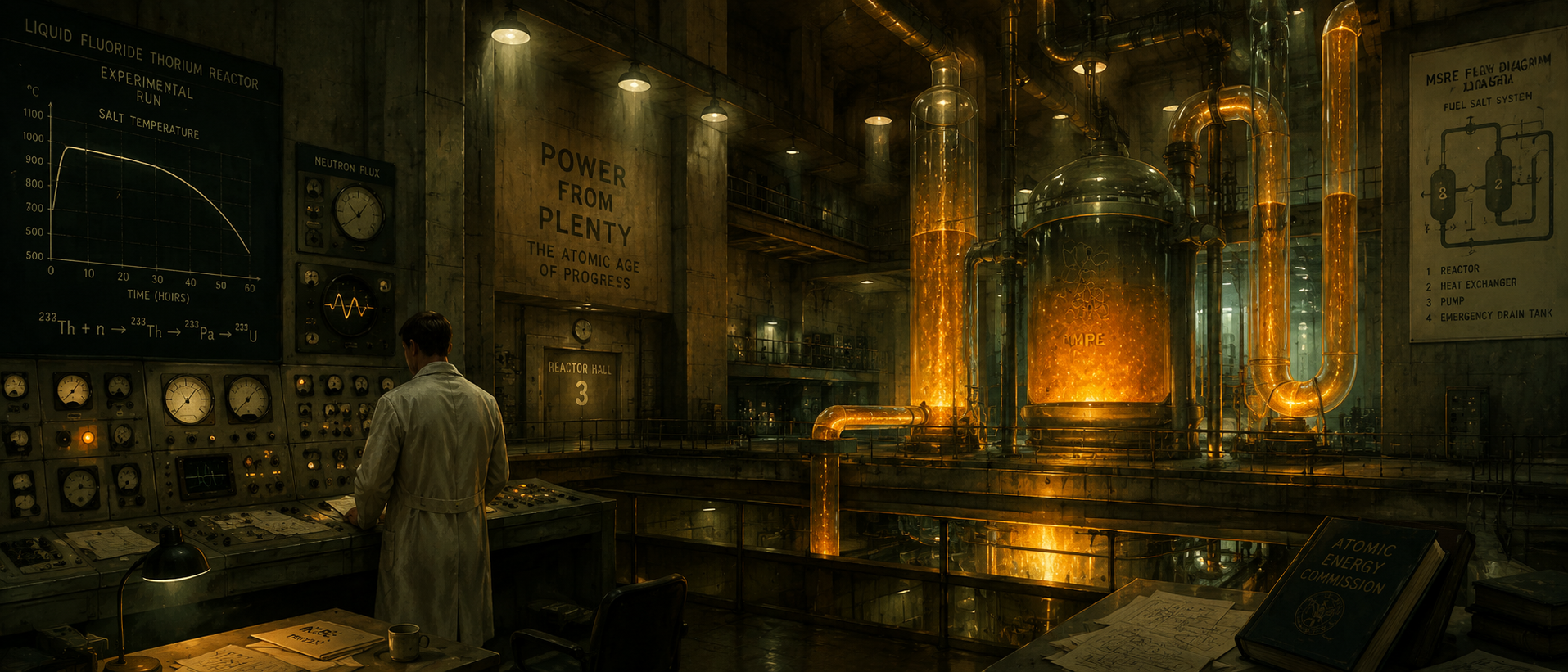
The thorium reactor history begins not with a failure, but with a success — and that’s what makes it so maddening. In the 1960s, a team of American scientists at Oak Ridge National Laboratory in Tennessee built and operated a reactor that ran on liquid fluoride and thorium fuel, produced no weapons-grade plutonium, generated far less long-lived radioactive waste than conventional uranium reactors, and could not physically melt down in the way that produced the disasters at Chernobyl and Fukushima. It worked. It ran for four years. And then, in 1969, the programme was shut down.
Not because it failed. Because it wasn’t useful enough for building nuclear bombs.
That single fact — cold, institutional, and thoroughly unsentimental — sits at the centre of one of the strangest stories in the history of energy technology. The thorium reactor is the road not taken of the nuclear age. And understanding why it was abandoned tells you something important not just about energy policy, but about how civilisations make choices that echo for generations.
Thorium Reactor History: What Made the Molten Salt Reactor Different
To appreciate what was lost, you need to understand what thorium reactors actually do — and how differently they work from the uranium-based light water reactors that dominate global nuclear power today.
Conventional nuclear reactors use enriched uranium-235 as fuel, suspended in solid fuel rods, cooled by pressurised water. The system works, but it carries inherent risks. The water coolant must be kept under enormous pressure — around 150 times atmospheric pressure in a typical pressurised water reactor. If that pressure is lost, or if the cooling system fails, the reactor can overheat catastrophically. The fuel rods can melt. Radioactive material can escape. This is, in simplified form, the failure mode that drove the disasters at Three Mile Island, Chernobyl, and Fukushima.
The thorium reactor at Oak Ridge — formally called the Molten Salt Reactor Experiment, or MSRE — worked on an entirely different principle. The fuel was dissolved directly into a liquid fluoride salt mixture that flowed through the reactor at atmospheric pressure. No pressure vessels. No fuel rods. No coolant that needed to be kept in an unnatural state. If the reactor overheated, the liquid fuel expanded, the nuclear reaction slowed, and the system self-corrected. If power was cut entirely, a frozen salt plug at the bottom of the reactor would melt, and the fuel would drain by gravity into a subcritical holding tank. The reactor would simply stop. No operator intervention required. No Chernobyl scenario possible.
The thorium fuel cycle also produces dramatically less long-lived radioactive waste than uranium. A conventional reactor generates transuranic elements — plutonium, americium, neptunium — that remain dangerously radioactive for tens of thousands of years. The thorium cycle produces far smaller quantities of these elements. Its waste products decay to safe levels within roughly 300 years rather than 100,000. That is not a minor engineering footnote. It is the difference between a problem solvable within human civilisational timescales and one that requires geological ones.
The Man Who Built It — and Why Nobody Listened
The architect of the Oak Ridge molten salt programme was Alvin Weinberg, a physicist who had been involved in the Manhattan Project and went on to direct Oak Ridge for nearly two decades. Weinberg was a genuine believer in nuclear power as a civilisational technology — not just a military one — and he spent years arguing that the molten salt thorium path was safer, cleaner, and more sustainable than the uranium light water approach the United States was standardising around.
He was overruled, consistently and decisively, by a combination of military priorities and institutional momentum.
The core problem was plutonium. The Cold War nuclear weapons programme ran on it. Conventional uranium reactors, as a byproduct of normal operation, produce weapons-grade plutonium that could be extracted and used in warheads. The thorium reactor history is, in a crucial sense, the history of a technology that was the wrong shape for the moment — it produced energy efficiently and safely but it didn’t produce the material that the United States military needed in the 1950s and 60s.
The uranium light water reactor, by contrast, served a dual purpose: civilian power and military material production. That dual utility made it the default choice, and once it became the default, the entire industrial infrastructure of nuclear power — the engineering training, the regulatory frameworks, the supply chains, the manufacturing base — oriented itself around uranium. Thorium was not defeated in a technical competition. It was bypassed in a political and military one. Much like the fusion plasma milestone that recently pushed humanity closer to a genuine artificial sun, the thorium programme proved the physics worked long before the politics and economics caught up.
When Weinberg continued to advocate publicly for thorium and for greater scrutiny of nuclear safety, he was fired from Oak Ridge in 1973. He had been director for 18 years. His successor presided over the programme’s wind-down. The molten salt reactor was dismantled. The thorium reactor history entered a four-decade dormancy from which it is only now, haltingly, beginning to emerge.
Why Thorium Reactor History Is Being Revisited Now
The case for thorium did not change. The world’s circumstances did.
Thorium is approximately three to four times more abundant in the Earth’s crust than uranium. India, which has some of the world’s largest thorium deposits, has maintained a three-stage nuclear programme explicitly designed to eventually transition to thorium fuel cycles — a programme that has been running, slowly and frustratingly, since the 1950s. China launched a serious molten salt reactor research programme in 2011, aiming to develop a commercial thorium reactor by the 2030s. Several Western startups have emerged in the last decade specifically to revive the molten salt approach.
The renewed interest reflects both the changing energy landscape and the accumulated weight of what conventional nuclear has cost. Chernobyl. Fukushima. The unresolved question of long-term waste storage that every uranium-based nuclear nation has been quietly deferring for decades. When you look at those costs and then look back at thorium reactor history — at a technology that demonstrably addressed most of them, running successfully in Tennessee before the Apollo programme put men on the Moon — the abandonment starts to feel less like a rational decision and more like a civilisational error.
The physics have never been in doubt. Quantum computing crossing the 1,000-qubit threshold showed how fast suppressed technologies can accelerate once institutional will catches up with scientific readiness. The same logic applies here. The molten salt reactor concept is not speculative. The engineering challenges that remain are real but finite — materials science issues around fluoride salt corrosion, tritium containment, and fuel processing chemistry. These are solvable problems. They are not fundamental physical barriers.
The Thorium Reactor History the World Chose Instead
It is worth sitting with what the alternative actually produced. The light water uranium reactor became the global standard. It provided roughly 10% of world electricity for several decades. It also produced the materials for tens of thousands of nuclear warheads. It generated waste that will require active management for longer than human civilisation has existed. It suffered catastrophic failures that contaminated large regions of Europe and the Pacific for generations.
None of this is to say that conventional nuclear power was simply a mistake. It displaced enormous quantities of fossil fuel combustion. It contributed meaningfully to the energy infrastructure of the industrialised world. The Great Oxidation Event reminds us that even catastrophic-seeming shifts in energy chemistry can ultimately be preconditions for new forms of life — the same logic, in a different register, might apply to the nuclear age and what comes after it.
But the thorium reactor history is a case study in how civilisational path dependencies form and calcify. A technology gets chosen not because it is best, but because it serves the most immediate and powerful interests of the moment. That choice generates infrastructure, expertise, regulation, and economic investment. Each of those layers makes the alternative harder to revisit. And by the time the military urgency has faded and the civilian costs are fully apparent, the alternative has been forgotten by everyone except a handful of physicists who remember what Alvin Weinberg built in Tennessee in 1965.
What Comes Next for Thorium
The story is not over. China’s thorium molten salt reactor programme has reported early operational results from a test reactor in the Gobi Desert. Several countries are revisiting their nuclear strategies in the context of climate commitments that make carbon-free baseload power essential. The CRISPR gene editing revolution showed how a suppressed biological tool could re-emerge decades later and transform an entire field when the conditions finally aligned — thorium advocates hold a similar hope for molten salt technology.
Whether that hope is justified depends on factors that go well beyond physics: regulatory frameworks designed around uranium, public perception of nuclear power shaped by uranium disasters, and the now-enormous installed base of conventional reactors whose operators have little incentive to advocate for their own replacement.
Alvin Weinberg spent the rest of his career after Oak Ridge writing and speaking about what he called the Faustian bargain of conventional nuclear power — the trade of enormous energy for enormous risk and waste. He died in 2006, having watched the world choose the bargain every time it had a chance to choose something else.
The thorium reactor history is still being written. Whether it ends as a cautionary tale about missed opportunities or as a delayed vindication depends on decisions being made right now — in China, in India, in the offices of energy ministries that are finally, slowly, starting to ask why the road not taken looked so much cleaner than the one they chose.