
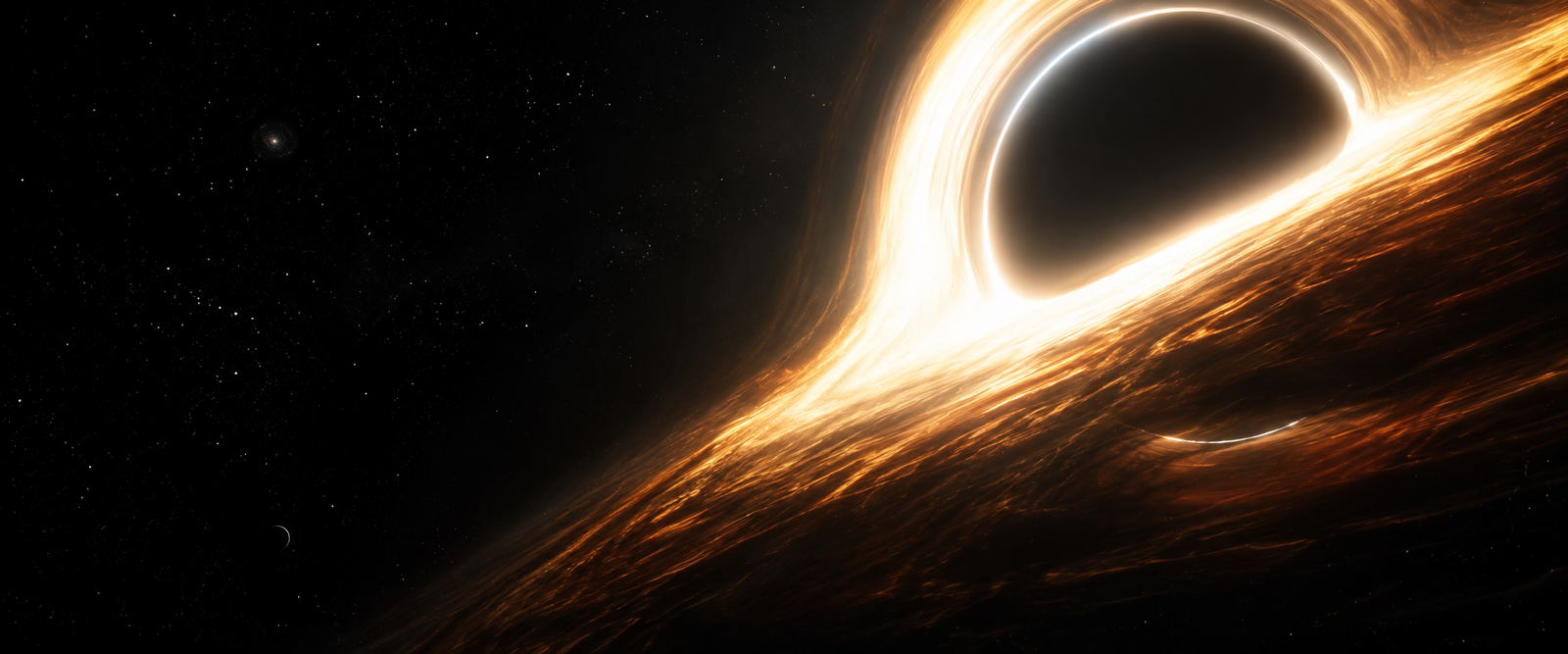
Supermassive black holes are supposed to sit still. For decades, astronomers assumed these giants — millions or billions of times the Sun’s mass — anchor the centres of galaxies and stay put. Then, in the summer of 2026, a University of Maryland team announced something that broke the rule: a wandering supermassive black hole drifting roughly 30,000 light-years from the heart of its galaxy, with no galaxy of its own around it. Like a hidden giant lurking at the edge of a system, it had stayed invisible — until it betrayed itself in the most violent way imaginable.
A Black Hole Where None Should Be
The object sits in the outskirts of a massive host galaxy about 750 million light-years away in the constellation Cetus. What makes it extraordinary is simply its address. Astronomers had never before caught a dormant, sleeping black hole this far from a galactic center — tens of thousands of light-years out, where you’d expect only scattered stars, not a giant of this scale.
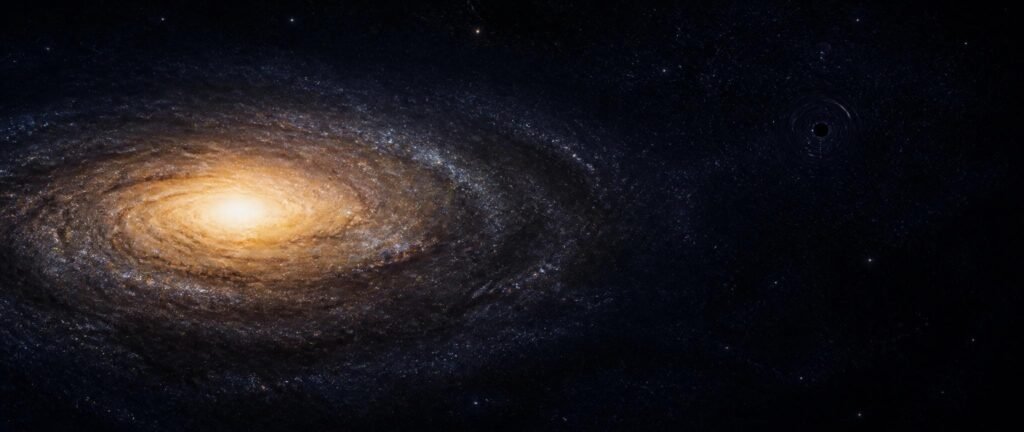
Normally a black hole this quiet is impossible to see; it emits nothing at all. This one gave itself away only because a passing star strayed too close, briefly exposing an unseen gravitational giant that would otherwise have stayed completely dark.
How Do You See an Invisible Wandering Supermassive Black Hole?
You wait for it to eat. When a star drifts near a black hole, gravity yanks far harder on the star’s near side than its far side, stretching it into a long ribbon of gas — an event astronomers call a tidal disruption event. That gas spirals inward and blazes brilliantly for weeks. It is, in effect, a star being shredded by a black hole and lighting a beacon on the way down.
That beacon is how this one was caught. An AI-powered sky survey at Palomar first flagged the flare in November 2025, and NASA’s Swift observatory and a network of telescopes confirmed it. The flash pinpointed the black hole exactly where no such object was thought to live — far out in the galactic suburbs, behaving less like a fixed anchor and more like an interstellar wanderer.
How Did It Get There?
So how does a giant end up adrift? The team offers two suspects, both rooted in the violent history of galaxy mergers. In the first, a large galaxy swallowed a smaller one and slowly stripped away nearly all its stars, leaving only the dense core and its black hole — a naked remnant orbiting far from any centre. That alone upends a long-held assumption that every massive galaxy keeps its black hole tidily at its core, exactly where the Milky Way keeps ours. In the second, three black holes met: a pair already circling each other at a galaxy’s heart encountered a third from an earlier merger, and the chaotic gravitational dance flung the lightest one outward like a slingshot.
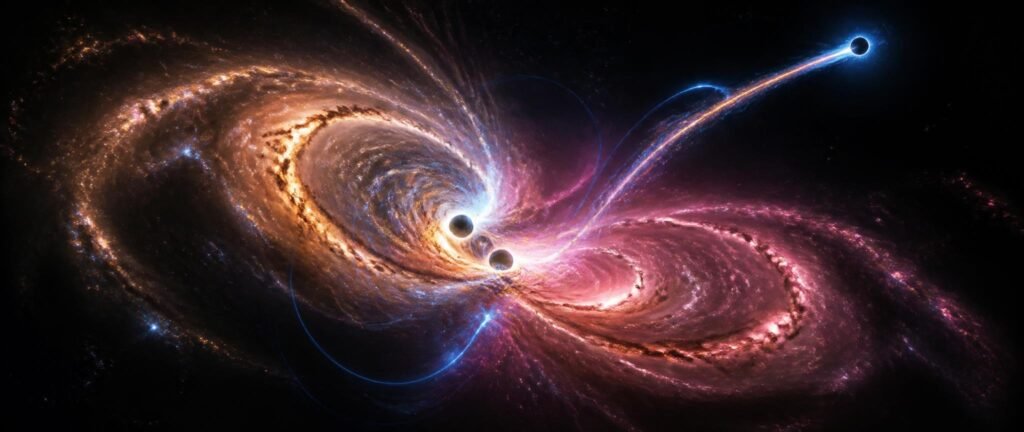
Either way, a wandering supermassive black hole is a fossil of cosmic collision — evidence that galaxies, and the monsters at their cores, grow by repeatedly crashing together. The one we’ve now spotted may have been thrown clear long ago, coasting silently through the dark ever since, a runaway from a crash that happened before there were humans to see it.
Why This Discovery Matters
The real prize isn’t this single object; it’s the method. Because dormant black holes stay invisible until they feed, we’ve almost certainly been missing countless wanderers threading through the cosmos. Now that we know how to catch them — by watching for the telltale flash of a dying star — the obvious question becomes how common these wandering supermassive black holes really are. The researchers suspect many more are out there, hiding in plain darkness, and that finding them will slowly rewrite where we expect these giants to live. Each one we find is a clue to how galaxies assembled themselves, one merger at a time, across billions of years.