
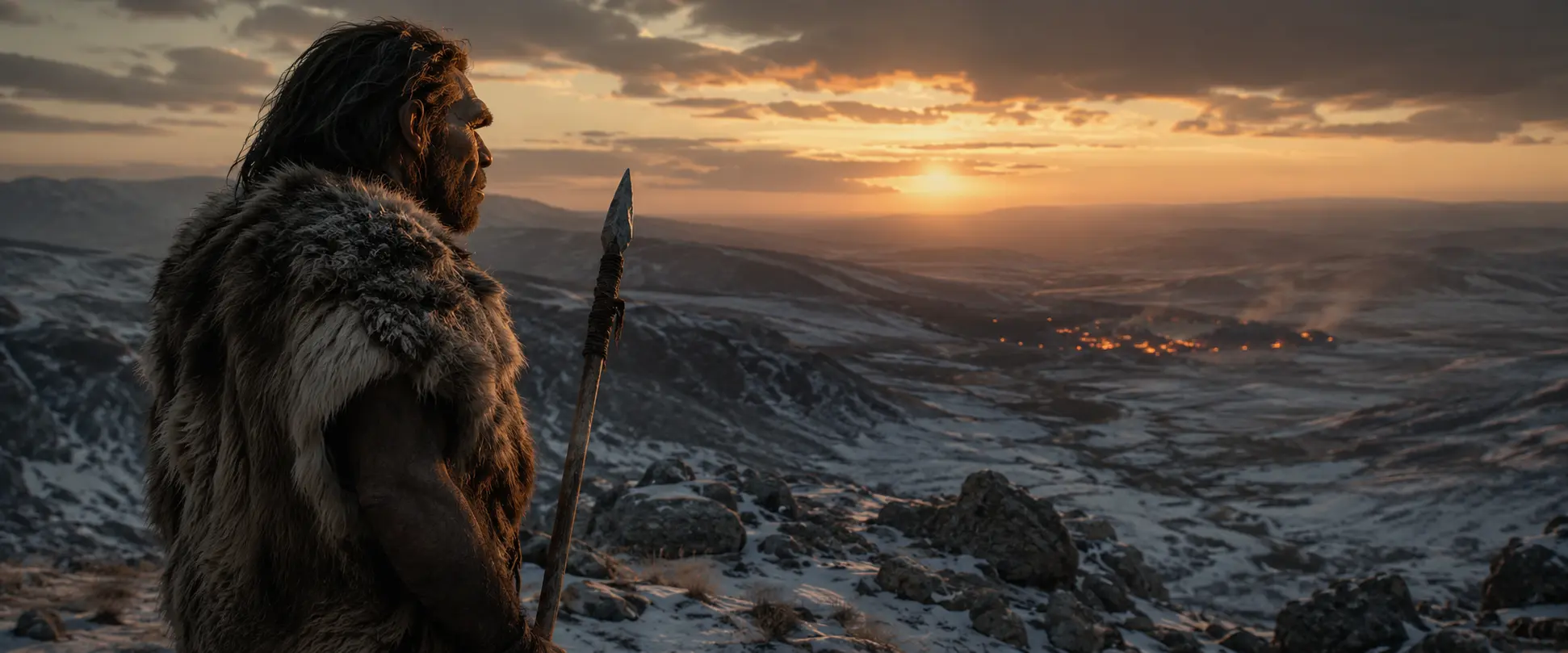
For nearly 400,000 years, they were us — or near enough. Neanderthals lit fires, buried their dead, crafted tools, and out-muscled the harshest winters of Ice Age Europe. Then, around 40,000 years ago, they vanished, leaving only faint traces in our DNA. The question of why Neanderthals went extinct has haunted science for over a century, and in 2026 a striking new study offered an answer almost no one expected: it may have come down to who they knew.
By the end of this article, you’ll learn why the usual suspects — cold and competition — don’t fully explain their disappearance, what a technique borrowed from digital ecology revealed, and why the real culprit might be the most human thing of all: the strength of a social network. It’s a story that echoes other moments when a sudden climate shock reshaped the fate of an entire people.
It Wasn’t Just the Cold
The easy explanation has always been climate change. Europe during this era was brutal and unstable — but here’s the catch: Neanderthals had already survived earlier ice ages. They were superbly adapted to cold, having endured glacial cycles for hundreds of thousands of years, much the way other species were forced through an ancient survival bottleneck and lived. If the cold alone could kill them, it would have done so long before.
The new research, led by Ariane Burke at the Université de Montréal, found that what mattered wasn’t absolute temperature but climate variability — how rapidly and unpredictably conditions swung from one extreme to another. And crucially, competition with incoming Homo sapiens couldn’t explain the disappearance either. Something subtler set the two groups apart.
The Real Answer: Why Neanderthals Went Extinct
That something was connection. Adapting spatial models normally used to track animal and plant populations, Burke’s team simulated how each group was linked across the landscape. The result was stark: the regions favourable to Homo sapiens were far more highly connected than those of the Neanderthals. Our ancestors built sprawling, flexible social networks that reached across vast distances, trading tools, genes, and information — the sort of deep mixing that ancient DNA reveals in our bones today.
Neanderthals had networks too — archaeology shows objects moving between regions — but theirs were more fragile and regionally limited, especially in Central and Eastern Europe. When the climate lurched, well-connected groups could share resources, absorb shocks, and repopulate empty land, a little like the way behaviour spreads through a crowd that is densely linked. Isolated groups simply winked out, one by one. In short, the answer to why Neanderthals went extinct may be less about brains or brawn than about bandwidth — the reach and resilience of their relationships.
A Tale of Two Networks
The picture wasn’t uniform across the continent. On the Iberian Peninsula in the west, Neanderthal groups stayed relatively well linked. But across Central and Eastern Europe, their connections grew thin, leaving populations stranded as conditions deteriorated. Cut off from their neighbours, these communities had no lifeline when a bad decade struck — no distant allies to marry into, trade with, or learn from. A single harsh stretch could wipe out such a band entirely, and with no neighbours left to refill the empty land or carry word of better ground, that whole corner of the continent could simply fall silent for good.
Modern humans, by contrast, seem to have carried connectivity like a kind of survival technology — perhaps as fundamental to our success as intelligence itself. It’s a humbling thought that our species’ true edge may never have been raw cleverness at all, but the sheer stubbornness with which we stayed in touch.
The Most Human Lesson of All
Burke is careful to stress what this does not mean. Neanderthals weren’t stupid, and they weren’t incapable of bonding. Their networks were simply more brittle, more easily severed when the world turned harsh — and once broken, far harder to rebuild than to lose. The lasting lesson of why Neanderthals went extinct is oddly comforting and a little unnerving at once — that survival, then and now, depends less on how clever we are alone than on how well we stay connected. Forty thousand years later, in a world of borders and glowing screens, that may be the oldest wisdom we have.