
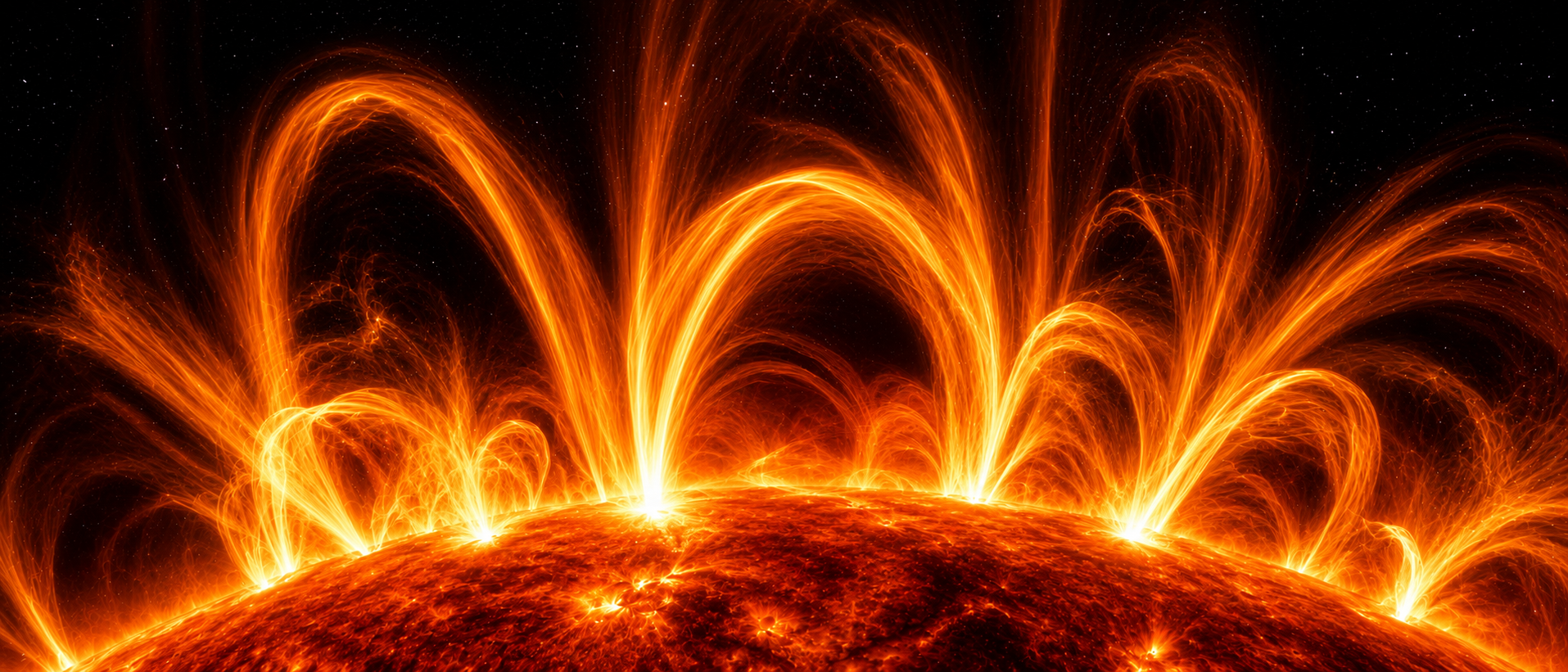
Why the sun’s corona is hotter than its surface is one of the most embarrassing unsolved problems in astrophysics — and it’s been sitting there, unanswered, for over 80 years.
Here’s the paradox. The Sun’s visible surface, the photosphere, sits at around 5,500°C. Move outward into its outer atmosphere — the corona — and instead of cooling down, the temperature explodes to 1–3 million degrees Celsius. In some regions, 10 million. That’s nearly 2,000 times hotter than the surface directly below it.
This breaks thermodynamics. Heat flows from hot to cold — not the other way around. Every equation, every experiment, every campfire in human history confirms this. And yet the Sun’s atmosphere disagrees, burning millions of degrees hotter than the surface it floats above, as if physics simply doesn’t apply here.
Why the Sun’s Corona Is Hotter: The Two Leading Theories
Scientists aren’t completely without answers. Two main theories dominate the debate — and both are probably partly right.
Wave heating proposes that Alfvén waves — magnetohydrodynamic waves generated by the Sun’s violently churning surface — travel up along magnetic field lines into the corona. When these waves break and dissipate, they release their energy as heat. Think of it like ocean waves crashing into a shoreline: the wave itself isn’t hot, but the energy goes somewhere. Alfvén waves have been directly detected in the corona. Whether they carry enough energy to explain the full temperature gap remains contested.
Nanoflare heating, proposed by physicist Eugene Parker in the 1980s, offers a different picture. The Sun’s magnetic field is extraordinarily complex — field lines constantly emerging, twisting, and colliding. When opposing field lines snap together and reconnect, they release a burst of energy. Parker suggested billions of these tiny explosive events, firing constantly across the entire solar surface, collectively maintain the corona’s impossible heat. The problem: individual nanoflares are too small and fast for current instruments to see directly. We observe the cumulative effect, not the cause — like hearing a roar without identifying a single voice.
Why the Sun’s Corona Is Hotter: What the Parker Solar Probe Found
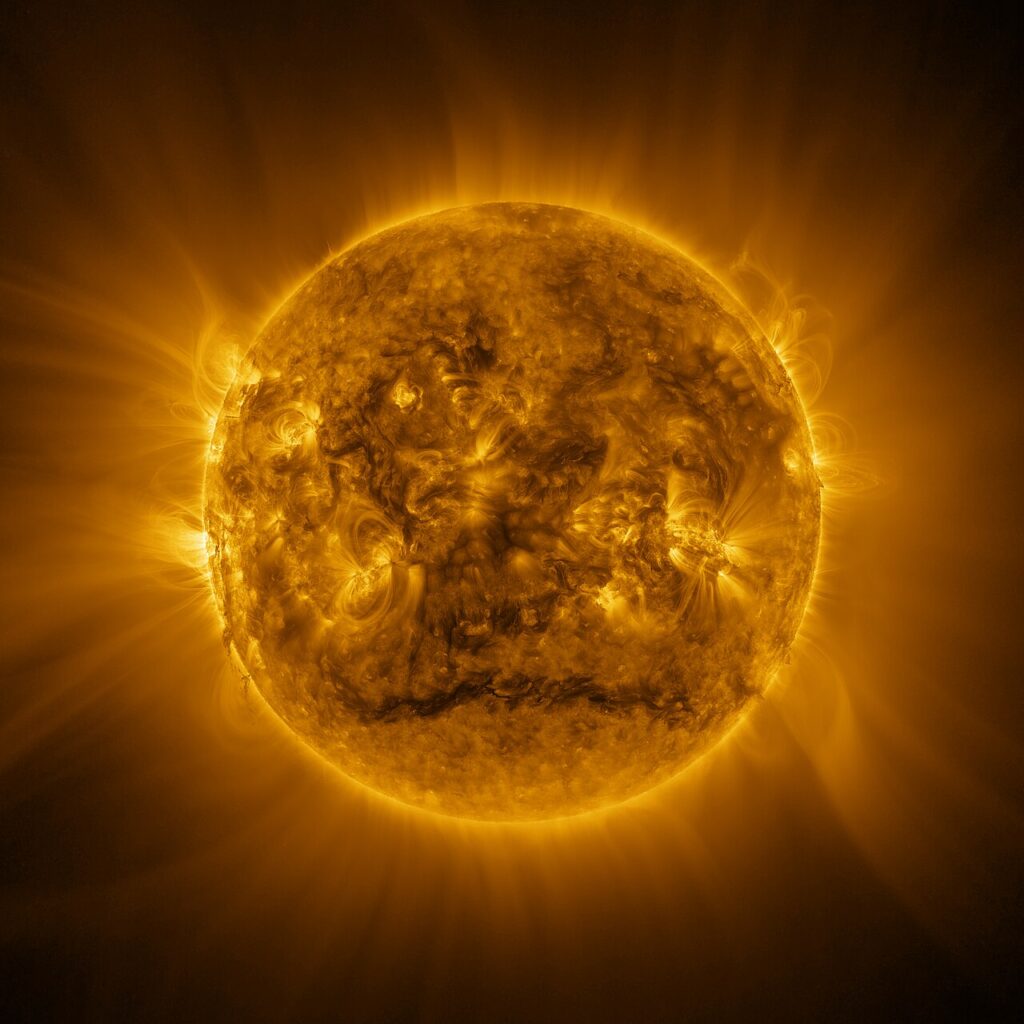
The best attempt to crack this mystery is NASA’s Parker Solar Probe, launched in 2018. In 2021, it became the first spacecraft ever to fly through the corona itself, passing within 6.9 million kilometres of the solar surface at nearly 700,000 km/h.
Early data revealed sudden magnetic field reversals — brief, intense events called “switchbacks” — that release energy bursts into surrounding plasma. Whether switchbacks are the smoking gun behind coronal heating is still being analysed. But they represent exactly the kind of detail that was invisible from a distance, much like what the James Webb telescope revealed about the early universe simply by getting closer to the question.
Why It Actually Matters
This isn’t purely academic. The corona drives the solar wind — a constant stream of charged particles pouring outward through the solar system at 400–800 km/s. That wind reaches Earth, interacts with our magnetic field, and during intense events, threatens satellites, GPS systems, and power grids. The 1989 geomagnetic storm knocked out power across Quebec for nine hours. A repeat of the 1859 Carrington Event today could cause trillions in infrastructure damage.
Understanding why the sun’s corona is hotter than its surface means understanding how it generates the solar wind, what triggers coronal mass ejections, and how to predict space weather with enough accuracy to protect critical systems. The same plasma physics also connects directly to fusion plasma research on Earth — the Sun heats and confines plasma through mechanisms we’re still reverse-engineering.
The Sun’s Best-Kept Secret
The leading consensus among solar physicists is that both wave heating and nanoflare heating contribute — in different proportions, in different regions. The Parker Solar Probe and ESA’s Solar Orbiter are gathering data that may resolve the question within this decade.
But for now, the Sun keeps its secret. The star that has sustained every living thing on this planet for four billion years is doing something the physics of our universe can’t fully explain. Its atmosphere burns hotter than its own skin. And the closest we’ve ever gotten to an answer is a spacecraft the size of a car, diving into a star at 700,000 kilometres per hour, hoping the data it sends back will finally tell us why.