
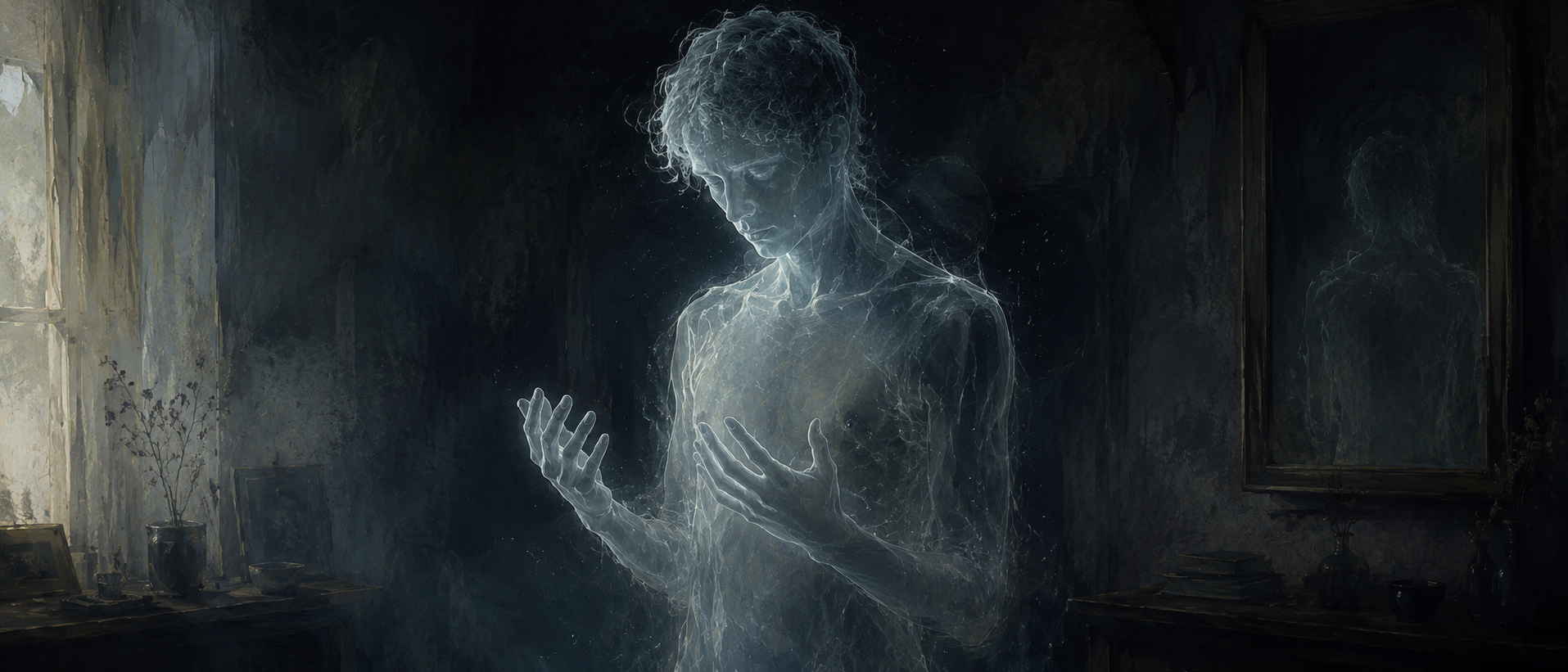
Cotard’s Syndrome is one of the strangest things the human brain can do to a person. Not strange in a quirky, interesting-fact way — strange in the way that makes you genuinely reconsider what it means to have a self at all. People with this condition believe, with complete sincerity, that they are dead. That their organs have rotted away. That they don’t exist. And no amount of rational argument, no mirror, no heartbeat felt beneath the ribs, can convince them otherwise.
It sounds like something from a horror story. It is, in fact, a neurological and psychiatric reality — and what it reveals about how the brain constructs the experience of being alive is more unsettling than the condition itself.
What Cotard’s Syndrome Actually Is
Cotard’s Syndrome — also called Cotard’s delusion or the walking corpse syndrome — was first described in 1880 by French neurologist Jules Cotard. He presented the case of a patient he called Mademoiselle X, who denied the existence of certain parts of her body and believed she had no need to eat because she was, in her own assessment, already dead. She eventually died of starvation.
The condition is characterised by nihilistic delusions of varying severity. At the milder end, patients believe that parts of their body are missing, decomposing, or non-functional. At the most severe extreme — which Cotard called le délire de négation, the delusion of negation — patients deny their own existence entirely. They believe they are dead, that the world around them is not real, that they are nothing.
What makes Cotard’s Syndrome clinically unusual is the quality of the belief. This is not metaphor. Patients are not expressing a figure of speech, a depressive sentiment, or a philosophical position. They hold the belief with the same certainty that you hold the belief that you are currently reading this sentence. The conviction is absolute. And it is devastatingly resistant to correction.
The Brain Failure Behind the Walking Corpse Delusion
To understand Cotard’s Syndrome, you need to understand something about how the brain normally generates the feeling of being alive.
Every moment of your waking life, your brain is doing something extraordinary: it is integrating sensory signals — from your skin, your internal organs, your visual field, your proprioceptive system — and stitching them together into a seamless, continuous experience of being a self. You don’t have to think about this. It happens automatically, beneath awareness, thousands of times per second. The result is what philosophers call the phenomenal self — the lived, felt, first-person experience of existence.
The brain processes far more than we consciously register — and most of that processing goes into building and maintaining the model of the self that feels so self-evidently real.
In Cotard’s Syndrome, this system breaks down in a very specific way. Neuroimaging studies of patients with the condition have found dramatically reduced metabolic activity across large regions of the brain — particularly in the frontal and parietal lobes. In some scans, the activity patterns resemble those of people under general anaesthesia, or in certain states of deep unconsciousness. The brain is running, but the circuitry responsible for generating the subjective sense of aliveness is, in some meaningful way, offline.
The leading neurological hypothesis involves a disconnect between the brain’s emotional processing regions — particularly the amygdala — and the areas responsible for recognising familiar things, including the self. Normally, when you look at your own hand or face, recognition is accompanied by a felt sense of ownership, of familiarity, of this is mine, this is me. In Cotard’s patients, that emotional signal appears to be absent. Recognition happens without the accompanying feeling of aliveness. The brain’s conclusion, generated from that gap, is not “something is wrong with my emotions” — it is “I must be dead.”
It is a logical inference made from catastrophically wrong data. And the brain’s tendency to construct explanations for what it perceives — even when those perceptions are badly distorted — is one of its most fundamental and, in this case, most devastating features.
Cotard’s Syndrome and the Problem of Consciousness
There is something philosophically vertiginous about Cotard’s Syndrome that goes beyond clinical curiosity. It raises a question that most of us never have reason to confront: how do you know you’re alive?
The obvious answer is: you just feel it. The sense of being present, awake, and experiencing is so immediate and undeniable that the question barely makes sense. But Cotard’s Syndrome reveals that this feeling — the bedrock certainty of your own existence — is not a given. It is a product. It is constructed by neural machinery that can malfunction. And when it malfunctions in the right way, a person can be fully conscious, fully articulate, fully capable of holding a conversation, and yet genuinely, unshakeably convinced that they are not alive.
How consciousness emerges in altered states — and what perception reveals about the self — becomes a very different question when you consider that the most fundamental perception of all, the sense of one’s own existence, is itself susceptible to corruption.
This is also why Cotard’s Syndrome resists treatment through argument. You cannot reason someone out of a position that did not arise through reason. The belief isn’t a conclusion the patient reached by thinking — it’s a raw perceptual output from a misfiring brain. Telling a patient with Cotard’s delusion that they are alive is, from their subjective perspective, like telling someone who has been shown red that they’re actually seeing blue. The evidence of their own experience says otherwise.
Who Gets Cotard’s Syndrome — and What Triggers It
Cotard’s Syndrome is rare — fewer than 200 cases are documented in the clinical literature, though the true number is likely higher due to misdiagnosis. It appears most commonly in association with severe depression, schizophrenia, and bipolar disorder, but it has also been documented following traumatic brain injury, typhoid fever, multiple sclerosis, and — in several striking cases — as a side effect of the antiviral drug aciclovir in patients with renal failure.
The aciclovir cases are particularly illuminating. They demonstrate that Cotard’s Syndrome can be triggered by a purely pharmacological disruption to brain chemistry, with no underlying psychiatric history. When the drug was stopped and the patient’s kidney function stabilised, the delusion resolved. The walking corpse syndrome, in those cases, was essentially a toxic side effect — a chemical accident that temporarily switched off the circuitry responsible for feeling alive.
This has unsettling implications. It suggests that the sense of being alive is not deeply embedded, not protected by redundant systems, not as secure as it feels. It is, like so much of what the brain produces, a fragile construct — and the brain’s grip on its own perceptions is far more tenuous than the experience of certainty implies.
The Overlap with Depersonalisation and Dissociation
Cotard’s Syndrome sits at the extreme end of a spectrum of dissociative and depersonalisation disorders. Many more people have experienced milder versions of the same underlying disconnection: the strange, unsettling sense that you are watching yourself from the outside, that the world around you is slightly unreal, that you are not quite inhabiting your own body.
Depersonalisation disorder — the clinical condition characterised by persistent feelings of unreality and detachment from the self — shares neurological features with Cotard’s. In both conditions, researchers have found reduced activity in the emotional processing regions of the brain that normally give sensory experience its felt, personal quality. The difference between depersonalisation and Cotard’s is largely a matter of degree: in depersonalisation, the feeling is this doesn’t feel quite real; in Cotard’s, it becomes I am dead.
The psychology behind intrusive, unwanted thoughts — including the brain’s tendency to generate disturbing content without the person’s conscious intent — offers a partial parallel: in both cases, the brain produces outputs that feel alien, unbidden, and deeply at odds with what the person consciously believes or wants to experience.
Cotard’s Syndrome: Treatment and Outcomes
Treatment for Cotard’s Syndrome depends on the underlying cause. Where it presents as part of severe depression or a psychotic episode, a combination of antidepressants, antipsychotic medication, and mood stabilisers has shown efficacy. In several documented cases, electroconvulsive therapy (ECT) produced rapid and dramatic improvement when medication had failed — sometimes resolving the delusion within days.
The mechanism isn’t fully understood, but the current thinking is that ECT produces a kind of neurological reset — restoring activity to the underactive metabolic regions identified in brain scans, and re-establishing the emotional-recognition circuitry that generates the felt sense of aliveness.
Recovery is possible. Many patients who have experienced Cotard’s syndrome and recovered describe the experience with a particular kind of stunned retrospective disbelief — not unlike the way memory distorts and reconstructs past experience to fit the narrative of the present self. They know it happened. They know, intellectually, what they believed. But the subjective experience of having been dead, from the inside, is something they struggle to fully communicate — because the brain that believed it and the brain that now knows better are, in some meaningful sense, not quite the same organ.
What the Walking Corpse Syndrome Tells Us About Being Alive
Cotard’s Syndrome is rare enough that most people will never encounter it clinically. But it matters beyond its rarity. It is one of the clearest demonstrations available that the most fundamental fact of human experience — the fact of being here, of being alive, of being you — is not a brute given. It is a production. A neural performance, generated moment to moment, dependent on machinery that can fail.
The walking corpse syndrome does not reveal that we might all be secretly dead. It reveals something stranger: that what it feels like to be alive is assembled by a brain that is always, on some level, making its best guess. Most of the time, the guess is right. Most of the time, the circuitry holds. Most of the time, you wake up and the self is there — familiar, intact, undeniable.
But Cotard’s Syndrome is a reminder that most of the time is not always. And that the certainty of your own existence, however absolute it feels, is one more thing the brain is quietly building for you — whether you asked it to or not.