
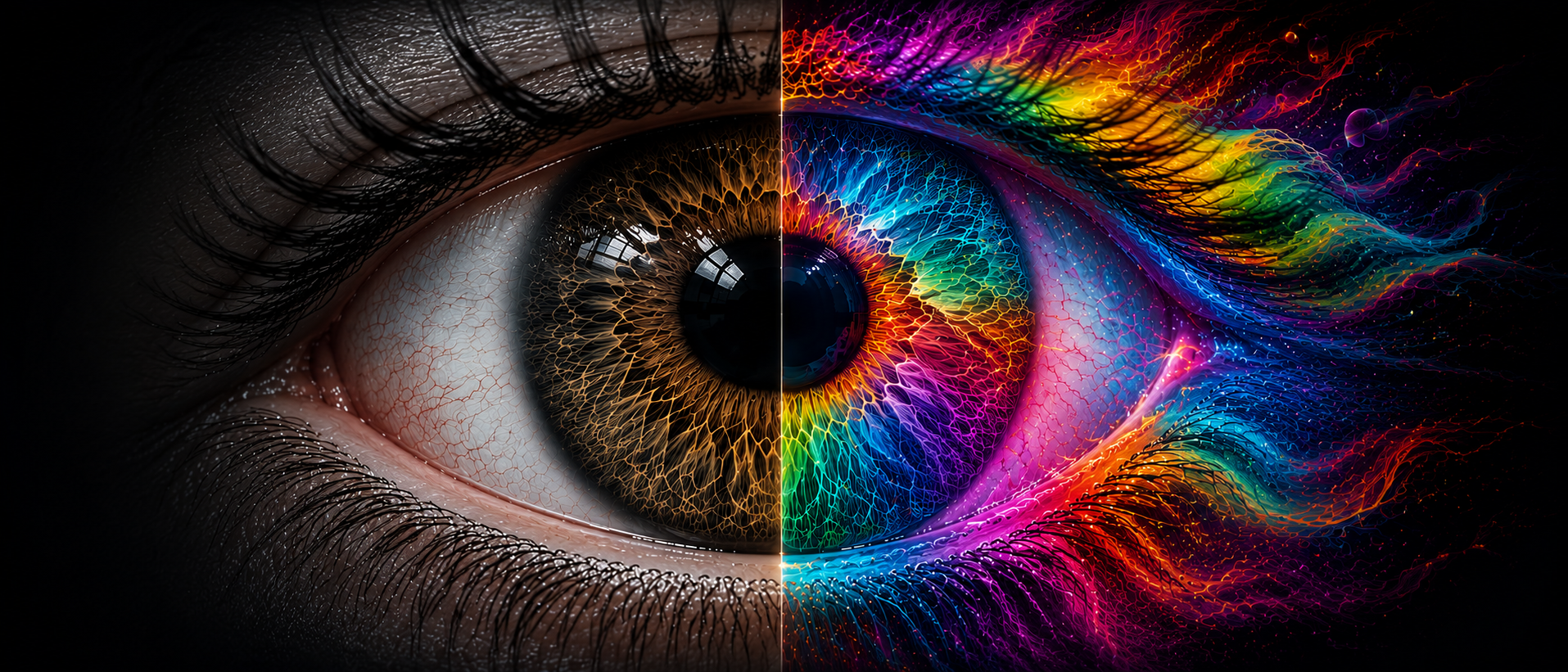
Most people assume everyone sees the world the same way. Same sky, same grass, same autumn leaves catching the afternoon light. But for a small number of people — almost exclusively women — the world is something categorically different. Not just richer in shade or contrast, but populated with colours that the rest of us have no name for, no reference point, no way to even imagine. This isn’t a superpower from a comic book. It’s tetrachromacy explained in full biological detail, and it’s stranger and more humbling than most people realise.
What Tetrachromacy Explained Actually Means
To understand what tetrachromacy is, you first need to understand what the rest of us are working with.
Human colour vision is built on photoreceptor cells called cones, concentrated in the central part of the retina. Most people have three types of cones, each tuned to absorb light at different wavelengths — roughly corresponding to red, green, and blue. Your brain combines the signals from these three cone types and constructs the full range of colours you experience. This is trichromacy, and it gives typical humans the ability to distinguish around one million distinct colours.
Tetrachromats have a fourth cone type. It sits in a wavelength gap between the red and green receptors — the orange-yellow region of the visible spectrum — and it allows the brain to make far finer distinctions in that zone of light. The theoretical result? The ability to perceive up to 99 million colours that trichromats simply cannot differentiate.
The word tetra comes from Greek, meaning four. Four cones, four dimensions of colour processing, four axes along which the brain can split and sort light. It’s not that tetrachromats see ultraviolet or infrared — their visible spectrum is the same as everyone else’s. The difference is resolution, not range. Where you see one colour, a tetrachromat may see dozens of subtle variations that look, to her, as obviously distinct as red and green look to you.
The Science of the Extra Cone
The story of how scientists actually confirmed tetrachromacy in humans took decades and a certain amount of stubbornness.
The genetic groundwork was laid in the 1940s when Dutch scientist H.L. de Vries first hypothesised that carriers of colour-blindness genes — women who carry one mutated copy of an opsin gene on one X chromosome — might actually end up with an extra cone type rather than a deficit. Colour blindness in its most common form is caused by an anomaly in one of the opsin genes, which encode the light-sensitive proteins in cone cells. Women, who have two X chromosomes, can carry the anomaly on one chromosome while having the normal version on the other. In theory, that genetic combination could produce four slightly different opsin proteins and four functional cone types.
The problem was proving it behaviourally. Having four cone types in the retina doesn’t automatically mean you use them to see more. The brain has to learn to process and integrate that fourth channel — and for many tetrachromats, it apparently never fully does.
Neuroscientist Gabriele Jordan at Newcastle University spent nearly twenty years trying to identify a true functional tetrachromat. She developed tests using coloured light rather than pigments (critical because printed colours are produced by mixing limited pigments, which doesn’t give a tetrachromat’s extra cone anything genuinely new to respond to). In 2007, she found one. A woman — known only by her initials — passed tests that should have been impossible for a trichromat, consistently distinguishing between colours that appeared identical under standard colour vision testing. Jordan estimates the condition may be present in some form in up to 12% of women, though far fewer are thought to be functional tetrachromats who actually process and perceive the fourth dimension of colour.
Tetrachromacy Explained Through What It Actually Looks Like
Here’s the hardest part to grasp: we can’t describe what a tetrachromat sees, because we lack the perceptual vocabulary.
Think about how you’d explain red to someone born blind. Not what wavelength causes it, not what objects we associate it with — but what red actually looks, experientially, from the inside. You can’t. The experience itself is the knowledge.
A tetrachromat looking at something as ordinary as a patterned tablecloth, or autumn leaves spread across a garden path, or even human skin in different lighting conditions — she may be seeing distinctions that have no name in any language, experiencing colours that have never been codified because most of the people who use language can’t perceive them. Some functional tetrachromats report that walking into paint stores is genuinely disorienting, because they see variation in supposedly identical swatches that store staff assure them are exactly the same.
For most of her life, the woman found by Gabriele Jordan had no idea what she was experiencing was unusual. It’s not like a superpower that announces itself. It’s more like the strange things your brain does without your knowledge — a fundamental process operating quietly beneath conscious awareness, reshaping experience without announcing itself.
Why It’s Almost Always Women
The genetics here are elegant and a little counterintuitive.
Colour vision gene anomalies are X-linked — they sit on the X chromosome. Men have one X and one Y, so if their single X has an anomalous opsin gene, they get colour blindness. Women have two X chromosomes, which is why they’re much more rarely colour blind — the normal copy on one X compensates for the anomaly on the other.
But that compensation, in the right circumstances, produces a fourth opsin. The anomalous gene, instead of breaking the visual system, adds a slightly different opsin protein to the mix. The result is a fourth cone type with a peak sensitivity somewhere between the normal red and green peaks — usually in the orange-yellow region of the spectrum.
This means men can almost never be tetrachromats, because they only have one X chromosome to carry these genes. Women who are carriers of deuteranomaly or protanomaly (the most common forms of colour vision deficiency) may be tetrachromats without knowing it. And since around 8% of men have some form of colour vision deficiency, the mothers, daughters, and sisters of those men are precisely the population most likely to carry the genetic mutation — and the potential — for four-cone vision.
It’s a peculiar biological irony: the same genetic variation that blinds some men to certain colours may give the women in their families access to colours those men — and the rest of us — will never see.
The Difficult Question of Whether They’re Actually Using It
This is where tetrachromacy explained gets genuinely complicated.
Having a fourth cone type doesn’t guarantee you perceive a fourth dimension of colour. The visual system is built by experience as much as genetics. Your brain learns, through years of seeing, how to interpret photoreceptor signals into colour experience. If you grow up in a world where all colour language, all colour categories, all cultural references to hue are based on trichromatic vision — it’s possible your visual system learns to compress its output back down to three dimensions, never fully utilising the extra channel.
This would explain why identifying functional tetrachromats is so difficult. Jordan’s estimates suggest the genetic condition is relatively common, but true perceptual tetrachromacy — where the brain actually exploits the fourth cone — may be rare. Some researchers believe it might require particular early visual experiences or specific neural architecture to fully develop. Others have suggested that the degree of spectral separation between the four cone types matters: a fourth cone that sits very close in wavelength to one of the others would add relatively little new information.
The question connects to deeper puzzles about perception, which Explorism has explored in other contexts — like how blind people dream in ways that reveal how much of vision is constructed by the brain rather than simply received by the eye.
Tetrachromacy and the Edges of Human Perception
The reason this matters beyond biology is what it says about consciousness and subjectivity.
Every experience you’ve ever had — every colour, sound, emotion, sensation — is a model your brain constructed, not a direct readout of reality. The human brain has more connections than stars in the Milky Way, and most of them are dedicated to the business of building that model from the raw data of sensation. Tetrachromacy is a window into how different two people’s internal worlds can be while sharing the same physical universe.
There are likely other dimensions of perception — not just colour — where the variance between individuals is larger than we assume. Olfaction is one obvious candidate: some people may be detecting scent molecules the rest of us are completely insensitive to. Hearing has its anomalies too. The sense of time, of social emotional nuance, of certain kinds of pattern recognition — all of these vary across individuals in ways that science is still mapping.
The science of déjà vu, for instance, suggests that memory itself is a constructed, error-prone system that sometimes misfires in ways that feel uncannily real. Perception is always an inference, always a best guess, and the parameters of that guess differ from person to person.
Tetrachromacy is simply the most vivid, most measurable example of that deeper truth. It’s the case where the gap between two people’s subjective experience of the exact same object is large enough to be demonstrated with a test.
What Most People Are Missing — and Don’t Know
Perhaps the most thought-provoking aspect of tetrachromacy is how little distress it causes.
The woman found by Gabriele Jordan didn’t know she was different. She’d assumed, as we all do, that the world she saw was the world everyone else saw. There was no moment of revelation, no sudden awareness of the gap. The colours she saw in excess were just colours to her — ordinary parts of a world she’d always lived in.
This is the quiet philosophical punchline: if she doesn’t know what she’s seeing in excess, and we don’t know what we’re missing, then neither party has a complete picture of what the other is experiencing. We can build tests to detect the difference. We can sequence the genes, measure the photopigments, map the cone responses. But the experience itself — what it’s like to see those 99 million additional colours, to live in that slightly wider world — remains, for now, untranslatable.
That’s not a failure of science. It’s a feature of consciousness: irreducibly first-person, always only accessible from the inside.
Tetrachromacy explained, at its deepest level, isn’t really about colour at all. It’s about how private the act of perception truly is — and how confidently we mistake our own version of the world for the only one there is.