
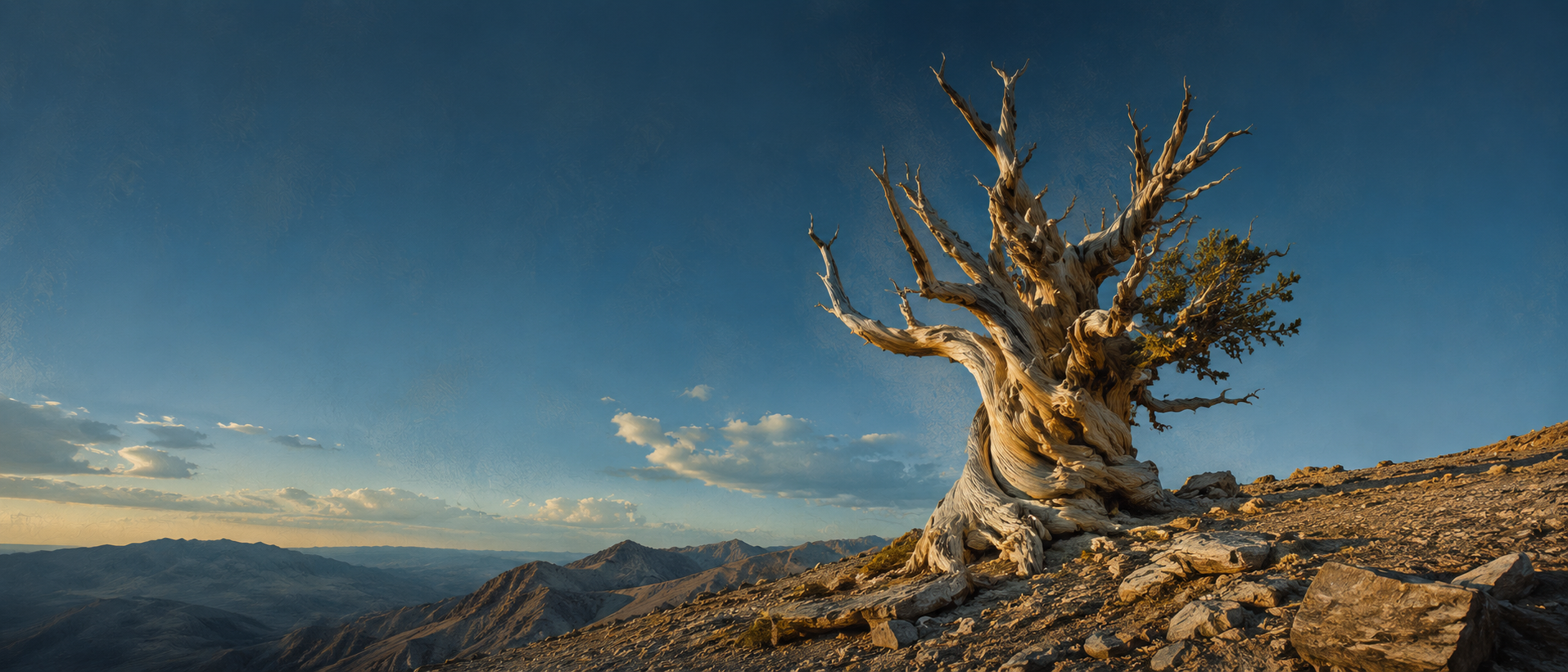
The oldest living trees on earth were already ancient when the Egyptian pyramids were being built.
They have no brain, no nervous system, no way to remember in any sense we’d recognize. And yet, locked inside their trunks is a physical record of nearly every major event in the last five millennia — every drought, every volcanic eruption, every decade of unusual cold. These trees don’t just survive time. They archive it.
Meet Methuselah
Pinus longaeva — the Great Basin Bristlecone Pine — grows in the White Mountains of California at elevations above 3,000 metres, in thin alkaline soil, under winds that would flatten most forests. It is one of the most inhospitable places on the planet. Which is exactly why these trees live so long.
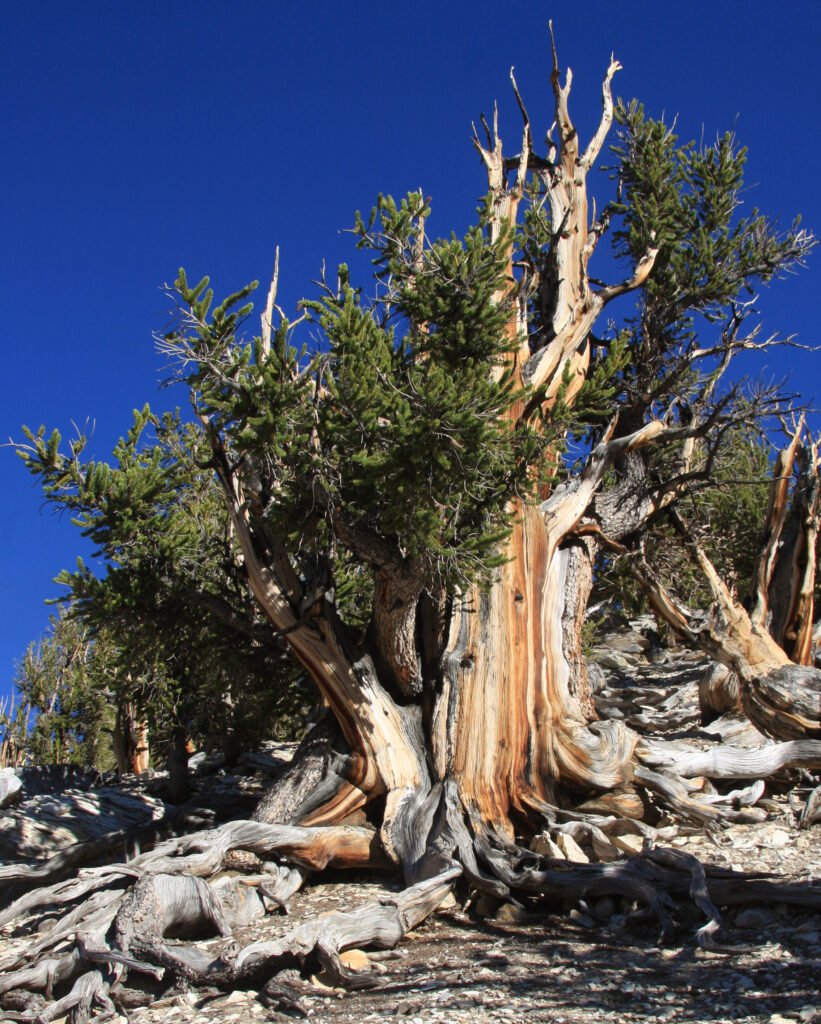
The most famous among the oldest living trees on earth is called Methuselah, estimated at around 4,855 years old. Its exact location is kept secret by the US Forest Service to protect it from tourists. It was a seedling roughly when Stonehenge was being assembled in England.
The secret to its longevity is adversity. Bristlecone pines grow less than a millimetre per year in width. Their wood becomes so dense and resin-saturated that fungi and insects struggle to penetrate it. There’s almost nothing to eat, almost no competition, and the cold dry air keeps disease at bay. Stress, counterintuitively, makes them nearly indestructible.
The Memory Inside the Rings
Every year, a tree adds one ring — a thin band of wood that encodes that year’s conditions. Wide rings mean warmth and rain. Narrow rings mean drought or cold. Volcanic ash years leave visible chemical signatures. Fire scars are frozen into the wood forever.
Reading these rings — dendrochronology — has become one of the most powerful tools in Earth science. By overlapping the patterns of living trees, ancient dead logs, and timber from archaeological sites, researchers have built continuous climate records stretching back over 14,000 years. Longer than any written history.
These records have been used to calibrate radiocarbon dating, verify the dates of ancient artefacts, and identify climate anomalies that reshaped civilisations. The devastating year 536 CE — when a volcanic eruption dimmed the sun and collapsed harvests across the Northern Hemisphere — was first confirmed in tree rings before any other evidence emerged. The Toba supervolcano eruption that nearly wiped out early humans 74,000 years ago left its own faint trace in environmental proxies that dendrochronology helps interpret.
A 5,000-year-old tree contains more climate data than most scientific databases.
The Organism That Predates History
If individual trees are impressive, clonal colonies are something else entirely.
Pando — a grove of quaking aspens in Utah — looks like a forest of about 47,000 trees. But every trunk is genetically identical, all growing from a single underground root system. The trunks die and regenerate every century or so. The root system itself is estimated to be between 80,000 and one million years old. By any reasonable definition, Pando belongs among the oldest living trees on earth — even if it doesn’t look like one.
It predates language, agriculture, and every civilisation that has ever risen and fallen. In the same way that mycorrhizal fungal networks thread through forest soil exchanging nutrients and chemical signals between trees, Pando’s root system has been quietly maintaining itself across geological time — underneath everything.
What They’re Saying Now
The oldest living trees on earth are now sending an unusual signal: their rings are changing in ways they haven’t in thousands of years.
Because dendrochronology gives scientists a multi-millennial baseline, they can see that the warming of the last century is anomalous — faster and more sustained than anything in the bristlecone record. Some trees are growing wider rings than they should. Others are showing stress patterns with no historical precedent. These organisms survived ice ages, civilisations, mass die-offs, and the gradual transformation of Earth’s atmosphere. What they’re experiencing now is different.
The pyramids are 4,500 years old. Methuselah is older. It doesn’t know that. But it has recorded everything anyway — in wood, in resin, in the silent geometry of its rings. The most durable archive in human history was never written by humans at all.