
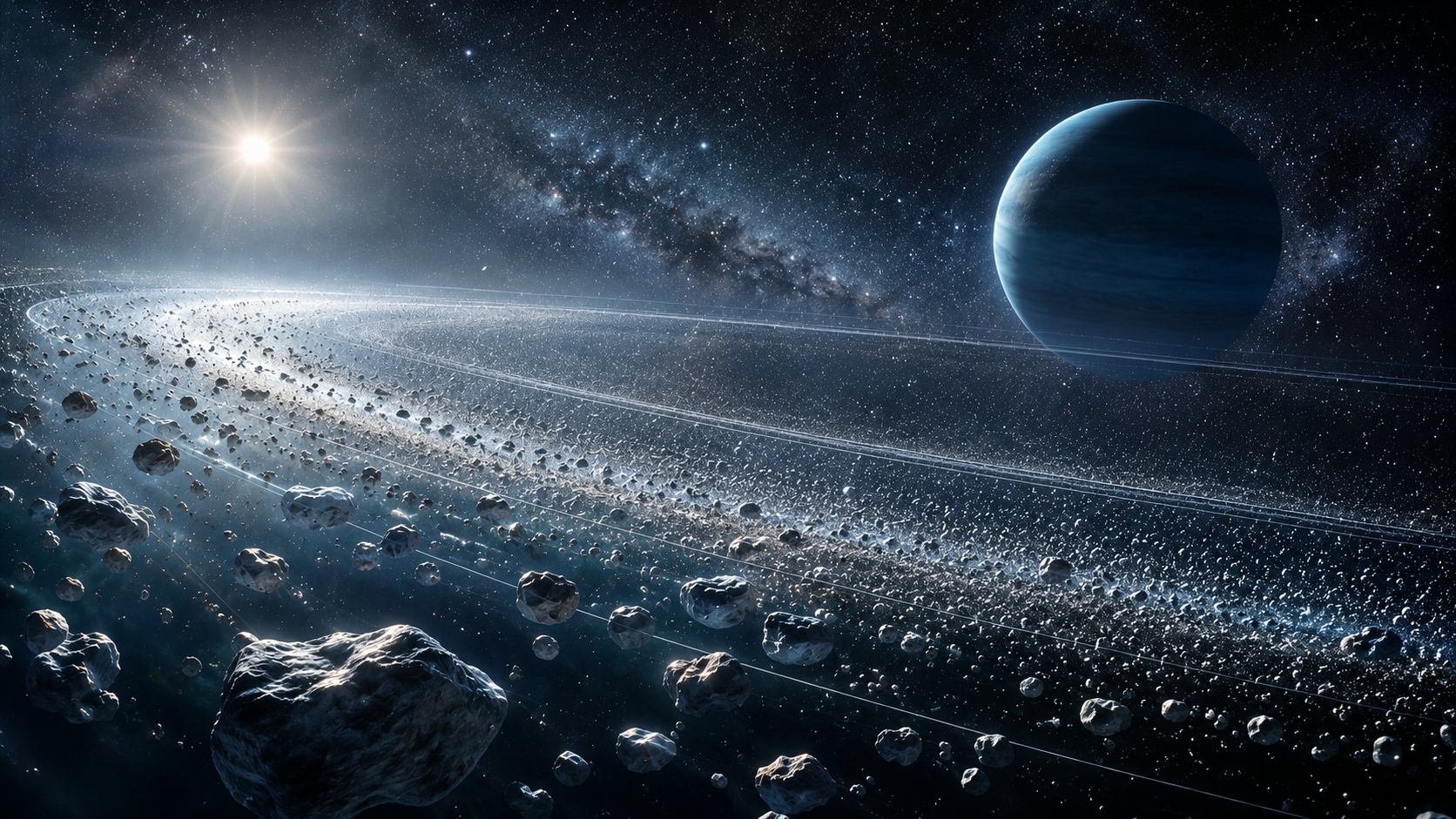
There are eight planets in our solar system. Everyone knows this. Textbooks say it. Astronomers say it. It’s one of the few facts about the cosmos that feels settled.
Except it might not be.
For over a decade, a growing body of evidence has pointed toward a hidden planet beyond Neptune — something massive lurking in the frozen dark — a ninth planet so far from the Sun that it takes between 10,000 and 20,000 years to complete a single orbit. A ninth planet solar system has always felt like a wild hypothesis. And the question of whether is Planet Nine real has quietly become one of the most electrifying unsolved problems in planetary science — rivalling even the silence of deep space as one of astronomy’s great open questions.
In 2026, new data arrived. It didn’t answer the question. It made everything stranger.
The Clue That Started Everything
The story begins not with a direct sighting, but with a pattern. The Planet Nine evidence that eventually emerged didn’t come from a telescope photograph. It came from mathematics — the kind of pattern that makes astronomers deeply uncomfortable, because it suggests something is out there that shouldn’t be.
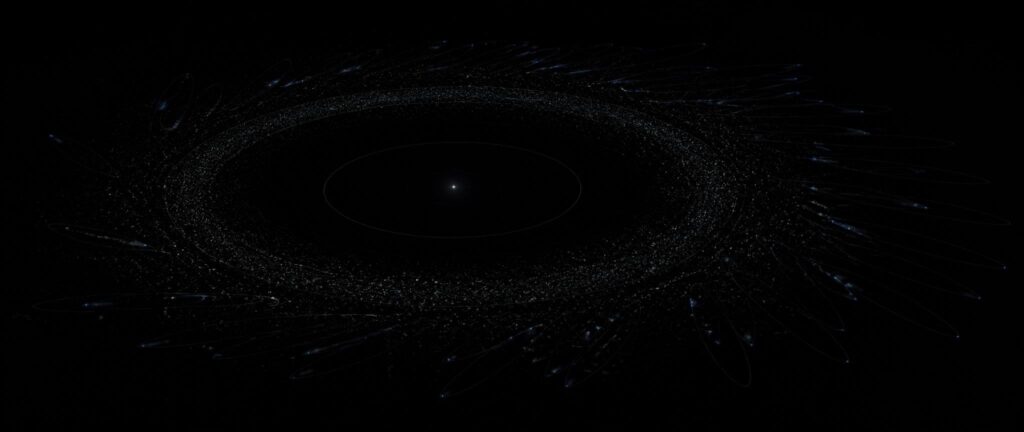
Far beyond Neptune lies the Kuiper Belt — a vast disc of icy rocks, dwarf planets, and ancient debris. The Kuiper Belt Objects mystery that drives the Planet Nine hypothesis begins here, in this frozen outer wilderness, with orbital patterns that simply should not exist. Most Kuiper Belt Objects, as astronomers call them, orbit the Sun in broadly predictable paths. Their movements are governed by known gravitational influences — Neptune, primarily, and to a lesser degree the other planets.
But a small subset of the most distant Kuiper Belt Objects don’t behave the way they should. Their orbits are clustered — tilted and aligned in patterns that physicists say have roughly a one-in-100 chance of occurring randomly. They orbit in the same direction, tilted at similar angles, pointing toward the same region of space. Something, the mathematics strongly suggests, is shepherding them. Something with enormous gravitational mass. Something we’ve never seen.
In 2016, astronomers Konstantin Batygin and Mike Brown at Caltech ran the numbers and proposed the most likely culprit: a planet roughly five to ten times the mass of Earth, orbiting the Sun somewhere between 400 and 800 astronomical units away — so far from us that reflected sunlight reaching its surface would be too faint for any current telescope to detect. They called it Planet Nine. And much like the strange object from interstellar space that defied every natural explanation, Planet Nine immediately forced scientists to confront how little they truly understand about the space nearest to home.
The evidence built steadily over the following years. By 2024, Batygin counted five independent lines of observational evidence, all pointing toward the same conclusion. He compared it to six hands on a clock, all moving at different rates, all pointing to the same spot at once. The probability of coincidence, he said, was vanishingly small.
Is Planet Nine Real — The 2026 Data Complicates Everything
Then came the complication.
In June 2026, a new study deepened the Kuiper Belt Objects mystery rather than resolving it. Using data from one of the most powerful sky surveys ever conducted, researchers found something that neither confirmed Planet Nine nor dismissed it — instead, it fundamentally unsettled the theoretical framework that had made the hypothesis so compelling in the first place.
The researchers discovered additional distant Kuiper Belt Objects whose orbits were more stable than Planet Nine’s gravitational influence would predict. If a massive planet were out there pulling and clustering the orbits of its distant neighbors, you’d expect a certain pattern of orbital disturbance. What the new data showed was a different pattern — one suggesting that if Planet Nine exists at all, it may be considerably farther away than anyone thought, or moving in a way the models haven’t accounted for.
The so-called “Planet Nine effect” — the gravitational shepherding signature that the entire hypothesis rests upon — suddenly looked less clean than it had before. And the question of whether is Planet Nine real became genuinely open again, in a way it hadn’t been for years.
This mirrors what happened with planets that defy formation models — objects whose existence seemed impossible until they showed up in the data, forcing entire frameworks to be rewritten. Sometimes the universe isn’t wrong. The theory is.
Three Possible Explanations — All of Them Unsettling
So what is actually out there? The Planet Nine evidence points in multiple directions simultaneously, and the science offers three serious possibilities — none of them fully comfortable.
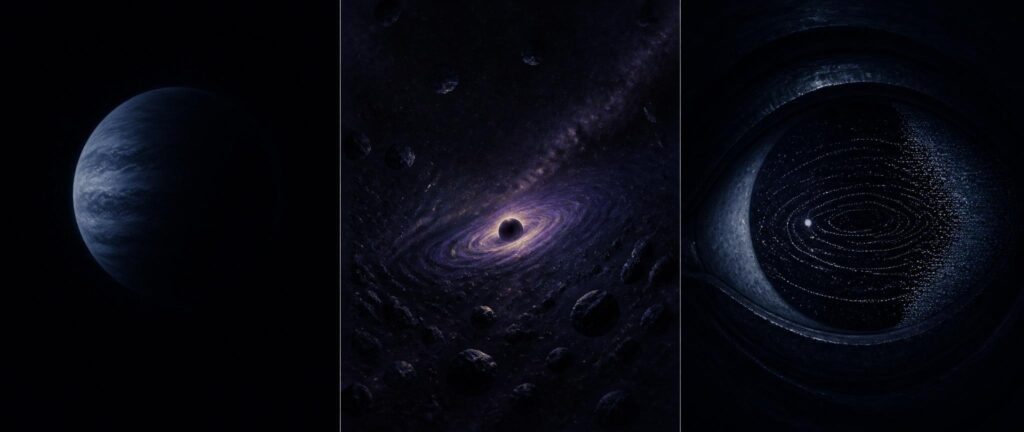
The first: Planet Nine exists, but it’s farther and darker than we thought. The new data could be consistent with a planet at a much larger orbital distance — perhaps over 1,000 astronomical units from the Sun. At that distance, even a Neptune-sized world would be nearly invisible to current instruments. It would be the most distant planet ever discovered, orbiting in a darkness so complete that our most powerful space telescopes have essentially never looked there with enough resolution to detect it.
The second: something else is causing the clustering. Several alternative explanations have been proposed over the years — a disc of smaller objects whose combined mass mimics a planet’s gravitational signature, or a primordial black hole captured early in the solar system’s history. This last idea — that our solar system may contain a tiny, ancient black hole — is not mainstream, but it is mathematically consistent with the observations. Researchers have noted that an unknown force pulls our entire galaxy toward it with no identified source, and our own solar system may contain its own version of that same uncanny, invisible mass.
The third: the clustering is a statistical illusion. This is the most deflating possibility, and a small but persistent minority of astronomers holds it. The argument is that observational bias — the fact that telescopes tend to look in certain regions of sky — could make a random distribution of Kuiper Belt Object orbits appear clustered when it isn’t. If this is correct, the entire Planet Nine theory collapses, and the orbital anomalies have no single explanation.
How Is Planet Nine Real Going to Be Tested?
The answer to whether is Planet Nine real may come sooner than expected — and from an observatory that has only just begun operating.
The Vera C. Rubin Observatory in Chile, which came online in 2025, is conducting the most comprehensive sky survey in astronomical history. Over the next decade, it will catalogue hundreds of millions of objects in the outer solar system — vastly more than the handful of distant Kuiper Belt Objects that sparked the Planet Nine hypothesis in the first place. If the Planet Nine evidence is real and significant, Rubin’s data will make it undeniable. If it’s statistical noise, Rubin will reveal that too.
There is also the Roman Space Telescope, scheduled to launch in August 2026, which will survey the sky with a field of view over 100 times larger than Hubble’s. Together, these two observatories represent the most powerful combination of sky-mapping instruments ever deployed simultaneously. If Planet Nine is out there in any form, the next five years are the most likely window in human history for finding it.
This is the same logic that drives the search for signals like signal with no known explanation — we build bigger ears, point them at silence, and wait for the silence to break. Sometimes it does.
What Finding — or Not Finding — Planet Nine Would Mean
The stakes of this question extend beyond planetary science.
Confirming a hidden planet beyond Neptune would be the most significant discovery in solar system astronomy since Neptune itself was found in 1846 — a planet found not by looking, but by reasoning from what other things were doing. It would also mean that our solar system, which we’ve studied more closely than any other in the universe, has been hiding a major planet from us for the entirety of human history. A world the size of several Earths, orbiting silently in the dark, undetected.
If Planet Nine is ruled out definitively, the Kuiper Belt Objects mystery deepens rather than dissolves. Something is causing those orbital anomalies. Whatever it is, it isn’t a familiar planetary body. The alternatives — a primordial black hole, a massive unseen disc, some gravitational effect we haven’t modeled — are in some ways more disturbing than the original hypothesis. At least a planet is something we understand.
And if the question simply remains unresolved — which is the most likely outcome in the near term — then we are left with one of the most vivid illustrations of how strange our immediate cosmic neighborhood remains. We have sent spacecraft to the edges of the solar system. We have mapped the cosmic microwave background radiation left over from the Big Bang, the afterglow of the universe’s first second. We have detected gravitational waves from collisions billions of light-years away.
And yet, whether is Planet Nine real — whether there is a massive planet sitting in our own backyard — remains genuinely unknown.
The Dark Frontier of Our Own Backyard
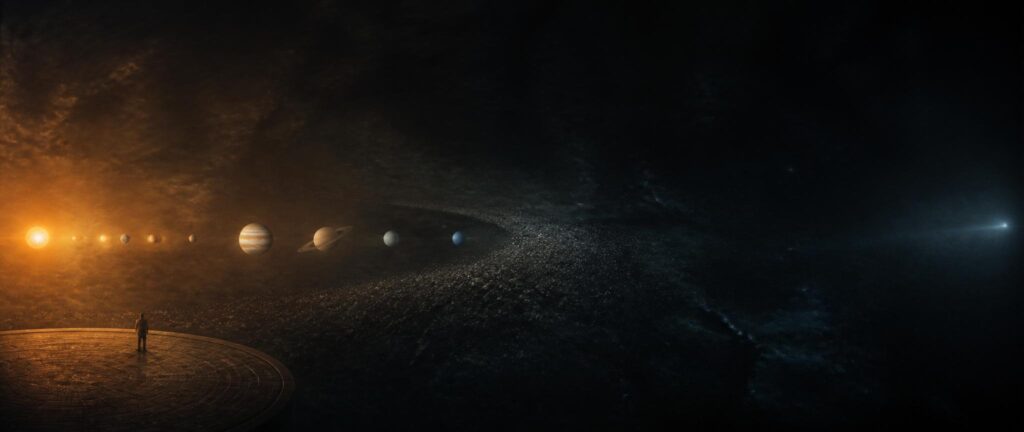
There is something philosophically vertiginous about this situation. The Kuiper Belt is not some distant, exotic region of the cosmos. It is part of our solar system. It is, astronomically speaking, local. And yet it remains so poorly understood that a planet the size of several Earths could be hiding in it, undetected, for the entire span of human civilization.
This is what makes the Planet Nine mystery different from the silence of deep space. The Fermi Paradox asks why we hear nothing from the vastness of other star systems — a silence we can at least partially attribute to distance and time. The Planet Nine mystery asks something more unsettling: why haven’t we found what might be sitting right next to us?
The outer solar system is our cosmic backyard. And whether or not a hidden planet beyond Neptune is waiting there for us, we’ve barely opened the gate.
Whatever is out there — planet, black hole, statistical ghost, or something we haven’t imagined yet — its discovery or definitive absence will force a reckoning with how much we think we know versus how much we actually do. The idea of a ninth planet solar system — a confirmed ninth planet in our solar system — would rewrite every textbook, every diagram, every childhood memory of a solar system poster on a classroom wall. A story we told ourselves because the full picture was too dark, too vast, and too strange to see clearly.
The 2026 data didn’t answer whether is Planet Nine real. But it confirmed something arguably more important: the mystery is real, the anomalies are real, and whatever is causing them has not yet been named.