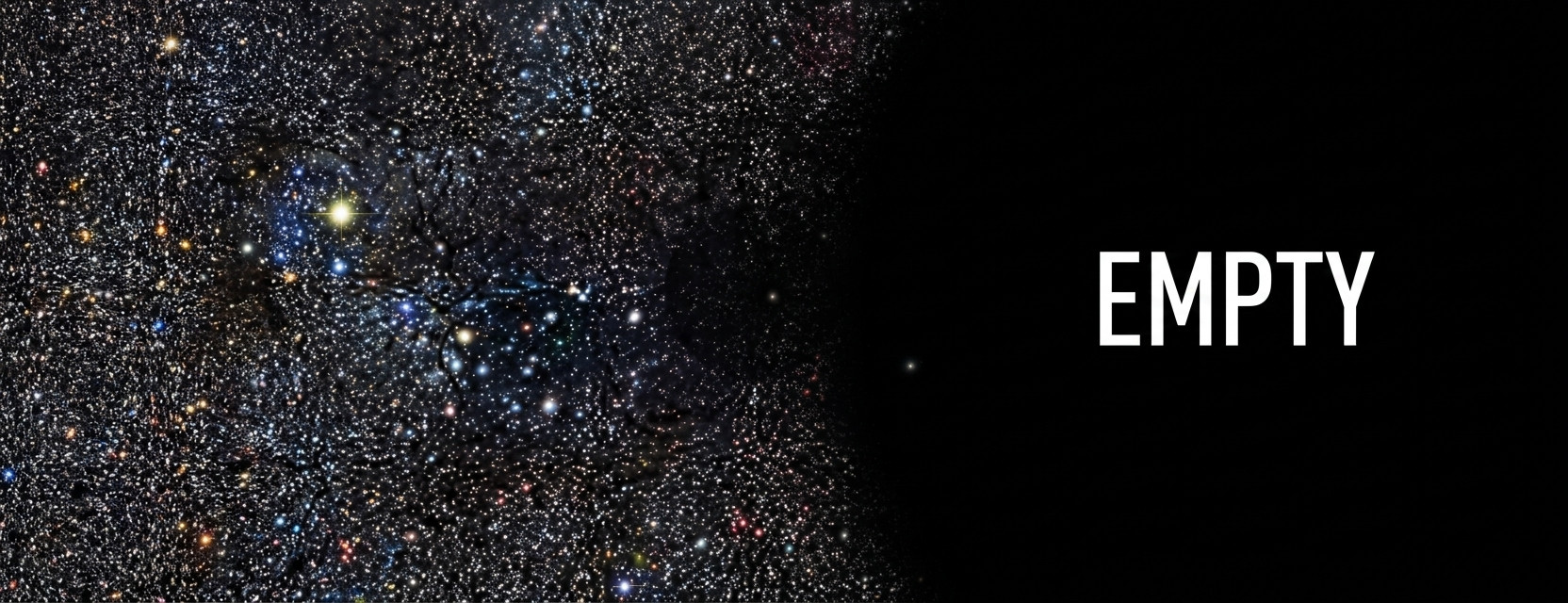
There is a place in the universe where almost nothing exists.
No stars. No planets. No gas clouds drifting between galaxies. No dark matter halos — the invisible scaffolding that holds the rest of the cosmos together. Just space. Hundreds of millions of light-years of it, in every direction, occupied by almost nothing at all.
It is called the Boötes Void. Astronomers, with a bluntness that feels almost poetic, sometimes call it something else: the Great Nothing.
And the more you understand about what a cosmic void of this magnitude means — not just physically, but cosmologically — the more unsettling the name becomes. Because the Great Nothing is not merely large. It is so large that its existence, according to the standard models of how the universe is structured, should be essentially impossible. And yet there it sits, 700 million light-years from Earth, defying tidy explanation with the quiet indifference of something that has had several billion years to simply be.
The Accidental Discovery That Changed Cosmology
The Boötes cosmic void was not found by scientists looking for it. It was found by scientists looking for something else entirely.
In 1981, astronomer Robert Kirshner and his team at the University of Michigan were conducting a survey of galactic redshifts — a technique that measures how fast galaxies are moving away from us, and therefore how far away they are, in order to build a three-dimensional map of the universe’s large-scale structure. The survey was methodical, unglamorous work. They were looking for patterns in how galaxies clustered and distributed themselves across space.
What they found instead was an absence. A vast, blank segment of space where, based on every model of cosmic structure available at the time, thousands of galaxies should have been. They measured the redshifts. They checked the data. They looked again. The galaxies were not there.
The Boötes Void spans approximately 330 million light-years in diameter. To understand what that number means — because light-years at this scale are genuinely beyond intuitive comprehension — consider this: the distance between our Milky Way and our nearest large galactic neighbour, Andromeda, is about 2.5 million light-years. The Boötes cosmic void is 130 times wider than that distance. It occupies roughly 0.35 percent of the entire observable universe. And according to the average density of matter in the cosmos, a region of this size should contain approximately 2,000 galaxies. Astronomers have found 60.
Sixty. In a space that should hold two thousand.
Astronomer Greg Aldering put the scale into human terms with a single sentence that has stayed in cosmology writing ever since:
“If the Milky Way had been in the centre of the Boötes Void, we wouldn’t have known there were other galaxies until the 1960s.”
Astronomer Greg Aldering
Read that again. An entire civilisation, on an entire planet, inside this cosmic void — and for most of human history, we would have looked up at the night sky and seen almost nothing. We would have believed, with complete scientific justification, that the universe was essentially empty.
Why the Cosmic Void Should Not Exist
To understand why the Boötes Void is so cosmologically troubling, you need to understand something about how the universe is structured at the largest scales.
After the Big Bang, matter was distributed with near-perfect uniformity across the early universe. But near-perfect is not the same as perfect. Tiny quantum fluctuations created regions that were fractionally denser than others. Gravity amplified those differences over billions of years — denser regions attracted more matter, pulling it from less dense surrounding areas, growing into the galaxies, galaxy clusters, and superclusters that populate the universe today.
The result, at the largest scale, is what cosmologists call the cosmic web — a vast, foam-like network of filaments and sheets of galaxies surrounding enormous empty regions. Voids are a normal, expected feature of this structure. They exist because gravity pulls matter away from some regions to concentrate it in others. The universe is, in a sense, supposed to have holes in it.
But the holes are supposed to be a certain size. Computer simulations of cosmic evolution — models that accurately reproduce the observed large-scale structure of the universe with extraordinary precision — predict that voids should form and grow over time, but they should not exceed a certain maximum diameter. The physics of how matter clumps and distributes itself simply should not produce a void as large as the Boötes supervoid within the age of the universe.
The standard cosmological model — the framework that underlies our best understanding of how the universe works — has no clean explanation for the Great Nothing. Some researchers have proposed that the Boötes Void is actually a cluster of smaller voids that merged over time, rather than a single structure that formed all at once. If true, this would ease the tension with the standard model. But the merging-voids hypothesis has not been conclusively confirmed, and the question of how so many voids aligned and merged into a single supervoid of this magnitude remains genuinely open.
It Gets Larger
Here is where the story shifts from remarkable to genuinely vertiginous.
The Boötes cosmic void held the record as the largest known void in the universe for decades after its discovery in 1981. Then, in 2015, astronomers found something bigger.
A team studying a persistent anomaly in the cosmic microwave background — the faint afterglow of the Big Bang that permeates the entire universe — had long been puzzled by a region known as the CMB Cold Spot. This area of the sky is measurably colder than its surroundings in ways that the standard model of cosmology struggles to explain. One proposed explanation was a supervoid — a region of such extraordinary emptiness that its gravitational effects would leave a detectable signature on the CMB.
They looked. They found one. The Eridanus Supervoid — sometimes called the Cold Spot Void — spans an estimated 1.8 billion light-years across. That is roughly five times the diameter of the Boötes Void. It represents nearly 2 percent of the diameter of the entire observable universe.
Even this structure, enormous as it is, does not fully explain the CMB Cold Spot. Which means either our models of what voids can do are incomplete, or something else entirely is responsible for the anomaly. Both possibilities are uncomfortable. Both are being actively investigated.
The universe, it turns out, contains absences so large that they affect the temperature of the light left over from the beginning of time.
The Cosmic Web and Our Place In It
There is a detail in the Boötes Void story that most popular accounts skip past, but that sits at the centre of the philosophical weight this place carries.
We are not outside the cosmic void, looking in. We are inside one.
Our own Milky Way galaxy sits within a structure called the KBC Void — also known as the Local Hole — a cosmic void approximately 2 billion light-years in diameter. We are not in a dense, well-populated region of the cosmic web. We live in an underdense region, a relative emptiness, surrounded by denser filaments and superclusters beyond.
This does not mean our neighbourhood is remotely as empty as the Boötes Void — the KBC Void contains many thousands of galaxies, including our own Local Group. But it means that the experience of looking out from inside a void is not foreign to us. It is, in the most literal sense, our perspective. Every observation we make of the universe, we make from inside a hole in it.
The implications for cosmology are not trivial. If we live in an underdense region of the universe, some of the measurements we use to determine the universe’s properties — including, potentially, its rate of expansion — may be subtly distorted by our unusual local environment. The so-called Hubble tension — a persistent and unresolved disagreement between different methods of measuring the universe’s expansion rate — may be partly explained by the fact that we are observing from inside the KBC Void rather than from a representative average region of the cosmos.
In other words: the cosmic void is not merely a curiosity out there in the direction of the constellation Boötes. It may be affecting our understanding of the universe from right here, from inside the emptiness we call home.
What the Great Nothing Teaches Us
Science has a tendency to frame discovery as accumulation — each new finding adding to the edifice of human knowledge, building toward a more complete picture of reality. The Boötes Void does something different. It is a discovery that, decades after it was made, still generates more questions than it answers.
Why does the Great Nothing exist? The merging-voids hypothesis is plausible but unconfirmed. Are there forces or mechanisms at work in the formation of cosmic structure that our current models do not account for? Possibly. Does the existence of structures this large require revisions to the standard cosmological model — the framework that has otherwise performed with extraordinary accuracy? Some cosmologists think so.
The cosmic void at the scale of Boötes sits at the edge of what current cosmology can comfortably explain. It is not a crisis — the standard model has survived many challenges and remains the best description of the universe we have. But it is an anomaly. A persistent, enormous, 330-million-light-year-wide anomaly that has been sitting in the data since 1981, waiting for an explanation that has not yet fully arrived.
There is something philosophically significant about that waiting. The universe is not obligated to fit our models. It does not adjust itself to the boundaries of what our mathematics predicts. It simply is what it is — including, apparently, a region of almost inconceivable emptiness that should not be as large as it is.
The View From Inside the Nothing
Return, one final time, to Greg Aldering’s observation. If the Milky Way had been inside the Boötes Void, we would not have known other galaxies existed until the 1960s.
Think about what that means for the development of human knowledge. The entire edifice of modern cosmology — the Big Bang, the expanding universe, the cosmic web, the age and scale of everything — rests on our ability to observe other galaxies, to measure their distances and velocities, to map the structure of the universe beyond our own small corner of it.
From inside the Great Nothing, that project would have been delayed by centuries, perhaps permanently. The sky would have been beautiful. The stars of our own galaxy would have blazed. But the universe beyond — the billions of galaxies, the web of filaments, the evidence for the Big Bang itself — would have been invisible. Not hidden by anything. Simply absent. Swallowed by the cosmic void.
We would have looked at the sky and believed, with complete scientific integrity, that this was all there was.
It is worth sitting with the possibility that there are other absences — other voids, other blind spots, other regions of the universe’s structure — that are currently producing exactly that effect on our understanding. Not because the universe is hiding something. Because it is simply larger, and stranger, and emptier in places, than we have yet had the instruments or the perspective to see.
The Great Nothing is not an anomaly in an otherwise well-understood universe. It is a reminder that the universe has not finished surprising us. It may not have even started.