

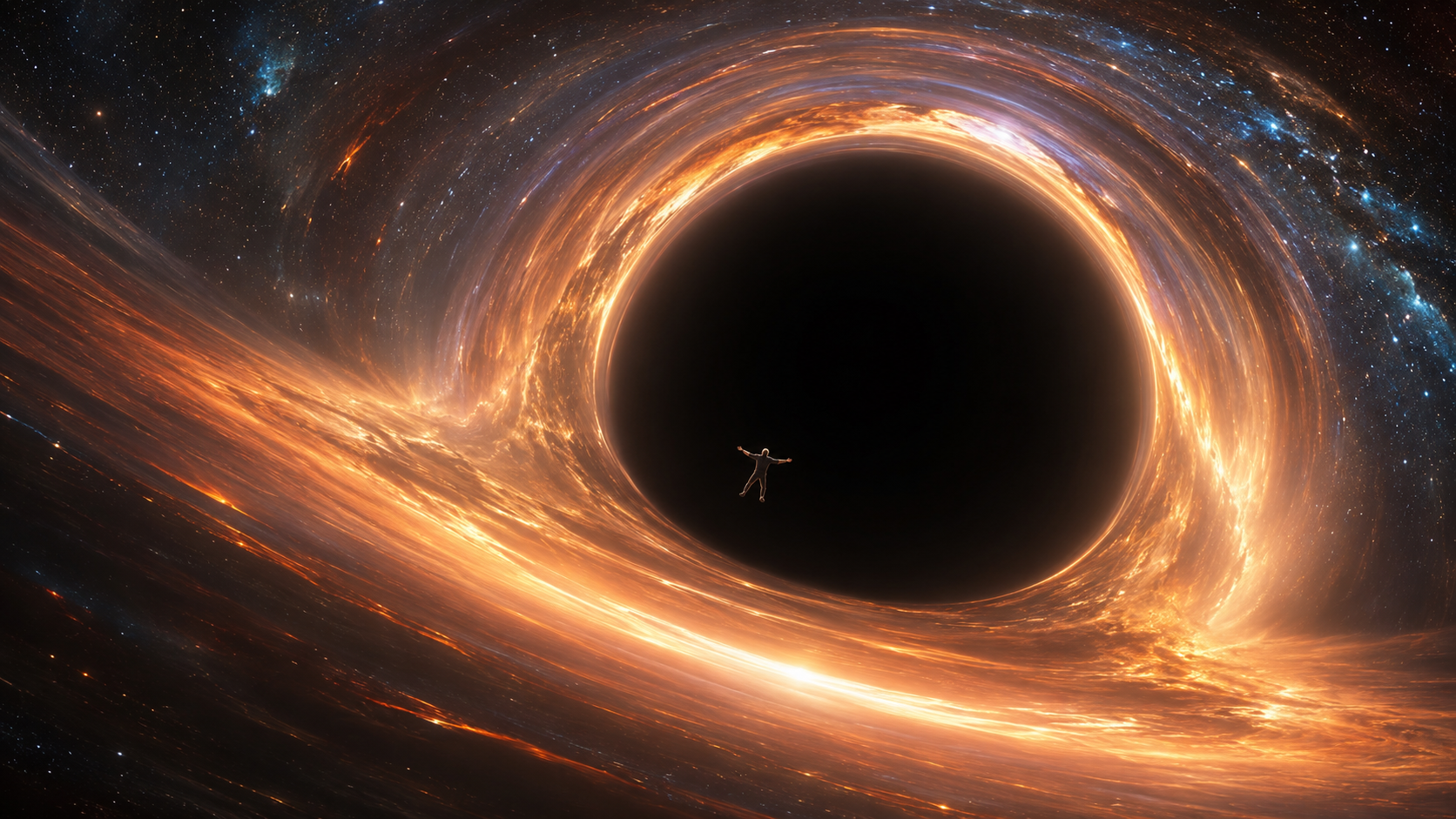
The falling into a black hole experience is one of the most extraordinary thought experiments physics has ever produced — and unlike most thought experiments, it has real, specific, disturbing answers.
You’re not dead yet. That’s the strange part.
You’ve crossed the event horizon — the point of no return — and nothing has exploded, no alarm has sounded, no force has ripped you apart. At least, not yet. From your perspective, the moment of crossing looks… surprisingly unremarkable. Just a boundary in space. Invisible. Unmarked. The universe continues to exist around you.
But something is deeply, irreversibly wrong. What you’d see depends entirely on where you’re standing.
The Problem With “Seeing” Anything Near a Black Hole
Before we go further, there’s a foundational issue to understand: light doesn’t travel in straight lines near extreme gravity. A black hole warps spacetime so severely that photons — massless particles that travel at the fastest speed allowed by the universe — curve around it, get trapped by it, and in some cases, orbit it.
This means that near a black hole, vision itself becomes unreliable. Your eyes work by receiving light. When the light reaching your eyes has been bent, delayed, and distorted across billions of kilometers of curved spacetime, “seeing” stops being simple.
Still, physics lets us trace exactly what light would do. And the picture it paints is extraordinary.
What the Falling Into a Black Hole Experience Looks Like from Far Away
Let’s start with an observer watching you fall in.
Say your best friend stayed behind in a safe spaceship, hovering far from the black hole. They watch you accelerate toward it, wave goodbye, and begin your descent. What do they see?
They don’t see you cross the event horizon. Ever.
Because of gravitational time dilation — the phenomenon where time passes more slowly the deeper you are in a gravitational field — your friend would watch you slow down as you approached the event horizon. Your movements would become more and more sluggish. Your image would redshift: the light bouncing off you would stretch to longer and longer wavelengths, first turning red, then infrared, then microwave, then radio.
To your friend, you would appear to asymptotically freeze. You’d hover there, fading, dimming, stretching slightly — never quite crossing. After a few minutes, you’d become too faint to see with any instrument. But in theory, your image would persist forever — infinitely stretched across the horizon.
You never arrive. You just… fade.
This is the first bizarre truth about falling into a black hole: what you experience and what others observe are completely different stories.
Spaghettification: The Physical Reality of the Descent
From your own frame of reference, the experience is very different — and far stranger.
For a stellar-mass black hole (a few times the mass of the sun), you’d feel something called spaghettification long before you reached the event horizon. The tidal forces — the difference in gravitational pull between your head and your feet — would be so extreme that your body would be stretched into a thin stream of particles. Death would come well outside the event horizon, and it would not be gentle.
But supermassive black holes — the kind sitting at the center of galaxies, millions or billions of solar masses — are different. Their event horizons are so large that tidal forces at the boundary are actually manageable. For a large enough black hole, you could theoretically cross the event horizon without immediately dying. You might not even notice it happening.
Which brings us to the real question: what would you see?
The Light Show: Einstein Rings and Warped Starfields
As you fell toward a supermassive black hole, the visual distortions would begin well before you crossed the horizon.
The black hole would appear as an absolute black circle ahead of you — not just dark, but void. No photons escape from within the event horizon, so there is nothing to see there. Just an absence of information. Around that void, however, the universe would be doing something spectacular.
Light from stars and galaxies behind you — and even beside you — would bend around the black hole and arrive at your eyes from odd angles. Stars that should be “behind” the black hole would appear at its edges, bent into rings. You might see the entire universe compressed into an increasingly narrow band around you as the black hole swallowed more and more of your visual field.
This is called an Einstein ring — a complete circle of light formed when a massive object bends the light from a source directly behind it. Near a black hole massive enough, you’d see multiple rings: light from the same galaxy that had orbited the black hole once, twice, three times before reaching you, each copy slightly different.
It’s worth thinking about how this connects to other extremes of our universe. The cosmic void in Boötes — a region nearly 300 million light-years across with almost no galaxies — represents one end of the scale: a near-empty expanse that challenges our cosmological models. A black hole represents the other: matter so concentrated that space itself tears.
The Photon Sphere: Where Light Orbits
At roughly 1.5 times the Schwarzschild radius — just outside the event horizon — lies one of the strangest regions in the known universe: the photon sphere.
This is where photons can orbit the black hole in circular paths. If you were somehow hovering at this location (which would require an impossible amount of thrust), you could, in theory, look straight ahead and see the back of your own head — light traveling around the black hole and completing the loop.
From outside, the photon sphere marks the boundary where any photon aimed just slightly toward the black hole will spiral inward and never escape. Those aimed slightly outward will escape to infinity. The region between these two fates is razor-thin. And the visual consequence is that the black hole appears slightly larger than its actual event horizon — a shadow cast by this trapped light region.
The James Webb Telescope has given us our first glimpses of early galaxies whose light traveled billions of years to reach us — bent, stretched, and lensed by gravity along the way. That James Webb telescope’s unveiled secrets of the early universe were captured precisely because gravity distorts light’s path. Black holes take this distortion to its logical extreme.
Crossing the Horizon: The Moment You Don’t Feel
If you’re falling freely — not firing rockets, not resisting — the moment of crossing the event horizon would not feel dramatic. General relativity’s equivalence principle tells us that freefall and floating in zero gravity are locally identical experiences. You wouldn’t feel the horizon. You wouldn’t see a boundary. The physics of your immediate surroundings would seem, briefly, normal.
But looking outward — back toward the universe you came from — the picture would be different.
Because you’ve crossed into a region where light from the outside can still reach you (light can fall in; it just can’t get back out), you’d still receive information from the universe. But that information would be compressed. The entire future history of the universe — trillions of years of stellar evolution, galaxy collisions, the ultimate heat death — might arrive compressed into a fraction of a second.
Some physicists have described this as seeing the universe “fast-forward” at the horizon. The outside universe would appear as a tiny bright point, shrinking as you fell. Whether you’d actually have time to observe this before other effects took over is debated.
The Singularity: Where Physics Breaks Down
Beyond the event horizon, time itself points toward the singularity. In the geometry of spacetime inside a black hole, “falling toward the center” is no longer a spatial direction — it’s a temporal one. You can no more avoid the singularity than you can avoid next Tuesday.
What would you see approaching it? Honestly, physics breaks down here. The singularity is not a place — it’s a point where our equations stop working. General relativity predicts infinite density. Quantum mechanics suggests this can’t be physical. The true answer likely requires a theory of quantum gravity we don’t yet have.
This connects to the deepest questions in physics — questions about whether we might be living in a simulation, whether spacetime is fundamental or emergent, and what “information” even means when a black hole evaporates via Hawking radiation.
The Information Paradox: What Happens to You After
Here’s one more thing that would “happen” to you — even after death.
According to Hawking radiation, black holes slowly evaporate. Over an incomprehensibly long timescale, a black hole radiates energy in the form of thermal particles and eventually shrinks to nothing. The black hole information paradox asks: what happened to all the information encoded in everything that ever fell in — including you?
If information is truly lost, it violates a foundational principle of quantum mechanics. If it’s somehow preserved in the Hawking radiation, we have no idea how. This is considered one of the deepest unsolved problems in theoretical physics, one that has occupied Stephen Hawking, Juan Maldacena, and the brightest minds in physics for decades.
You, falling into a black hole, become a footnote in the most profound debate physics has ever faced.
Why the Falling Into a Black Hole Experience Matters to Physics
What makes this thought experiment so valuable isn’t the morbid drama. It’s what it reveals about how reality works.
Two people can observe the same event — your crossing the horizon — and reach completely incompatible descriptions. Both are correct within their own frames. General relativity is fine with this. It’s special relativity that can’t handle it. And the tension between these two is exactly where quantum gravity lives.
The Fermi Paradox asks why, in a universe full of stars, we haven’t heard from anyone else. Black holes might be part of the answer — sterilizing entire regions of galaxies, making life impossible in their neighborhoods. The same objects that make the cosmos visually spectacular may be what makes it so quiet.
The universe at its extremes tends to break the tools we use to understand it. The deeper we fall — metaphorically and literally — the more we realize how much of reality we’ve yet to map.
Maybe that’s the most honest thing physics can tell you about the falling into a black hole experience.
You’d see everything. Understand almost none of it. And the universe would keep moving, indifferent and extraordinary, long after you were gone.
Leave a Reply
You must be logged in to post a comment.