
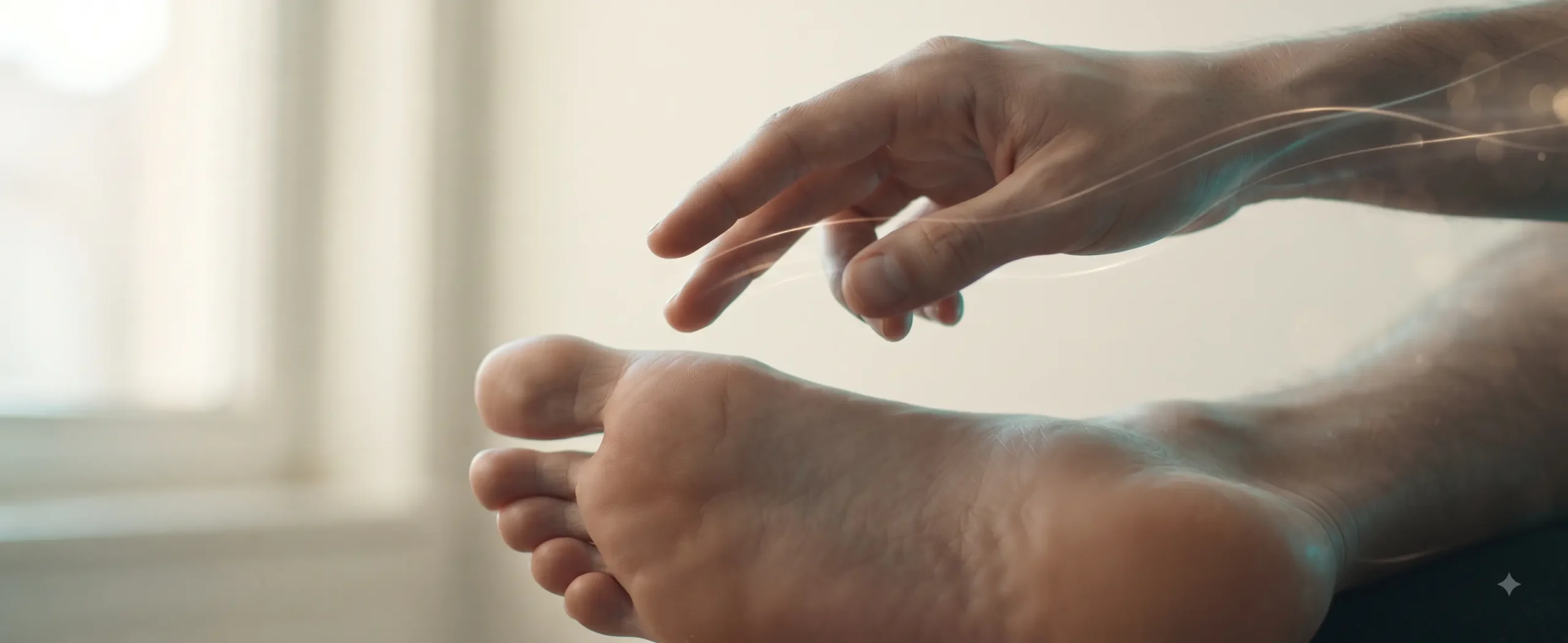
Try it right now. Run your fingers across your ribs, your neck, the sole of your foot — every spot where another person could reduce you to helpless laughter. Nothing. Not even a flicker. Yet the instant someone else does the exact same thing, you squirm. That tiny everyday failure hides a real neuroscience mystery, and the reason why you cant tickle yourself reveals something surprisingly deep about how your brain builds your whole reality.
By the end of this piece, you’ll know why your own fingers fall flat, what a tickling robot proved in a lab, and why this quirk is secretly one of the most important tricks your brain performs every waking second — a hidden talent as strange as any of the quirks you never notice.
Your Brain Saw It Coming
The answer starts with prediction. Every time you choose to move, one part of your brain issues the command — but it also sends a quiet copy of that command elsewhere, essentially whispering, “here’s what’s about to happen.” Deep in the back of your skull, your cerebellum uses that copy to forecast the precise sensation your movement will create. So much of what you feel is really your brain’s best guess, the same predictive habit that produces oddities like a curious brain glitch.
Because it can predict the sensation a heartbeat before your fingers land, your brain simply cancels it out. This muffling of expected feelings is a phenomenon scientists call sensory attenuation. It’s the same reason your own voice sounds quieter to you than a recording, and why you stop noticing the constant press of your clothes. Anything predictable gets turned down, so the surprising can stand out — a little like the way expectation can shape sensation more than we realise. That efficiency is the first real clue to why you cant tickle yourself.
The Real Reason Why You Cant Tickle Yourself
A tickle only works when it’s a genuine surprise. Tickling appears to hijack an ancient alarm system — your own threat radar, the reflex that flinches at an unexpected touch on vulnerable skin. When someone else’s fingers approach, your brain can’t predict their timing, pressure, or path, so the feeling arrives at full, unfiltered volume and your body reacts before you can even think — it simply refuses to be startled by you.
When you do it yourself, that surprise is impossible. Your brain generated the movement, so it already knows exactly what’s coming, and this self-generated touch is silenced before it can even register.
The Robot That Tickled People
Neuroscientists actually tested this with a clever machine. Volunteers used a lever to control a soft robotic arm that tickled their own palm. When the arm moved in perfect time with their hand, they felt almost nothing. But when researchers slipped in a tiny delay — a fraction of a second between the motion and the touch — the sensation abruptly became ticklish again.
That small gap was enough to break the brain’s prediction. The movement no longer matched the feeling, so the brain flagged it as “not me” and let the tickle through. Ticklishness, it turns out, isn’t about the touch at all — it’s about whether your brain expected it, which is the whole secret behind why you cant tickle yourself.
A Tiny Window Into a Predicting Mind
So why does this matter beyond party tricks? Because this same predictive machinery is how you tell yourself apart from the rest of the world. Every second, your brain quietly labels each sensation “me” or “not me,” and that split is part of what makes you feel like a self at all. The next time your own fingers fail to make you laugh, remember what you’re really seeing — the everyday proof of why you cant tickle yourself, and one of the brain’s deepest talents at work: the constant, invisible art of predicting your own existence.