
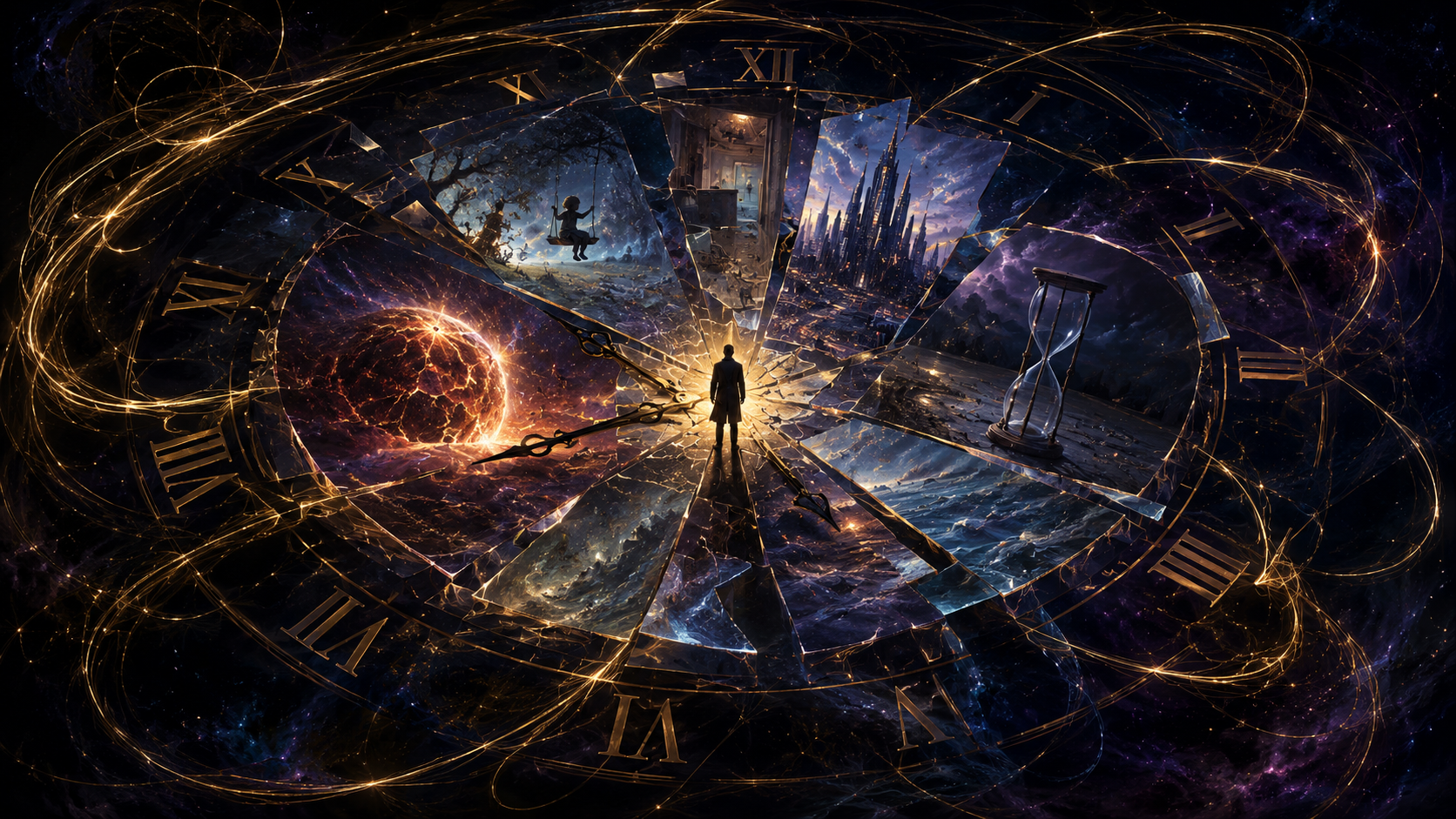
There’s a moment — maybe it hits you at 2am, or mid-commute, or staring into a bathroom mirror — when the concept of time stops feeling ordinary and starts feeling like a trap. You didn’t choose to be born into this particular sliver of history. You can’t go back. You can’t pause. Every second that passes is gone in a way that’s genuinely irreversible.
That’s not just poetic discomfort. The uncomfortable facts about time run far deeper than existential dread. Physics, neuroscience, and philosophy have all taken their turn pulling at this thread — and what they’ve found is genuinely strange. Time is not what you think it is. It may not even be what it feels like.
Here are ten facts that will make you rethink one of the most familiar things in your life.
1. The Past, Present, and Future All Exist Simultaneously
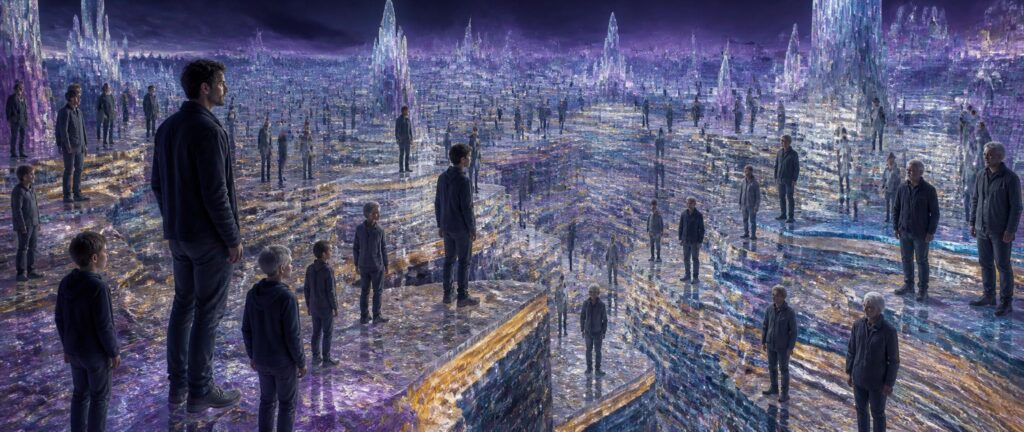
According to Einstein’s block universe theory — which most physicists quietly accept — time doesn’t “flow.” All moments in time exist at once, stretched out like a landscape. The past isn’t gone. The future isn’t unwritten. They’re all equally real, equally present.
What we experience as the movement of time might be an illusion created by consciousness — the sensation of moving through a static structure, not time actually progressing. The question of whether the present moment exists at all turns out to be one physics genuinely struggles to answer.
This is one of the most uncomfortable facts about time because it implies that everything you’ve lost — every person, every moment, every version of yourself — still exists somewhere in the structure of spacetime. You just can’t get back to it.
2. Time Passes at Different Rates Depending on Where You Are
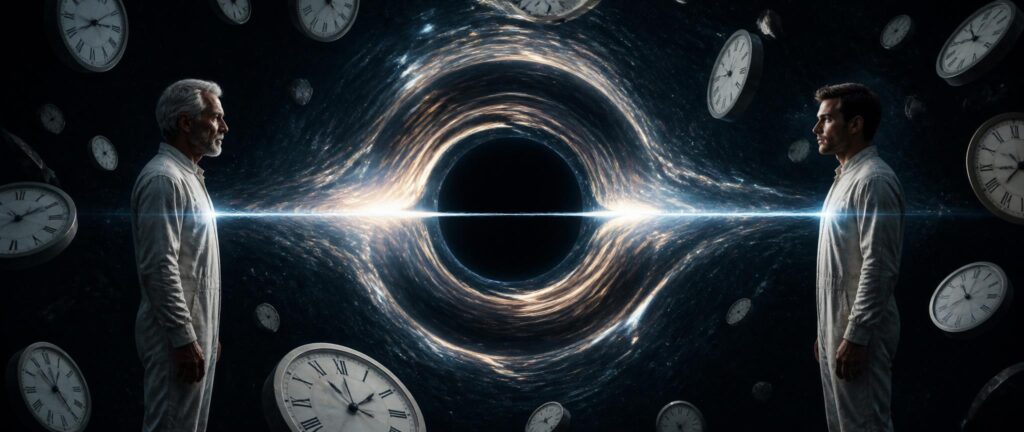
Climb a mountain. Stand near a black hole. Move very fast. In each case, time physically slows down for you relative to everyone else. This isn’t metaphor or perception — it’s measurable, confirmed, and accounted for in GPS satellites that would drift off by miles per day if Einstein’s equations weren’t corrected for.
Gravitational time dilation explained in simple terms: mass warps spacetime, and the deeper you are in a gravitational field, the slower time runs. Your head is literally aging faster than your feet.
You and a friend born on the same day are not the same age. Not exactly. The person who spent more time at altitude has aged fractionally more. The universe has always been this precise. We just didn’t notice.
3. Your Brain Constructs Time — It Doesn’t Record It
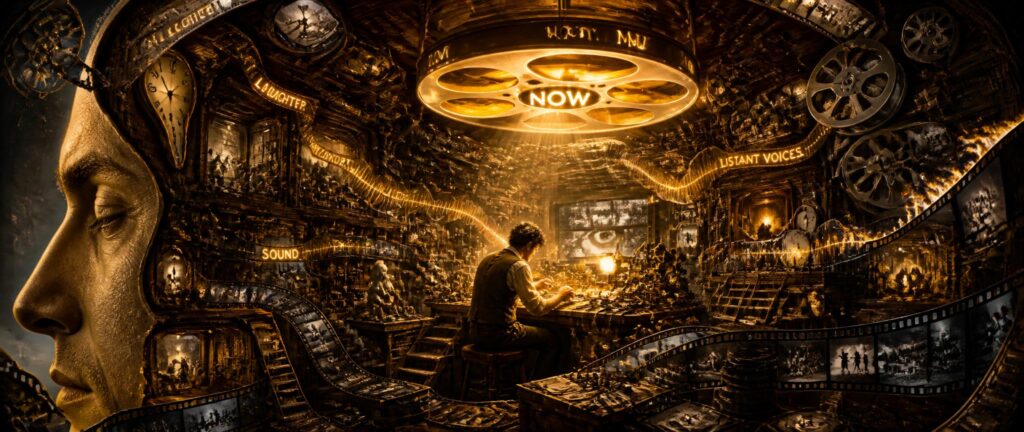
You don’t experience time the way a camera records video. Your brain actively constructs a sense of temporal order by stitching together sensory signals that arrive at slightly different times. Neurons fire at different speeds. Signals from your eyes travel faster than signals from your fingertips.
The sense that things are happening “now” and “in order” is a post-hoc edit. The experience of the present moment is assembled a fraction of a second after it supposedly occurs. You are always, neurologically, living slightly in the past.
This is part of why why time speeds up as you age — your brain stops encoding new detail as carefully, and without dense memory encoding, time perception collapses.
4. There Is Likely a Smallest Unit of Time That Cannot Be Divided

The Planck time — approximately 5.39 × 10⁻⁴⁴ seconds — is theorized to be the smallest meaningful unit of time that physics can describe. Below this threshold, the concepts of “before” and “after” may simply stop applying.
This is one of the quietly disturbing uncomfortable facts about time: it might be granular. Discrete. Like pixels in a photograph, except the photograph is reality. Between one Planck unit and the next, nothing happens — because “happening” requires time, and at that scale, time doesn’t exist yet.
5. The Speed of Light Is Also a Limit on How Far Back in Time You Can See

When you look at a star, you’re seeing the past. The light from the Andromeda Galaxy left 2.5 million years ago. Some of the stars you see at night no longer exist — they burned out long before the light reached you.
The physics of faster than light travel also reveals something stranger: exceeding light speed wouldn’t just be fast — it would mean travelling backwards in time. The universe set its speed limit partly to protect causality. To stop effects from preceding causes.
The observable universe, then, is a time machine. You are always looking backward. You have never seen anything as it is right now.
6. We Don’t Know Why Time Only Goes Forward

The laws of physics are almost entirely time-symmetric. The equations that govern particle interactions work identically whether time runs forward or backward. There is no fundamental law that says time must move in one direction.
The second law of thermodynamics — entropy always increases — gives us an arrow of time, but it’s statistical, not absolute. In a small enough system, entropy can reverse. Time, technically, could theoretically run backward without violating most known physics.
Why doesn’t it? Genuinely unknown. The forward direction of time may be a consequence of the Big Bang’s initial conditions, not a law of nature. Which means the past being inaccessible might be a cosmic accident, not a rule.
7. At the Big Bang, Time May Not Have Existed

Ask what happened before the Big Bang and most physicists will tell you the question doesn’t make sense — because time itself began with the Big Bang. There was no “before.” Not empty space waiting for an explosion. Not darkness. The conditions under which “before” is meaningful didn’t exist.
What happened in the first second after the Big Bang is already staggeringly complex — but the moment before that first second is a question that language and mathematics both struggle to frame. Time having a beginning is one of those facts that sounds philosophical until you realize it’s physics.
8. The Passage of Time Is Heavily Distorted by Emotion and Attention

Time perception and emotion are deeply linked. Frightening events feel like they lasted longer. Boring experiences stretch. Flow states compress hours into what feels like minutes. Grief distorts time almost beyond recognition — days feel endless while months evaporate.
This is because your brain encodes time partly through the density of events and emotional significance. High-stakes, novel experiences generate more memory anchors, which makes time feel longer in retrospect. Routine compresses into almost nothing.
You don’t experience clock time. You experience psychological time — a subjective, malleable, emotionally coloured version of something that physics insists is objective.
9. You Will Spend Roughly a Third of Your Life Unconscious
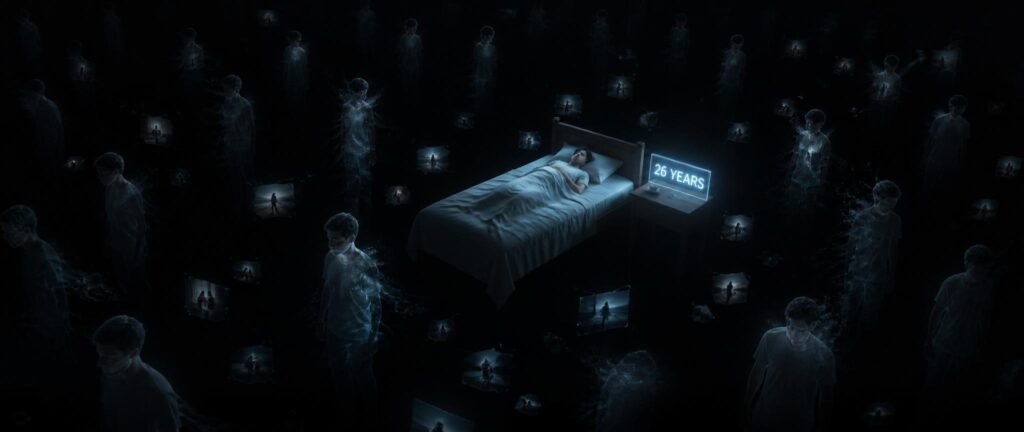
Sleep isn’t passive rest. But from the perspective of conscious time — the time you actually experience — roughly a third of your life is simply absent. Gone. For an 80-year lifespan, that’s somewhere around 26 years of subjective non-existence, broken into nightly chunks.
There’s no experience of time during deep sleep. No waiting. No sensation of hours passing. You close your eyes and then it’s morning — which means each night is, from a consciousness standpoint, a small-scale rehearsal for something much more permanent.
This is one of the uncomfortable facts about time that people rarely let themselves sit with. The erasure of subjective experience for a third of your life isn’t frightening in itself — but it does ask a pointed question about what “experiencing time” actually means.
10. Every Decision You Delay Is Made for You by Default

This is the least physics-based fact on this list, and possibly the most personally uncomfortable. Time’s unidirectional nature means inaction is itself a choice. Every moment you spend not deciding something, reality makes the decision through inertia. Relationships that aren’t tended drift apart. Health not maintained declines. Skills not practiced atrophy.
The uncomfortable truth isn’t that time is running out — it’s that time is always running, in one direction, and the default state of most things is entropy. The burden of keeping anything good is a constant, active one.
Time doesn’t wait for readiness. It doesn’t reward hesitation with extra preparation time. The clock was already running before you understood the game.
The Uncomfortable Facts About Time Nobody Talks About
The strange thing about these uncomfortable facts about time is that none of them are speculative. The block universe is mainstream physics. Time dilation is measured daily. Psychological time distortion is documented in neuroscience literature.
What makes them uncomfortable isn’t that they’re uncertain — it’s that they’re true, and most of us spend our entire lives treating time as something simple, linear, and guaranteed.
It isn’t any of those things. And the earlier you stop pretending otherwise, the more clearly you can see what you’re actually working with.