
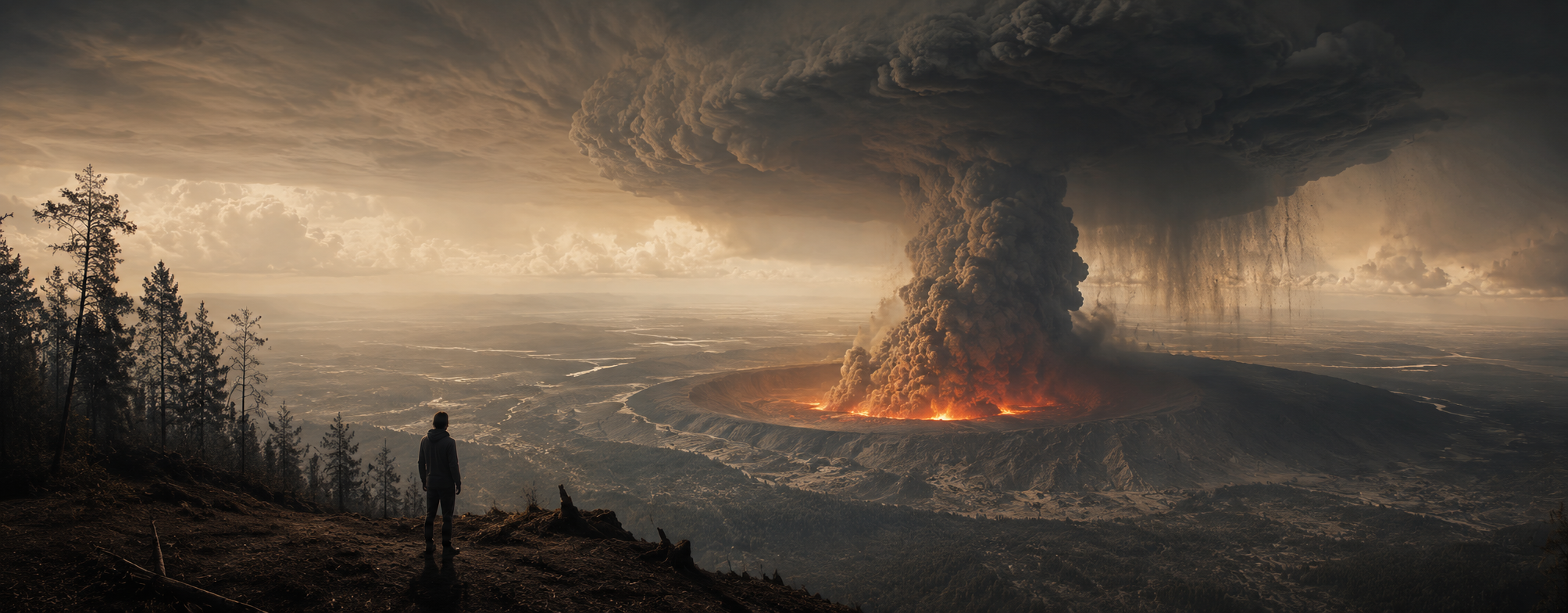
Around 74,000 years ago, a supervolcano on the Indonesian island of Sumatra erupted with a force so incomprehensible that it makes every other volcanic event in human memory look like a campfire. The Toba catastrophe theory holds that this single eruption — the largest in the last 2 million years — didn’t just reshape a landscape. It may have nearly ended our species entirely. And if it did, then every human alive today is descended from a handful of survivors who somehow made it through a volcanic winter that plunged the Earth into darkness.
That’s not metaphor. That might literally be your origin story.
The Toba Catastrophe Theory and the Scale of the Unimaginable
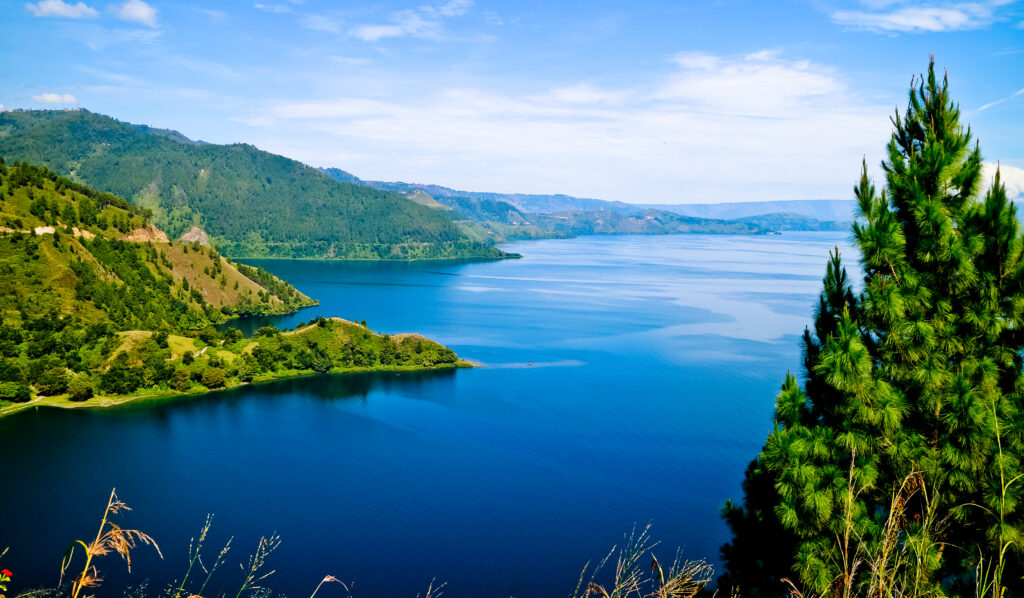
The Toba supervolcano ejected roughly 2,800 cubic kilometres of magma and ash — about 5,000 times more material than the 1980 Mount St. Helens eruption. The crater it left behind is now Lake Toba in Sumatra, a body of water 100 kilometres long. To put that in perspective: the eruption site is large enough that you could fit a small country inside it.
But what made the Toba catastrophe theory so scientifically explosive wasn’t the eruption itself — it was what researchers believe happened to human populations afterward. When geologists and geneticists started comparing ash layer evidence with human DNA data in the 1990s, they noticed something deeply strange: around the same time the eruption occurred, the genetic diversity in the human lineage appears to have crashed.
This is the genetic bottleneck hypothesis. The idea is that Toba didn’t just blanket the Earth in ash and cool global temperatures. It reduced Homo sapiens — possibly the entire global human population — down to somewhere between 3,000 and 10,000 breeding individuals. Some estimates go as low as a few hundred. Our entire species, compressed to a village.
What a Volcanic Winter Actually Means
After the eruption, Toba pumped sulfur dioxide into the stratosphere at a scale that created a global aerosol haze. Sunlight was partially blocked. Temperatures are estimated to have dropped by 3–5°C globally, with some models suggesting drops of up to 15°C in parts of the northern hemisphere. Forests retreated. Food chains collapsed. For human groups living in Africa, Asia, and Europe, it was an extinction-level stress event.
The term “volcanic winter” sounds dramatic, but it underestimates the lived reality. Imagine seasons where crops — had they existed — would fail. Where the megafauna your ancestors depended on migrates or starves. Where ash deposits contaminate water sources and coat plant life. This wasn’t a bad decade. This may have been a thousand years of profound ecological disruption.
And here’s the terrifying implication: if the Toba catastrophe theory is correct, humans came closer to disappearing from Earth than nearly any other large mammal species has come and survived. We got extraordinarily lucky — or extraordinarily resilient, which amounts to the same thing from a geological perspective.
The Genetic Evidence — And Why Scientists Still Debate It
The genetic bottleneck case for Toba draws heavily on mitochondrial DNA analysis. Humans have remarkably low genetic diversity for a large mammal species — far less than chimpanzees, for instance, despite chimps having a much smaller population. This lack of diversity suggests our lineage passed through a severe chokepoint at some point in the relatively recent past.
When Stanley Ambrose proposed the formal Toba catastrophe theory in 1998, he connected this genetic signal with the 74,000-year ash layer found in sediment records across South Asia, the Indian Ocean, and East Africa. The correlation seemed compelling: a near-extinction event inscribed in both geology and genetics simultaneously.
But science, as always, is messier than a good theory. More recent research has pushed back. Archaeological sites in South Africa and India show evidence of human activity continuing through the Toba ash layers, suggesting that some populations may not have collapsed at all. Stone tools were found below and above ash deposits, implying continuity, not catastrophe, in at least some regions.
This is one of those rare debates where the disagreement itself is revealing. Whether Toba caused a near-extinction or merely a severe regional disruption, it offers a window into the extraordinary fragility of early human existence. Even a revised, less catastrophic version of events is still a story about survival against the most extreme odds. Understanding the oldest DNA ever found is helping researchers reconstruct exactly how thin the thread of human continuity was during this period.
Toba Catastrophe Theory and What It Says About Human Resilience
If you accept even a moderate version of the Toba catastrophe theory, the implications cascade in fascinating directions. A population of a few thousand humans, geographically isolated, genetically bottlenecked, and under intense environmental pressure, would have faced selection pressures unlike anything before or since.
Some researchers argue that the cognitive and social traits we consider most distinctively human — advanced language, complex cooperation, abstract planning — may have been accelerated by exactly this kind of bottleneck event. When survival depends on tighter group coordination, on sharing information across a harsh landscape, on innovating faster than the environment punishes you, evolution doesn’t wait around.
This connects to a broader question about human uniqueness. The surprising reason humans are the only animals that cook food is itself an evolutionary story about how adaptive pressure shaped behaviour in ways that compounded over millennia. The Toba survivors, if the theory holds, were the most adaptable humans alive — and we are all their descendants.
Africa as the Refuge — and Why It Matters
One of the most interesting aspects of the Toba catastrophe theory is the geographic dimension. The ash fall was most dense across South Asia and the Middle East. Sub-Saharan Africa, while affected by temperature drops, may have been buffered by its distance from the eruption site and the relative stability of some forest refugia — pockets of livable habitat that survived the worst of the volcanic winter.
This is consistent with the out-of-Africa model of human migration. If the surviving human population was concentrated in Africa, then the subsequent re-expansion of Homo sapiens across Eurasia — which genetic evidence suggests happened roughly 60,000–70,000 years ago — would represent the repopulation of a world by a species that had nearly vanished from it.
We have other examples of Earth’s history being rewritten by catastrophe and recovery. The Great Oxidation Event nearly wiped out all anaerobic life on Earth roughly 2.4 billion years ago, before becoming the precondition for all complex life that followed. Disruption and near-extinction, it turns out, are recurring chapters in the story of life on this planet.
The Toba Catastrophe Theory in Modern Science
Toba continues to generate research and revision in equal measure. Advances in genomic sequencing have allowed scientists to date population bottlenecks more precisely, and the debate over whether the genetic evidence aligns with 74,000 years ago — or a different period — remains active. Some population geneticists suggest the bottleneck may pre-date Toba, complicating the causal story.
What the research has definitively established, regardless of the Toba debate, is that modern humans descend from a very small ancestral population. The genetic diversity of the entire human species is narrower than that of many single animal subspecies. We are, in genetic terms, a young and closely related family. Why the Cambrian Explosion still baffles scientists is another case study in how sudden, massive environmental shifts can both destroy and, paradoxically, diversify life — and the Toba event belongs in the same conversation about planetary-scale turning points.
There is also the question of other human species. At the time of the Toba eruption, Homo sapiens shared the planet with at least Neanderthals and Denisovans. Whether Toba affected those populations as severely — or helped clear ecological space for sapiens expansion — is another open question that paleoanthropology is slowly unpacking.
A Thread That Should Have Snapped
The Toba catastrophe theory, at its core, is a story about contingency. History as we know it — civilisation, language, philosophy, science, all of it — depends on a thread of human survival that may have been reduced to a few thousand people huddled in African refuges while ash fell from a sky that had gone grey.
That thread should, by any reasonable probability assessment, have snapped. It didn’t. And every subsequent development in human history — the emergence of art, agriculture, the fermi paradox question of why, if intelligence is common, we seem so alone — flows from that improbable continuity.
Perhaps the most unsettling version of the Toba story isn’t the near-extinction. It’s the reminder that existence is always conditional. The volcanic winter ended. The survivors endured. And then, slowly, the world they built from almost nothing became the world that eventually looked back and tried to understand how close it had all come to not happening at all.