
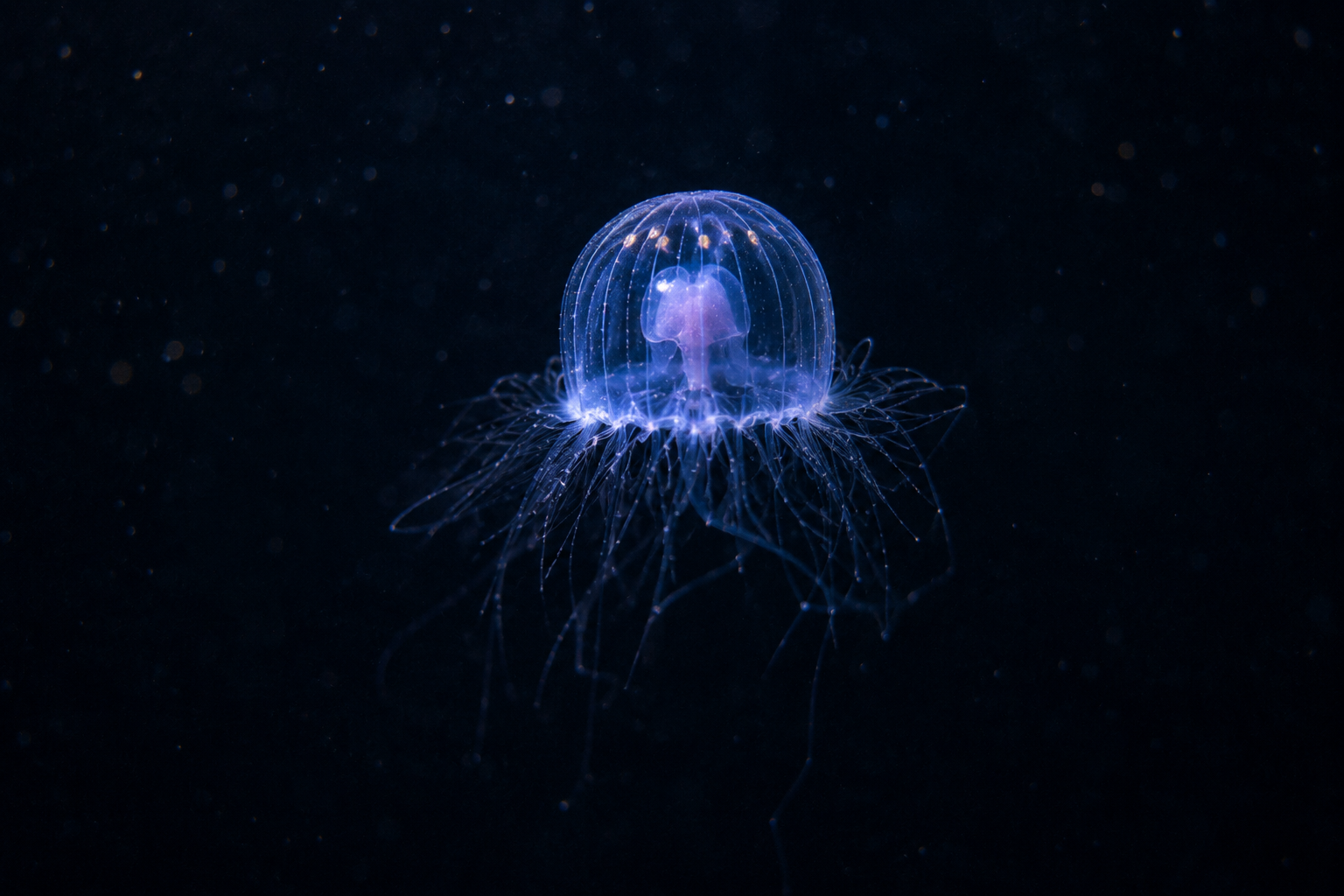
Immortal jellyfish biology is not a metaphor. Turritopsis dohrnii — a jellyfish smaller than a human fingernail — can reverse its own ageing cycle and return to its juvenile state after reaching full sexual maturity. Not once. Repeatedly. Indefinitely. In the entire catalogue of life on Earth, no other organism has been confirmed to do this. It is, by the strictest biological definition, potentially immortal.
This is not science fiction. It is one of the most quietly astonishing discoveries in modern zoology — and the implications of what this tiny animal is doing at the cellular level are only beginning to be understood.
What Turritopsis Dohrnii Actually Does
Most jellyfish follow the standard arc of life: larva becomes polyp, polyp becomes medusa (the adult, free-swimming form), medusa reproduces and dies. Turritopsis dohrnii follows this path too — until something goes wrong.
Under stress — starvation, physical damage, disease, even old age — this jellyfish does something no other animal is known to do reliably. It sinks to the seafloor, retracts its tentacles, and begins a process called transdifferentiation. Its mature, specialised cells — muscle cells, nerve cells, digestive cells — revert to an undifferentiated, stem-cell-like state. The adult medusa effectively dissolves back into a juvenile polyp. It is a biological reset. A complete reversal of developmental fate.
From that polyp, an entirely new medusa can grow. Same individual. New body. The clock doesn’t just slow — it runs backwards.
This challenges one of the most fundamental assumptions in developmental biology: that cellular differentiation is a one-way street. Once a cell becomes a muscle cell, it stays a muscle cell. Turritopsis dohrnii rewrites that rule entirely.
The Cellular Mechanics Behind the Reset
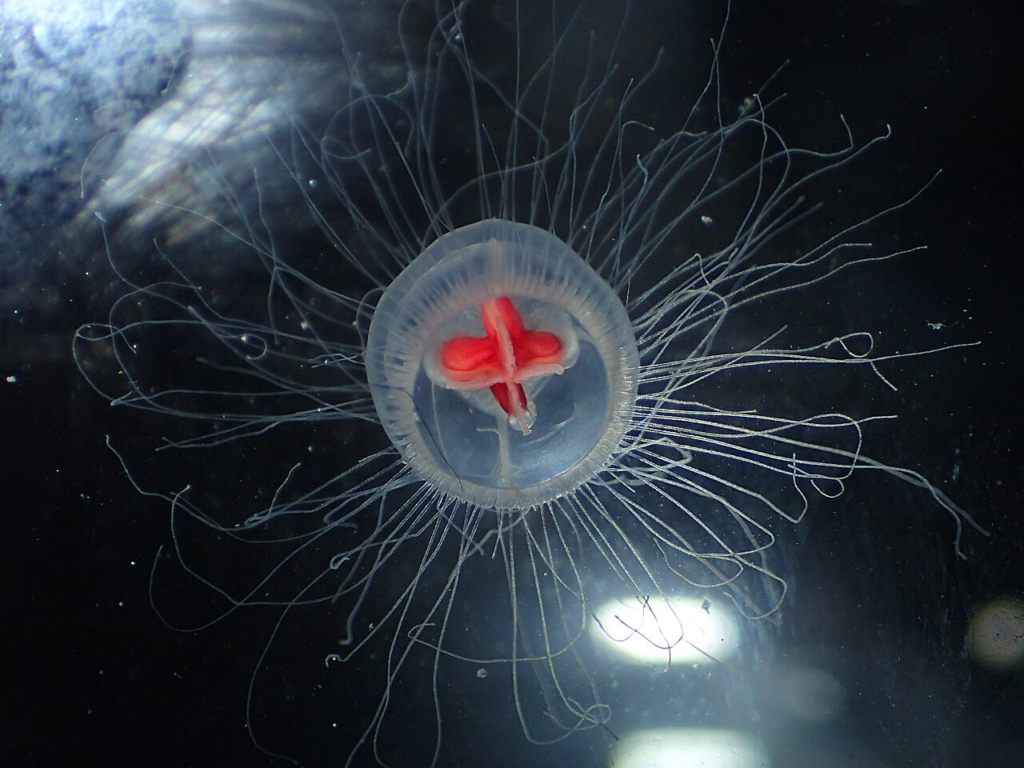
To understand immortal jellyfish biology properly, you have to go deeper than the behaviour and into the cell itself.
Transdifferentiation is not unique to this jellyfish — it occurs in limited forms in a handful of other organisms, including some of the simplest life forms that survived the Cambrian explosion. But the scale and completeness of what Turritopsis dohrnii achieves is unprecedented.
What triggers the reversal appears to be cellular stress signalling — the same kind of molecular distress call that, in humans, can trigger programmed cell death. In this jellyfish, instead of dying, the stressed cells appear to activate a set of genes associated with pluripotency: the capacity to become any cell type. Research published in the last decade has identified unusually high activity in genes related to DNA repair, stem cell maintenance, and cell cycle regulation in Turritopsis dohrnii — significantly higher than in its closely related but mortal cousin, Turritopsis rubra.
The jellyfish is not cheating death in some vague hand-wavy sense. It is running a precise, genetically encoded biological programme — one that evolution has preserved and refined over hundreds of millions of years. Understanding how DNA encodes and repairs itself across time gives some context for how deep these mechanisms run. The question researchers are now asking is not whether this process is real — it clearly is — but whether the underlying genetic logic can be applied elsewhere.
Is It Actually Immortal?
Here is where the story gets complicated.
Turritopsis dohrnii can, in theory, cycle between juvenile and adult states indefinitely. But “in theory” is doing a lot of work in that sentence. In the wild, these jellyfish are eaten by predators, killed by pollution, and destroyed by physical damage just like everything else. The biological reset is only triggered under specific stress conditions and requires the animal to survive long enough to complete it. In practice, most Turritopsis dohrnii die before they ever use it.
Immortal jellyfish biology is less about invincibility and more about biological potential — a failsafe that evolution installed, perhaps because for an organism this small and vulnerable, being able to restart was more effective than being able to fight. It is a strategy, not a superpower. One that life developed in the ocean long before complex land animals existed, in conditions that made radical cellular flexibility worth the metabolic cost.
There is also the question of identity — one that immortal jellyfish biology raises but cannot resolve on its own. If the medusa reverts to a polyp and a new medusa grows, is it the same individual? The genetic material is identical. But the memories — if jellyfish can be said to have anything resembling them — are gone. The nervous system is rebuilt from scratch. Whether that counts as immortality or as a very elegant form of reproduction is a question biology alone cannot answer.
What It Means for the Rest of Us
The honest answer is: we don’t know yet. But the scientific interest in immortal jellyfish biology has grown sharply in the last two decades, and it is not hard to see why.
Ageing in complex organisms is driven largely by the gradual failure of cells to replicate accurately, repair damage, and maintain their specialised functions. The genes that Turritopsis dohrnii activates during transdifferentiation — the ones governing DNA repair, telomere maintenance, and stem cell renewal — are versions of genes that exist in humans too. They just don’t behave the same way.
If researchers can understand what switches these genes on in the jellyfish, and whether any of that logic is transferable, the implications for age-related disease research are considerable. Not immortality for humans — the complexity gap between a jellyfish and a mammal is vast. But potentially new tools for understanding why human cells age, why cancerous cells sometimes seem to recapture pluripotency in destructive ways, and what the gut microbiome and cellular environment contribute to long-term cell health.
A creature the size of a pinhead, drifting in the Mediterranean, has been quietly solving one of biology’s oldest problems for millions of years. It doesn’t know what it’s doing. It doesn’t need to. Evolution found the answer long before we thought to ask the question.
Immortal jellyfish biology is, at its core, a reminder that the most radical ideas in science are often not invented in laboratories. They are discovered in the ocean, in the dark, living their strange and improbable lives entirely without our permission.