
Before you were born, your grandmother was already carrying the egg that would become your mother. That’s about as nested as human biology gets — two generations, overlapping in time, briefly sharing the same body.
An aphid laughs at this.
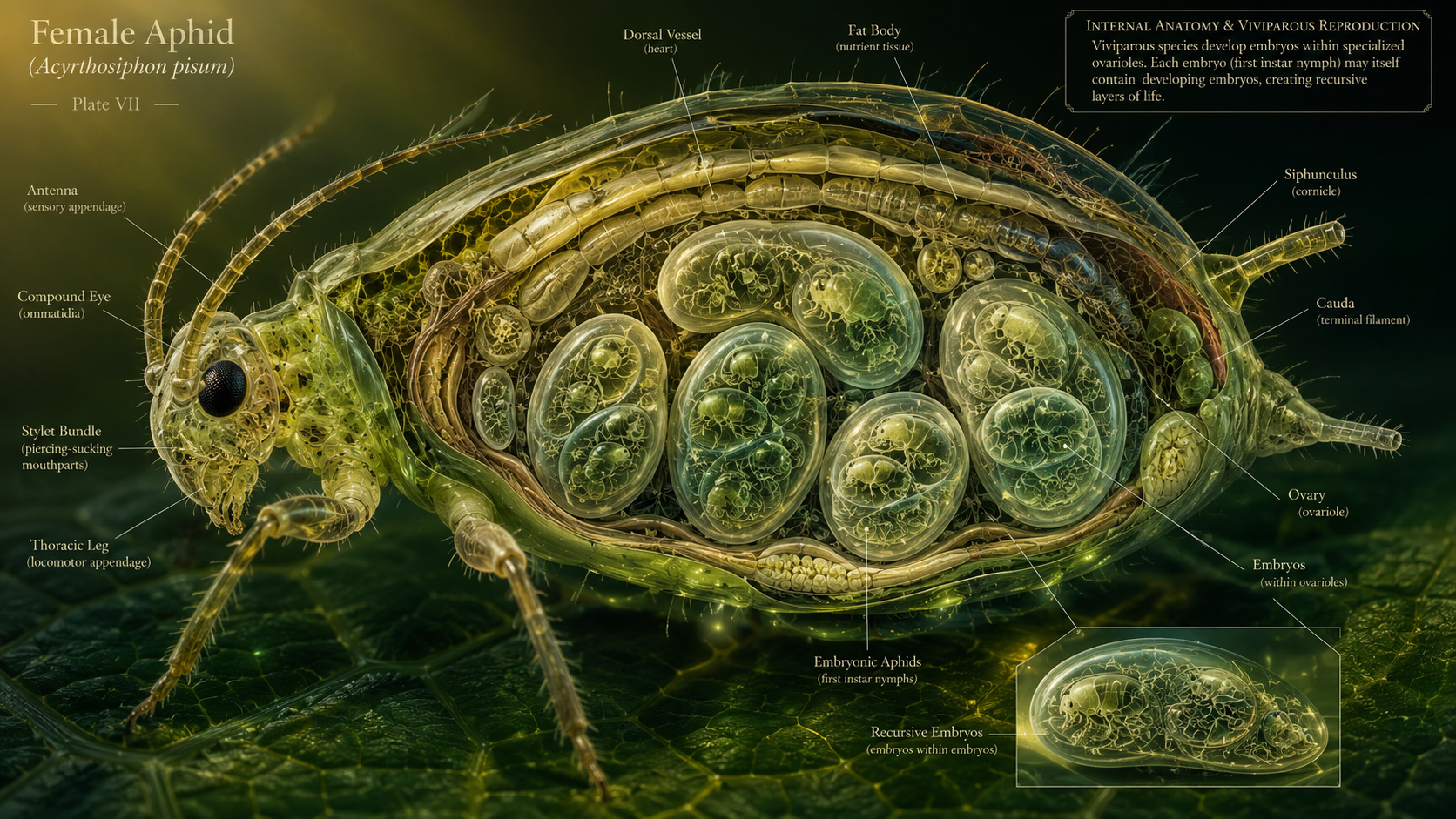
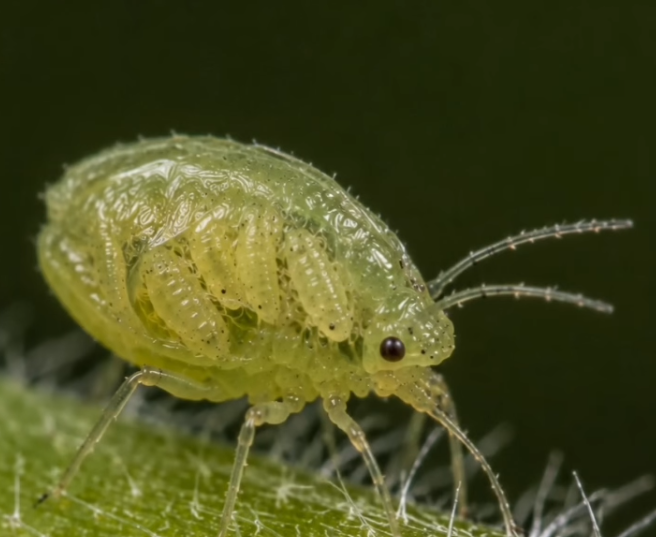
When a female aphid enters the world, she doesn’t just arrive as a blank slate ready to grow up and reproduce. She arrives already pregnant. And the embryos developing inside her? They already have their own embryos developing inside them. Three generations — grandmother, mother, grandchild — exist simultaneously inside a single body the size of a sesame seed. It is, without question, one of the strangest reproductive strategies in all of biology. And understanding the aphid life cycle means confronting just how alien life on this planet can be, even in your garden.
The Russian Doll Problem of Being an Aphid
The phenomenon has a name: telescoping generations. It sounds clinical, almost boring. The reality is anything but.
During spring and summer, female aphids reproduce entirely without males — a process called parthenogenesis, meaning “virgin birth.” No mating, no fertilization, no genetic input from another individual. The mother simply begins building embryos that are, essentially, copies of herself. But here’s where it gets genuinely strange: those embryos don’t wait to be born before starting the same process. While still inside their mother’s body, they begin developing embryos of their own.
The result is a biological Russian doll. You have a living aphid. Inside her, daughters already forming. Inside those daughters, granddaughters already beginning. All of it happening at once, in real time, inside an organism you could crush between two fingers without noticing.
This isn’t a metaphor or an approximation. It is literally what’s happening inside an aphid on a warm spring day.
Why Evolution Invented This
To understand why the aphid life cycle works this way, you have to think like a creature that has been optimized by hundreds of millions of years of evolutionary pressure. Aphids are soft-bodied, slow-moving, and nutritious. Everything wants to eat them — ladybugs, lacewings, parasitic wasps, birds, spiders. Their primary defence against a world full of predators is not speed, armour, or venom.
It’s numbers.
An aphid that can give birth to a live, already-developing daughter within days of being born herself doesn’t just reproduce fast — she reproduces exponentially. Each daughter arrives pre-loaded with the next generation. The population doesn’t add; it compounds. Biologists estimate that under ideal conditions, a single aphid could theoretically produce hundreds of billions of descendants in a single season if nothing stopped them.
Nature, of course, stops them. Predators, disease, temperature, and resource limits all apply brakes. But the telescoping generation strategy means that even with enormous losses, aphid colonies can recover and expand with terrifying speed. It’s an arms race written in reproductive biology — and aphids are very, very good at it.
This kind of evolutionary ingenuity is everywhere in the insect world. The zombie fungus that hijacks ant brains is another example of how survival pressure has produced strategies that seem almost impossibly strange to human observers. But aphids achieve their dominance not through parasitism or mind control — just through the sheer, compounding mathematics of being born pregnant.
The Clone Army and Its Hidden Weakness
Here’s the other side of the coin. Every aphid born during the warm season is a genetic clone of her mother. No mixing, no variation, no shuffling of chromosomes. What works for the mother works for every single daughter and granddaughter, right down the line.
This is brilliant — until it isn’t.
In stable conditions, a clone army is devastatingly efficient. Every individual is already optimized for the current environment. There’s no wasted genetic diversity, no individuals born ill-suited to present conditions. But when the environment changes — a new pesticide, a new fungal pathogen, a shift in temperature — the entire colony is equally vulnerable. The same trait that makes one aphid susceptible makes all of them susceptible. There’s no variation to hide behind, no outlier that happens to carry resistance.
It’s a gamble that evolution has clearly decided is worth taking. The speed advantage of parthenogenesis outweighs the fragility of genetic uniformity — at least during the good times.
Interestingly, this trade-off between speed and resilience appears across nature in different forms. The story of how fungi communicate across forest floors shows another system that prioritizes network efficiency over individual robustness. Evolution keeps arriving at the same kinds of compromises, just wearing different disguises.
Winter Changes Everything
As autumn approaches, something shifts inside aphid colonies. The days shorten. Temperatures drop. And the aphid, sensing these changes through hormonal cues, abandons parthenogenesis entirely.
Sexual reproduction returns.
Males are born — the only time during the aphid’s annual cycle when males exist at all. Females that will lay eggs rather than give birth to live young appear. Mating occurs. Eggs are laid on plant stems, tough-shelled and cold-resistant, designed to survive the winter that would kill any exposed adult aphid within days.
These eggs carry something the summer clones never had: genetic recombination. Two sets of DNA mixing, shuffling, producing offspring that are genuinely novel combinations — not copies. It’s slower, less efficient, metabolically expensive. But it introduces the variation that makes the population resilient across years, capable of adapting as environments shift.
Then spring arrives. The eggs hatch. A single female emerges — already, of course, pregnant — and the whole cycle begins again.
This alternation between asexual and sexual reproduction depending on environmental conditions is one of the most elegant adaptive strategies in the insect world. It’s a system that gets the best of both worlds: explosive growth when conditions are good, genetic flexibility when survival depends on it. The Cambrian explosion produced the ancestors of insects through a similarly dramatic burst of adaptive experimentation — and aphids feel like a living echo of that ancient evolutionary creativity.
The Ants Who Farm Them
No discussion of the aphid life cycle is complete without the ants.
Aphids feed by piercing plant tissue and drawing out phloem sap — the sugar-rich fluid that plants use to transport energy. It’s a resource-rich meal, but far more sugar arrives than an aphid can use. The excess gets excreted as a sticky, sweet liquid called honeydew.
Ants discovered this resource a very long time ago.
Many ant species have evolved a full mutualistic relationship with aphids. They stroke the aphids with their antennae — a behaviour called “milking” — stimulating them to release droplets of honeydew. In exchange, the ants protect the aphid colony from predators, drive off ladybugs and parasitic wasps, and sometimes carry aphids to new, more productive plants when food runs low. Some ant species even bring aphid eggs into their underground nests during winter, keeping them safe and warm, then returning them to plants in spring.
The aphid, in this arrangement, has essentially been domesticated. It exists in a relationship that looks remarkably like livestock farming — except it evolved independently, through millions of years of mutual reinforcement, with no conscious intent on either side. It is one of the more quietly astonishing examples of what evolutionary pressure can produce when two species’ interests happen to align.
We tend to think of agriculture as a uniquely human invention. The surprising story of how humans became the only cooking animal shows how transformative food processing has been for our species. But ants were farming long before Homo sapiens existed — and they didn’t need fire, language, or tools to get there.
What Three Generations in One Body Actually Means
It’s worth sitting with this for a moment, because it’s easy to absorb the aphid life cycle as a list of facts and miss how genuinely strange it is.
When a female aphid is born, the individual inside her is already alive — already developing, already building the next generation within herself. The boundary between one life and the next is not the moment of birth. It’s smeared across time, overlapping, nested. An aphid is, in some sense, never truly separate from her descendants. They exist inside her before she exists in the world in any fully independent way.
Biology is full of moments that destabilize our intuitions about what life is and how it works. The discovery of the oldest DNA ever found reminded us that the information of life can persist across timescales almost beyond comprehension. The aphid reminds us of something equally disorienting: that the boundaries between individual lives can be far stranger and more fluid than they appear.
A creature that is born pregnant, whose daughters are born pregnant, whose granddaughters are already forming — this is not a curiosity. It is a window into how radical evolution’s solutions can be when the pressure is high enough and the time is long enough.
The next time you see a cluster of tiny green insects on a rose stem, you’re looking at something extraordinary. Not just a pest. A dynasty, unfolding in real time — three generations deep, already in motion, built by hundreds of millions of years of extraordinarily patient experimentation.