
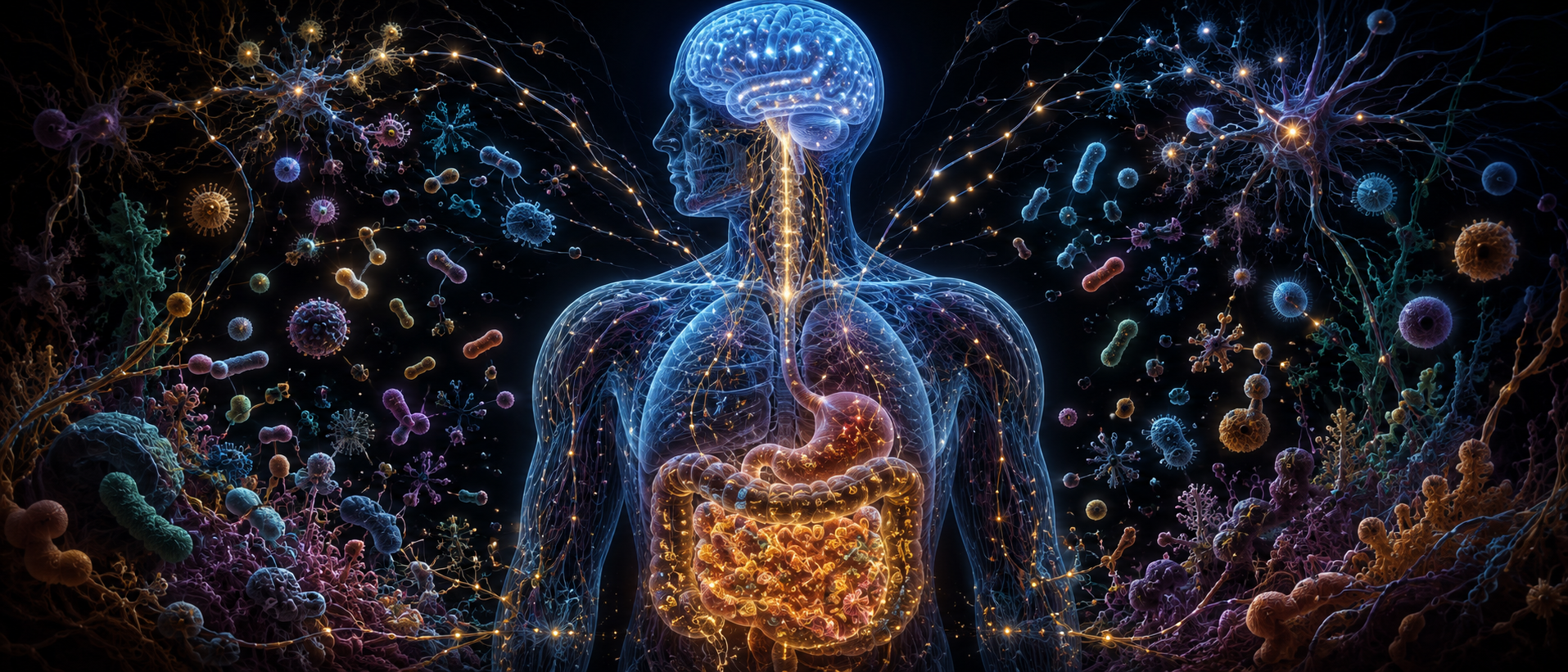
There’s something unsettling about the idea that the bacteria living in your intestines might have more say over how you feel today than your actual brain does. And yet, the more scientists dig into the gut-brain connection, the harder it becomes to dismiss. Your gut microbiome and mood are linked in ways that feel less like biology and more like a quiet conspiracy — one that’s been operating beneath your awareness your entire life.
How the Gut Microbiome and Mood Got Scientists’ Attention
For most of modern medicine’s history, the brain was the unquestioned seat of emotion. Depression was a brain disease. Anxiety lived in neural circuits. The gut was, at best, a metaphorical participant — the nervous stomach, the gut feeling. But researchers started noticing something strange in animal studies: germ-free mice, raised without any gut bacteria at all, behaved very differently from mice with normal microbiomes. They were more anxious. More reactive to stress. When you gave them microbiomes from anxious mice, they became anxious themselves.
That’s not a metaphor. That’s bacteria changing behaviour.
The gut hosts approximately 100 trillion microorganisms — bacteria, fungi, viruses, archaea — collectively weighing about 1.5 kilograms. This community of microbes, called the gut microbiome, produces a staggering range of neurochemicals. Around 90% of the body’s serotonin is made in the gut. GABA, the brain’s primary calming neurotransmitter, is also synthesised there. Dopamine precursors, short-chain fatty acids that influence inflammation, and compounds that directly affect how stress hormones are regulated — all produced, at least partially, by the trillions of microorganisms you’ve been unknowingly co-existing with since birth.
The brain is far more connected than imagined — but it turns out those connections are deeply influenced by signals that start nowhere near the skull.
The Gut-Brain Axis: A Two-Way Street You Didn’t Know Existed
The communication channel between your gut and brain is called the gut-brain axis, and it’s far more complex than a simple nerve pathway. It runs through the vagus nerve — one of the longest nerves in the body, stretching from the brainstem all the way down to the abdomen — but also through the immune system, the endocrine system, and the bloodstream.
What makes this unusual is the direction of traffic. Most people assume the brain sends signals down to the gut (hence: butterflies before a stressful event). That’s true. But roughly 80–90% of the signals travelling along the vagus nerve go upward — from the gut to the brain. Your gut is talking to your brain far more than your brain is talking to your gut.
This means that the microbial communities in your intestines are constantly sending chemical and electrical signals upward, influencing everything from stress response and emotional regulation to sleep quality and cognitive performance. It’s not that the gut replaces the brain. It’s that the gut is, in many ways, an upstream input to the emotional processing your brain then takes credit for.
It also helps explain something strange about why humans evolved to cook. The relationship between what we eat, what microbes colonise us, and how we feel is ancient — and running far deeper than nutrition.
What Disrupted Gut Bacteria Actually Do to Mental State
The clinical term is dysbiosis — a disruption or imbalance in gut microbial populations. And the mental health consequences of dysbiosis are beginning to look significant.
The link between gut bacteria and depression is one of the most replicated findings in this field — people with major depressive disorder consistently show measurably different gut microbiome compositions compared to healthy controls. Lower levels of Lactobacillus and Bifidobacterium. Higher levels of certain pro-inflammatory bacterial strains. Reduced microbial diversity overall. These aren’t minor statistical quirks — they replicate across multiple independent studies on different continents.
One mechanism is through the HPA axis (hypothalamic-pituitary-adrenal axis), which controls cortisol and the body’s stress response. Gut bacteria regulate the sensitivity of the HPA axis. When your microbiome is disrupted, the HPA axis can become dysregulated — leaving people in a state of chronic low-grade stress response even when no external threat is present. That state feels, to the person experiencing it, like anxiety. Like dread. Like the vague sensation that something is wrong.
The human addiction to bad news might partly be a downstream effect of exactly this: a nervous system primed for threat by signals it’s receiving from below the diaphragm.
The gut also produces and regulates inflammatory cytokines. Chronic low-grade gut inflammation — common with dysbiosis — sends inflammatory signals to the brain, and neuroinflammation has increasingly been implicated in both depression and anxiety. The old model of depression as a simple serotonin deficiency is being rapidly replaced by something more complicated — a model in which inflammation, microbiome disruption, and metabolic dysfunction all interact.
The Psychobiotics Hypothesis: Can You Eat Your Way to a Better Mood?
If gut bacteria affect mood, the logical next question is whether you can deliberately alter gut bacteria to improve mental health. This is the emerging field of psychobiotics — a term coined by researchers Ted Dinan and John Cryan to describe probiotics that, when ingested in adequate amounts, produce measurable mental health benefits. Psychobiotics mental health research is still young, but the early signals are hard to ignore.
Early results are genuinely interesting. A 2019 study published in Nature Microbiology found that across 1,000 participants, lower levels of Coprococcus and Dialister bacteria were consistently associated with lower quality of life and higher rates of depression — even after controlling for antidepressant use. Another study by the Lewin Lab at the Weizmann Institute found that simply increasing dietary fibre altered gut microbiome composition in ways that correlated with improved mood within weeks.
None of this means you can replace antidepressants with yogurt. The psychobiotics research is promising but still early — the species are diverse, individual microbiomes vary enormously, and the specific mechanisms are still being mapped. But the broader point stands: what you eat influences who lives in your gut, and who lives in your gut influences how you feel.
The fungus that hijacks animal brains does so by commandeering neurochemistry from the outside. The gut microbiome does something eerily similar — not as a parasite, but as a partner that’s slowly revealing how much leverage it actually has.
Stress Works Both Ways: Your Mood Shapes Your Microbiome Too
Here’s where the gut-brain axis becomes genuinely vertiginous. The relationship is bidirectional.
Stress — sustained, chronic stress — has been shown to alter gut microbiome composition directly. It changes gut motility, increases intestinal permeability (what gets described in popular media as “leaky gut”), and creates conditions in the gut environment that favour certain bacterial populations over others. So a stressful period in your life reshapes your microbiome. That reshaped microbiome then sends different signals to your brain. Which affects your mood and stress tolerance. Which further affects your gut.
Chronic overthinking and ruminative anxiety — the kind that feeds on itself — may be partly maintained by this feedback loop. The gut dysbiosis caused by stress produces neurochemical signals that make the stress response harder to turn off. Which produces more dysbiosis. The loop is not infinite, but it can become self-reinforcing in ways that purely brain-focused interventions struggle to fully interrupt.
This has practical implications for psychiatry. If you treat depression purely pharmacologically without addressing the gut microbiome — the diet, the inflammation, the dysbiosis — you may be managing symptoms downstream while the underlying signal keeps transmitting. It’s one reason why exercise (which dramatically improves microbial diversity), dietary change, and sleep quality all show outsized effects on depression that can’t be entirely explained by their effects on the brain alone.
The Gut Microbiome and Mood: What We Don’t Know Yet
The science is compelling but not complete. We don’t yet have a precise map of which bacterial species produce which neurochemicals in which quantities. We don’t know how much individual variation matters — and human microbiomes are staggeringly different from person to person, shaped by geography, diet, antibiotic history, birth method, and a dozen other factors.
We don’t fully understand why gut microbiome and mood correlations are strong in population studies but highly variable in individuals. And we don’t know whether the gut microbiome changes observed in depression and anxiety are causes, consequences, or both.
What we do know is that sleep’s role in brain detox and the research on gut-brain communication are starting to converge around the same uncomfortable conclusion: the brain is not running the show alone. It is embedded in a biological system far wider than the skull — one that includes a living ecosystem of trillions of microorganisms that have been quietly shaping human cognition and emotion for as long as humans have existed.
The Body Is Not Just a Vehicle for the Brain
There’s a deeply held intuition in Western culture that the self lives in the mind. The body is transport. The brain is the director. Everything else is logistics.
The gut-brain connection challenges that intuition at its foundation. It suggests that your emotional life — your anxiety, your low moods, your capacity for resilience — is partly an output of microbial chemistry happening in your intestines. The intestinal microbiome and emotions are not metaphorically linked but biochemically entangled in ways we are only beginning to quantify. That the gut microbiome and mood operate as a system, not a hierarchy.
This is not a reason to panic. It is, however, a reason to be less confident that you know where you end and the rest of your biology begins.