

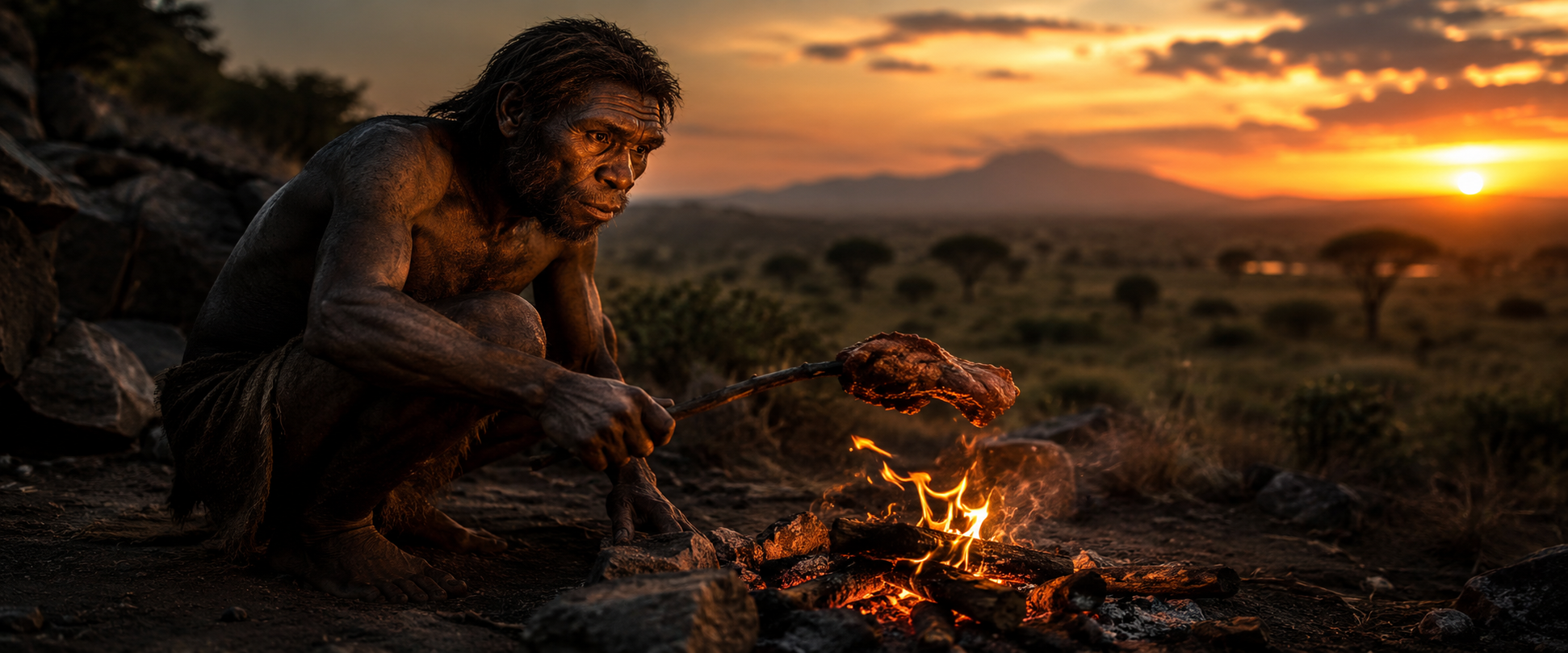
Understanding why humans cook food evolution unfolded the way it did is one of the most fascinating questions in all of science. Think about the last meal you cooked. Whether it was a simple bowl of pasta or a full Sunday roast, you performed an act that no other species on Earth does — you deliberately transformed raw ingredients using heat before eating them. Dogs don’t do it. Chimpanzees don’t do it. No bird, fish, insect, or mammal does it. Only us.
But the answer to why humans cook food isn’t just about taste or tradition. It cuts right to the heart of what made us human in the first place — and the story begins nearly two million years ago.
Why Humans Cook Food: The Question That Stumped Scientists
For a long time, cooking was treated as a cultural quirk — a clever trick humans picked up somewhere along the way, like making pottery or weaving cloth. Interesting, sure, but hardly central to our identity as a species.
That all changed in 1999 when Harvard biological anthropologist Richard Wrangham published a paper that reframed everything. He proposed something radical: humans don’t just cook food because we can. We cook because, biologically speaking, we have to. And more than that — cooking is the very reason we became human at all.
He called it the Cooking Hypothesis, and it turned the field of paleoanthropology on its head. Wrangham later expanded the idea in his 2009 book Catching Fire: How Cooking Made Us Human, which remains the definitive text on the subject.
What Cooking Does to Food: The Calorie Unlock
Before diving into the why humans cook food evolution argument, it helps to understand what heat actually does to food on a biological level.
When you cook a piece of meat or a root vegetable, something remarkable happens. Heat breaks down tough cell walls, unravels protein structures, and gelatinizes starches — essentially doing part of the digestive work before the food even enters your body. The result? Your gut extracts significantly more usable calories from cooked food than it would from the same food eaten raw.
Studies on animals have confirmed this repeatedly. Mice fed cooked meat gain more body mass than mice fed raw meat of identical caloric content, even when the raw meat is ground up to make digestion easier. The difference isn’t small — cooking can increase the energy your body absorbs from food by anywhere from 20% to over 50%, depending on what’s being eaten.
This is the core of the argument: cooking is essentially an external pre-digestion system — one that unlocked a caloric surplus our ancestors had never experienced before.
The Brain That Couldn’t Be Fed by Raw Food
Here’s where the why humans cook food evolution story gets truly fascinating. The human brain is extraordinarily expensive to run. It accounts for roughly 20% of your body’s total energy use, despite making up only about 2% of your body weight. No other organ demands so much for its size.
For millions of years, this created an almost impossible constraint. How do you fuel a growing brain when your food source — raw plants, tough tubers, unprocessed meat — delivers calories so inefficiently that you’d need to spend nearly half your waking hours just chewing?
Chimpanzees, our closest living relatives, face exactly this problem. They spend around six hours a day chewing. Their jaws are massive, their teeth large, their gut proportionally enormous. All of that machinery is dedicated to processing raw food. And even with all that effort, they simply cannot extract enough calories to support a brain the size of ours.
Wrangham’s argument is that fire broke this ceiling. By pre-softening and pre-digesting food externally, our ancestors suddenly had access to far more energy from the same amount of food, in far less time. That caloric surplus went somewhere: into growing bigger, more complex brains.
How Cooking Reshaped the Entire Human Body
If cooking really did drive human evolution, you’d expect to see physical evidence — and we do, written into our own skeletons and organs.
Look at the timeline: around 1.8 million years ago, a new species appeared in the fossil record. Homo erectus was strikingly different from the australopithecines that came before. Compared to earlier hominins, Homo erectus had a significantly larger skull and brain cavity, smaller teeth and weaker jaw muscles, a shorter narrower digestive tract, and a smaller rib cage to accommodate a shrunken gut.
All of these changes are consistent with a species that had shifted to a cooked diet. Smaller jaws and teeth make sense when food is soft. A shorter gut makes sense when food arrives pre-digested. And a bigger brain becomes possible when the caloric burden on the gut is reduced.
This trade-off is known as the Expensive Tissue Hypothesis — the idea that since both the brain and gut are metabolically costly, evolution couldn’t easily grow one without shrinking the other. The why humans cook food evolution theory positions cooking as the exact mechanism that made that bargain possible.
“Cooking is the signature feature of the human diet, and indeed, of human life.” — Richard Wrangham, Harvard University
Time: The Hidden Gift of the Campfire
There’s another angle to the why humans cook food evolution story that doesn’t get enough attention: time.
A chimpanzee’s day is largely consumed by foraging and chewing. Eating raw food is slow, exhausting work. Cooking doesn’t just give you more calories — it gives you your hours back.
Wrangham estimates that cooking may have freed up several hours of chewing time per day for early humans. And what did they do with those hours? They used tools. They formed social bonds. They communicated, cooperated, and planned. The campfire wasn’t just a cooking device — it was the original meeting place, the first social hub where language, culture, and community could develop.
In this sense, the campfire didn’t just feed our brains. It gave us the time to use them.
Why No Other Animal Evolved to Cook
This raises an obvious question: if cooking is so beneficial, why hasn’t any other animal figured it out?
The honest answer is that cooking requires a remarkable combination of abilities that, as far as we know, only humans ever developed together: the ability to control fire, the capacity to understand delayed reward, sufficient manual dexterity, and crucially — the cognitive architecture to plan, teach, and pass the behaviour on across generations.
Interestingly, many animals prefer cooked food when offered it. Chimpanzees, bonobos, gorillas, and orangutans have all been shown to choose cooked versions of food over raw alternatives. So the preference exists — what’s missing is the ability to act on it.
Humans crossed that threshold. Nothing else did. This is a central pillar of the why humans cook food evolution theory — the behaviour and the biology co-evolved in a feedback loop unique to our lineage.
The Archaeological Evidence (and Its Limits)
One challenge for the cooking and human evolution argument is the archaeological record. Physical evidence of controlled fire use — charred bones, hearth-like structures — becomes reliable only around 800,000 years ago, long after Homo erectus appeared at 1.8 million years ago.
Wrangham argues this gap doesn’t disprove the hypothesis — it just reflects how poorly ancient fires preserve over geological time. Small campfires used by hunter-gatherers, like those of the Hadza people in Tanzania today, leave almost no lasting trace. The biological changes in the fossil record, he argues, are the more reliable signal.
The debate remains ongoing. Some researchers suggest that meat-eating — particularly energy-dense marrow and brain matter — might explain some of the same anatomical changes without requiring fire. But even sceptics tend to agree that once cooking became regular, its evolutionary consequences were enormous.
What This Means for Us Today
The evolutionary legacy of why humans cook food shows up in unexpected ways in modern life.
Raw food diets, for example, are genuinely difficult to sustain. Studies of people who eat exclusively raw food show that around half of raw foodist women stop menstruating due to chronic energy deficit — their bodies simply cannot extract enough calories from unprocessed food to maintain normal reproductive function. We have become, over 1.8 million years, obligate cookers — a species that biologically depends on the practice.
Our small jaws and teeth, our short guts, our enormous calorie-hungry brains — all of it is shaped by fire. Every time you turn on a hob or light a grill, you’re continuing a tradition that stretches back almost two million years, one that quite literally made you the creature you are.
The Bottom Line
The answer to why humans cook food evolution shaped us so profoundly is both simple and staggering: cooking unlocked calories that raw food couldn’t deliver efficiently enough, allowing our ancestors’ brains to grow to sizes that would have been metabolically impossible otherwise.
Fire, in this view, isn’t just a tool humans discovered. It’s the forge in which the modern human mind was built.
The next time you smell something sizzling in a pan, you’re not just preparing dinner. You’re reenacting the ancient act that separated our lineage from every other creature on Earth — and doing something that, across two million years of life on this planet, nothing else has ever learned to do.
Leave a Reply
You must be logged in to post a comment.