
Four billion years ago, there was no life on Earth. Then, at some point, there was. Something happened in the gap — some chemical event so improbable, so specific, and so consequential that it set off a chain reaction that eventually produced every living thing that has ever existed, including you.
What was that event? How did chemistry become biology? These are the core questions origin of life science has wrestled with since Darwin first dared to imagine a warm little pond.
The question of how life began on Earth is the oldest in science. And in 2026, a team of researchers in Cambridge published findings that brought humanity closer to answering them than ever before. They created a small RNA molecule — a ribozyme — that can copy itself. Not just its complementary strand, but a functional copy of the entire molecule. A molecule that makes more of itself.
The RNA world hypothesis explained in a single sentence: life didn’t begin with DNA, cells, or proteins — it began with RNA, a simpler molecule that could both carry genetic information and catalyze chemical reactions, all at once. What was once a compelling theory just became substantially harder to dismiss.
The Problem With Every Other Theory of Life’s Origin
Before getting to what the 2026 discovery actually showed, it helps to understand why the origin of life has been so impossibly difficult to explain.
The central problem is a chicken-and-egg paradox that has frustrated biologists for over a century. Modern life requires three types of molecules working in concert: DNA, which stores genetic information; proteins, which do the chemical work of the cell; and RNA, which acts as a messenger between the two. The problem is that none of these can exist without the others. DNA cannot replicate without proteins. Proteins cannot be made without DNA. And neither can function without RNA coordinating between them.
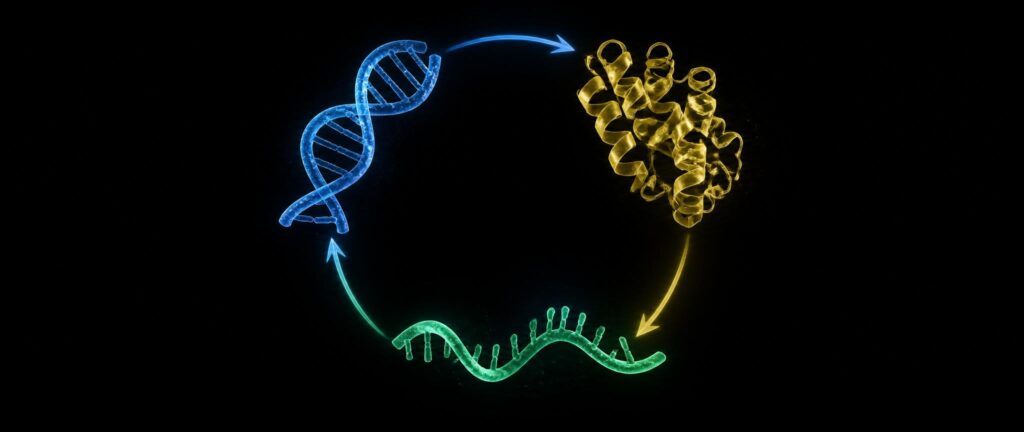
So which came first? How did this perfectly interdependent system bootstrap itself from nothing?
The origin of life science field has long been divided between two dominant theories. The first, sometimes called the “genetics first” model, proposed that some molecule capable of carrying and copying information appeared first — establishing heredity before metabolism. The second, “metabolism first,” argued that a network of self-sustaining chemical reactions emerged before any information-carrying molecule, creating the energy flows that life would later exploit.
Both theories had fatal weaknesses. Genetics-first couldn’t explain how a replicating molecule arose without cellular machinery to support it. Metabolism-first couldn’t explain how a chemical network acquired the ability to encode and transmit information across generations. Neither could fully account for the leap from chemistry to life.
The RNA world hypothesis explained a potential resolution: what if the first molecule did both? What if one molecule carried information and catalyzed reactions — making the chicken-and-egg problem irrelevant because both capabilities lived in the same place?
What RNA Actually Is — And Why It’s Special
RNA — ribonucleic acid — is one of the most ancient molecules in biology. It predates DNA in evolutionary terms, and in modern cells it still performs functions that hint at its primordial origin. Unlike DNA — which modern science can now edit with tools like gene editing without breaking DNA — RNA is reactive, flexible, and catalytically active. It can fold into complex three-dimensional shapes that allow it to perform chemical reactions — the same role that proteins play in modern cells.
This dual capacity — information storage plus catalytic activity — is what makes RNA uniquely suited to the starring role in the RNA world hypothesis. A molecule that can both carry a genetic blueprint and act as its own construction crew doesn’t need a cell, a protein, or any pre-existing biological infrastructure to get started. It just needs the right chemical environment and enough time.
The concept has been around since the 1980s, when molecular biologist Walter Gilbert coined the term “RNA world” after the discovery that RNA could catalyze its own reactions. But ribozyme self-replication — the complete copying of an RNA molecule by itself — had never been fully demonstrated until now. But the hypothesis always had a critical gap: nobody had demonstrated that an RNA molecule could actually copy itself completely — that it could produce a functional replica of the whole molecule, not just a partial strand.
That gap was what the Cambridge team closed.
The 2026 Discovery — A Molecule That Makes Copies of Itself
The researchers developed a small polymerase ribozyme — the same class of molecule at the center of ribozyme self-replication research for decades — that acts as a molecular copying machine. Previous versions of similar molecules could synthesize complementary RNA strands, but they couldn’t complete the final step: producing a full, functional copy of themselves. They’d get most of the way there and stall.
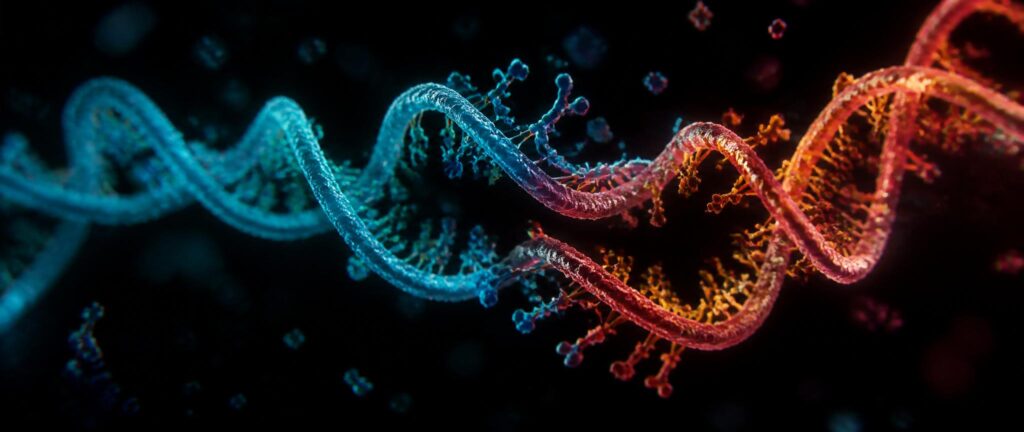
The 2026 version didn’t stall. It synthesized its complementary strand and then used that strand as a template to produce a copy of the original molecule. The process is called self-replication: the molecule makes more of itself, without any protein enzymes, without any cellular machinery, without any biological assistance whatsoever.
This is interpreted as the strongest experimental support yet for the RNA world hypothesis explained through direct demonstration rather than theoretical argument. For the first time, scientists didn’t just propose that RNA could have self-replicated in the early Earth — they showed an RNA molecule doing it in a laboratory.
The implications cascade outward in multiple directions. Much like single chemical shift changed everything when oxygen first flooded the atmosphere, a self-replicating RNA molecule represents the kind of threshold event that divides all of history into before and after.
What This Tells Us About How Life Began
The early Earth was a radically different place from the planet we inhabit now. Four billion years ago, the atmosphere contained almost no oxygen. The oceans were warm and chemically rich — loaded with the raw molecular components that chemistry needed. Hydrothermal vents on the seafloor pumped mineral-rich water into the deep ocean, creating chemical gradients that could drive reactions. Tidal pools on the surface evaporated and concentrated molecules, then refilled, creating cycles of chemical enrichment.
In this environment, the RNA world hypothesis explained through the Cambridge findings becomes startlingly plausible. You don’t need a cell. You don’t need an enzyme. You don’t need a genetic code. You just need a self-replicating RNA molecule of the right sequence to form spontaneously — and in a sufficiently large, chemically rich ocean over millions of years, “spontaneous formation” stops being astronomically improbable and starts being statistically inevitable.
Once the first self-replicating RNA molecule appeared, everything that followed was a consequence. Copying is imperfect — errors creep in. Errors mean variation. Variation means some copies replicate better than others. Better replicators produce more copies. This is natural selection operating at the molecular level — the same drive toward persistence that makes the jellyfish that reverses aging so biologically astonishing. Before there were cells, before there were organisms, before there were species. It is evolution in its most naked and primitive form.
This is the moment that separates the merely chemical from the genuinely biological. And the fossil record that followed — with its sudden explosion of complex animal life — is the downstream consequence of what began in a warm puddle with a molecule copying itself.
The RNA World Hypothesis Explained — What It Still Doesn’t Answer
Origin of life science is honest about what remains unknown, and it would be dishonest to present this discovery as the final word. The RNA world hypothesis, even strengthened by the 2026 findings, still leaves significant questions open.
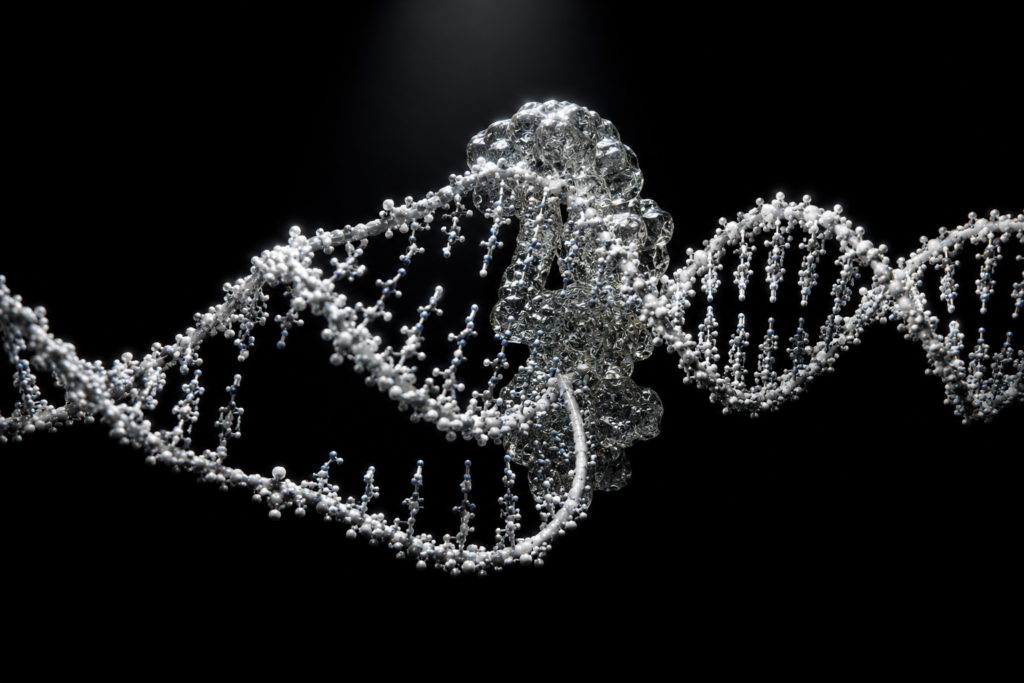
The most pressing is the origin of RNA itself. The 2026 ribozyme demonstrates that RNA can self-replicate — but it doesn’t explain how the first RNA molecule arose from purely inorganic chemistry. RNA nucleotides — the building blocks of the molecule — are themselves fairly complex structures. How they assembled into functional sequences on the early Earth remains genuinely uncertain, though researchers have proposed several plausible chemical pathways involving minerals, UV radiation, and the concentrated chemistry of drying tidal pools.
The second open question is the transition from RNA to DNA-based life. Modern organisms use DNA, not RNA, as their primary genetic material. DNA is more stable and less error-prone — a better long-term archive. At some point, some early life forms made the switch, relegating RNA to its current role as a middleman. How and why this happened is still being worked out.
The third question is perhaps the most philosophically loaded: even if we can demonstrate that all of this is chemically possible, does that mean it’s what actually happened? The history of life on Earth extends far beyond what our oldest preserved DNA record can reach. We are reconstructing a crime scene four billion years after the fact, with almost no physical evidence from the critical period. The RNA world hypothesis explained through laboratory chemistry is compelling. Proving it was the actual pathway remains beyond current science.
Why This Discovery Matters Beyond Biology
The implications of the 2026 finding extend well past the question of how life originated on Earth. They reach into astrobiology — the study of life elsewhere in the universe.
If life on Earth began with a self-replicating RNA molecule, and if that molecule could form spontaneously from raw chemistry given the right conditions, then the same process could in principle occur anywhere those conditions exist. The RNA world hypothesis explained as a universal pathway — not a uniquely terrestrial accident — transforms the probability of life in the universe from vanishingly small to potentially commonplace.
Liquid water. Chemical richness. Time. These are the conditions the RNA world requires — and understanding how life began on Earth tells us exactly what to look for elsewhere. Planetary science has found all three in multiple locations within our own solar system: Europa’s subsurface ocean, Enceladus’s hydrothermal vents, the ancient riverbeds of Mars. Beyond our solar system, billions of potentially habitable planets orbit sun-like stars. tools to scan distant worlds — and the biological frameworks being developed to understand what signatures life would leave — are built on assumptions about what life fundamentally requires. The RNA world finding sharpens those assumptions considerably.
There is also a deeper philosophical dimension. The discovery suggests that life — at its most fundamental level — is not a miraculous exception to chemistry. It is chemistry’s inevitable product, given sufficient complexity and time. The same forces that cause crystals to form, that drive chemical reactions toward equilibrium, that push complex systems toward self-organization, may also, under the right conditions, produce molecules that copy themselves. And from there, everything follows.
jellyfish that reverses its own aging represents life at its most resourceful — biology finding loopholes in its own rules. A self-replicating RNA molecule represents something more fundamental: life finding a way to exist before it even knew what existing meant.
The First Law of Biology
There is a phrase often attributed to the evolutionary biologist Theodosius Dobzhansky: nothing in biology makes sense except in the light of evolution. The RNA world hypothesis extends that logic backward, past the first cell, past the first organism, all the way to the first molecule that made a copy of itself.
The question of how life began on Earth stops being abstract when you realize: everything alive today — every bacterium, every fungus, every plant, every animal — carries within it the direct legacy of that first replication event. Your DNA is a direct descendant of whatever molecular system first figured out how to perpetuate itself in the warm chemistry of the early Earth. The information in your cells has been copying itself, imperfectly, with errors accumulating and selection weeding them out, for four billion years without interruption.
With the RNA world hypothesis explained through direct experimental evidence for the first time, the Cambridge finding doesn’t just support a theory. It demonstrates, in a flask, the moment that physics became biology. The moment that matter first did something matter had never done before — made more of itself, on purpose, without being told to.
That moment changed everything. And we may have just watched it happen again.