
Nature has produced some genuinely terrifying things.
Venomous creatures. Parasites that eat you from the inside. Viruses that rewrite your DNA. But nothing — nothing in the entire catalogue of biological horror — comes close to what a small, threadlike fungus has been quietly perfecting for millions of years in the forests of the world.
It doesn’t kill its host immediately. That would be wasteful.
Instead, it takes control.
Zombie fungus mind control sounds like the premise of a science fiction film. It is, in fact, one of the most extraordinary and well-documented phenomena in all of evolutionary biology — and the more scientists study it, the more unsettling the picture becomes.
Meet Ophiocordyceps: The Original Mind Hijacker
The organism at the center of zombie fungus mind control is Ophiocordyceps unilateralis — a parasitic fungus that targets specific species of carpenter ants in tropical forests across South America, Africa, and Southeast Asia.
The infection begins simply enough. A fungal spore lands on an ant. It penetrates the exoskeleton. And then, with a patience and precision that feels almost intelligent, it begins its work.
The fungus spreads through the ant’s body — not destroying organs, not killing cells indiscriminately, but threading itself through the tissue with extraordinary care. It produces compounds that interfere directly with the ant’s nervous system. And then, at a specific point in the infection cycle, something happens that has no parallel anywhere else in nature.
The ant stops being an ant.
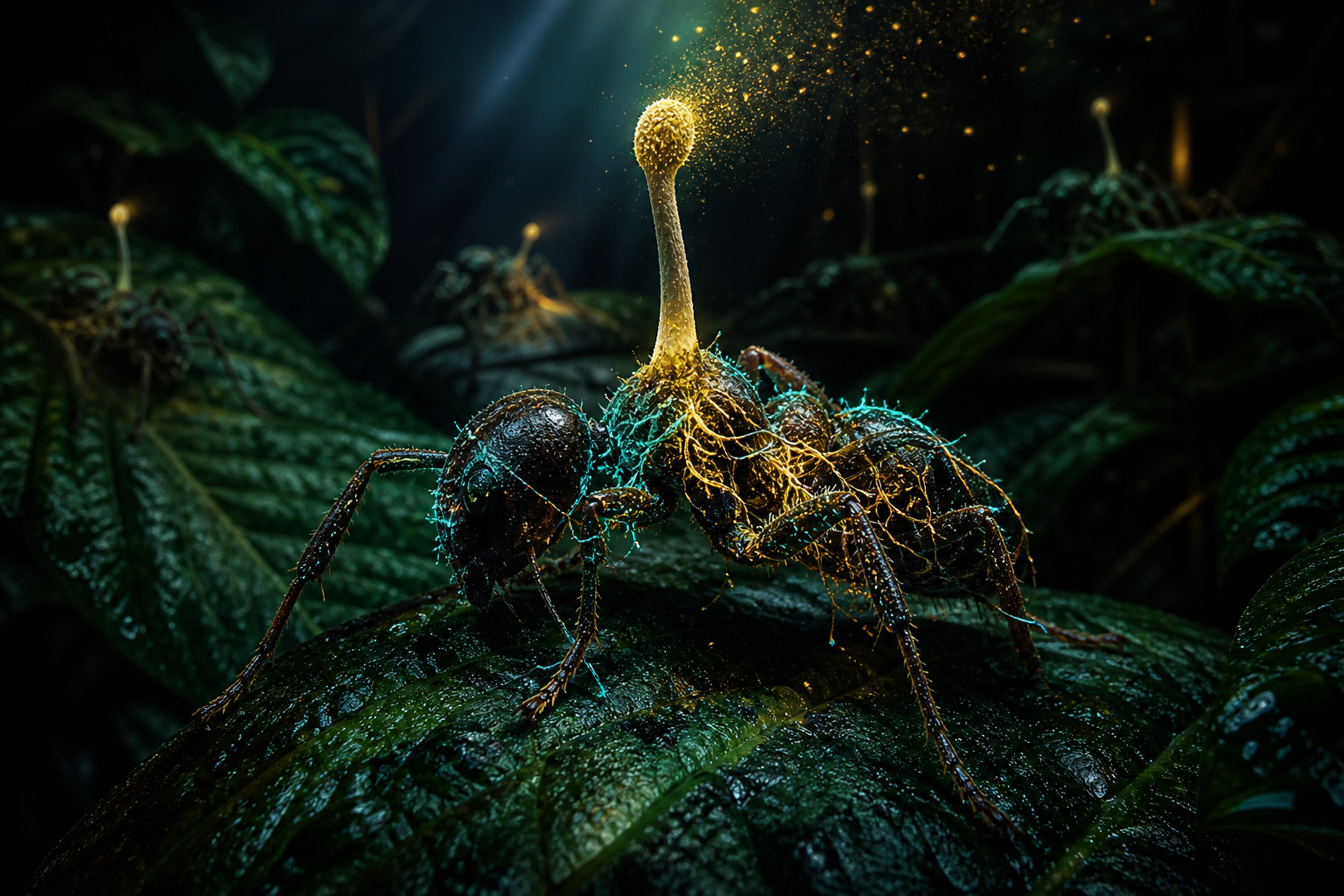
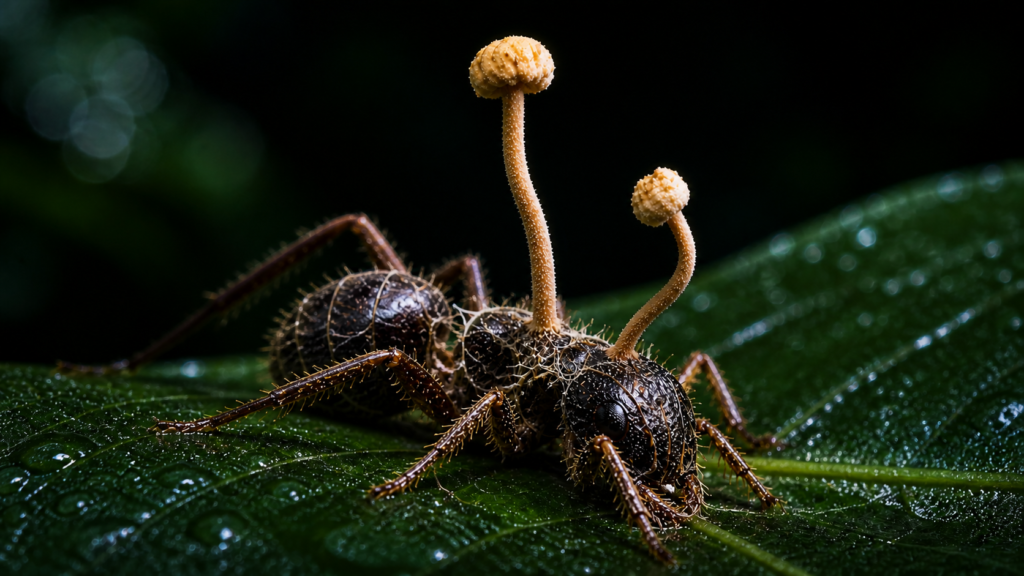
It leaves its colony — abandoning the pheromone trails and social behaviors that have governed its entire existence. It climbs. Always upward. Always toward a very specific height above the forest floor — typically 25 centimeters, in an area with specific humidity and temperature. It finds the underside of a leaf. And it bites down with a force that locks its mandibles permanently into the leaf’s vein.
Then it dies.
And from the back of its head, the fungus blooms.
The Precision Is What Makes It Terrifying
What separates zombie fungus mind control from other parasitic manipulations in nature is the extraordinary specificity of the behavior it produces.
The ant doesn’t just climb randomly. It climbs to a precise height — the optimal microclimate for fungal spore dispersal. It doesn’t bite just anywhere — it bites a leaf vein specifically, which provides the structural grip needed to hold the ant’s body in place through decomposition. It doesn’t die at a random time — it dies at solar noon, when humidity conditions are optimal for the fungus’s next stage of development.
Every single behavior the fungus induces serves the fungus’s reproductive needs with surgical precision. The ant has been converted from an organism with its own survival drives into a perfectly optimized spore-dispersal vehicle.
Researchers who first documented this behavior were so disturbed by its precision that several initially refused to believe a fungus could be responsible. It looked, one described, less like a parasite and more like a programmer who had accessed the ant’s source code.
How Does It Actually Control the Brain?
This is the question that keeps neuroscientists and mycologists up at night — and the answer, which is still being uncovered, is stranger than anyone predicted.
Early research assumed the fungus invaded the ant’s brain directly — physically taking over the neural tissue responsible for motor control. Electron microscopy proved this wrong. The fungus does not, in most cases, significantly invade the brain itself.
Instead, it surrounds the muscles.
Studies published in the Proceedings of the National Academy of Sciences revealed that Ophiocordyceps threads itself through the ant’s body in a network that essentially replaces the normal relationship between nerves and muscles. The fungus secretes compounds — including psychoactive alkaloids and compounds that interfere with neurotransmitter function — that allow it to activate the ant’s muscles directly, bypassing the brain’s normal command structure.
The brain is not hijacked. It is simply made irrelevant.
The ant’s own consciousness — whatever form that takes in an insect — may still be present, locked inside a body it can no longer control, while the fungus drives.
The implications of that, if you sit with them long enough, are genuinely horrifying.
It Gets Worse: This Is Everywhere
Ophiocordyceps unilateralis is the famous case — the one that inspired the fungal apocalypse in the television series The Last of Us. But zombie fungus mind control is not limited to one species or one host.
The Ophiocordyceps genus alone contains over 200 identified species, each one specialized for a different host insect. There are species that target flies, species that target beetles, species that target moths and butterflies and grasshoppers and spiders. Each one produces behavior modifications precisely tailored to its specific host’s biology and the fungus’s specific reproductive needs.
Beyond Ophiocordyceps, the broader phenomenon of fungal and parasitic behavioral manipulation is staggering in its scope. Entomophthora muscae infects houseflies and drives them to climb to elevated positions before death, spreading spores downward onto other flies below. Massospora infects cicadas, consuming and replacing their abdomens with a mass of spores — and the cicadas continue attempting to mate, spreading the infection sexually, apparently unaware that half their body has been replaced by fungus.
The natural world, it turns out, is full of organisms that have solved the problem of reproduction by simply borrowing another organism’s body and behavior.
The Ant Colonies Figured It Out
Here is the detail that provides the only genuine comfort in this entire story — and it is extraordinary in its own right.
Ant colonies, over millions of years of coevolving with Ophiocordyceps, have developed behavioral responses to zombie fungus mind control that function as a remarkably sophisticated public health system.
Worker ants can detect — through chemical signals — when a nestmate has been infected with the fungus, often before any behavioral symptoms appear. When they identify an infected individual, they carry it away from the colony and deposit it far from the nest. Not because they’ve been taught to. Not because any individual ant understands what a fungus is. But because the colony, as a superorganism, evolved this response over evolutionary timescales because colonies that didn’t do it died out.
The colony-level immune response to zombie fungus mind control is, in some ways, as remarkable as the manipulation itself. It represents millions of years of biological arms race — the fungus evolving more sophisticated control mechanisms, the ants evolving more sophisticated detection systems — playing out in slow motion across geological time.
What About Humans?
The question everyone asks after learning about zombie fungus mind control — particularly after The Last of Us brought it into popular consciousness — is the obvious one.
Could it happen to us?
The honest scientific answer is: not in the way the television series depicts, but the dismissal shouldn’t be too comfortable.
Ophiocordyceps is specifically adapted to insect nervous systems. Human neurology, immune response, and body temperature create an environment the fungus cannot currently survive in, let alone manipulate. The leap from ant to human would require evolutionary changes of a magnitude and specificity that scientists consider extraordinarily improbable.
However.
Fungi are the fastest-evolving major organisms on the planet. They mutate rapidly, adapt to new environments with remarkable speed, and have repeatedly surprised researchers by developing capabilities previously considered impossible for their kingdom. The rise of Candida auris — a fungal pathogen that emerged seemingly from nowhere in the 2010s and rapidly developed resistance to every available antifungal treatment — is a reminder that fungal adaptation can happen faster and more dramatically than our models predict.
And there are already fungi that affect human neurological function. Aspergillus species have been linked to neurological symptoms. Ergot fungus — Claviceps purpurea — produces alkaloids that cause hallucinations, convulsions, and psychosis in humans who consume infected grain. The Salem witch trials of 1692 have been theorized by some historians to have been triggered by ergot poisoning in the local food supply.
Fungi have been influencing human brains, in their own quieter ways, for longer than we’ve known they existed.
The Forest Has Been Running This Program for Millions of Years
The next time you walk through a forest — particularly a tropical one — consider what is happening beneath your feet and above your head.
In the leaf litter, infected ants are climbing their final ascent. On the undersides of leaves, fungal stalks are emerging from the heads of their hosts, preparing to release the next generation of spores into the humid air. In the soil, networks of fungal mycelium stretch for miles, processing, communicating, waiting.
Zombie fungus mind control did not emerge yesterday. It has been running, refining itself, growing more precise and more effective, for longer than our species has existed.
We discovered it recently.
It was never looking for us.
But it’s worth remembering that from the fungus’s perspective, a host is just a host.
And it has had a very long time to practice.