
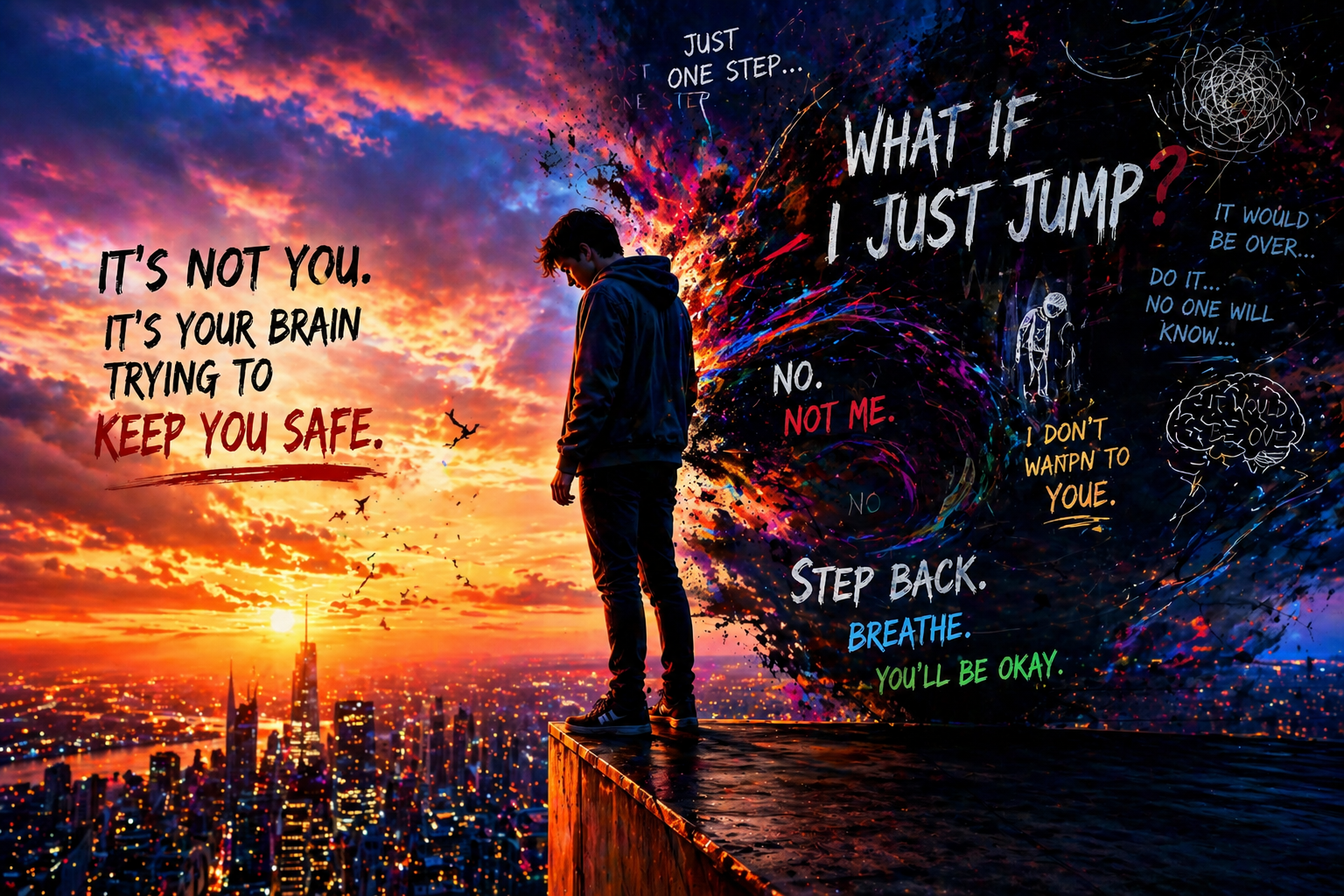
There’s a moment most people never talk about, not because it’s rare, but because it feels too strange to explain. You’re standing somewhere high, maybe leaning slightly over a balcony, maybe looking down from a rooftop, maybe just pausing for a second on a bridge while everything below seems distant and quiet, and then without warning, a thought appears that doesn’t feel like it belongs to you, a sudden whisper inside your mind that says, “What if I just jump?” It doesn’t stay long, it doesn’t grow into anything, and it disappears almost instantly, but the feeling it leaves behind is heavier than the thought itself, because for a brief second, you didn’t imagine danger—you imagined yourself choosing it, and that’s what makes the experience unsettling in a way that’s difficult to shake off. This phenomenon is known as the Call of the Void, a term that sounds dramatic but describes something surprisingly common, something that can happen even to people who feel completely stable, grounded, and in control of their lives, which makes the question even more uncomfortable: if you don’t want it, why did your mind go there?
The Moment Your Mind Misfires
At first, it feels like a contradiction, because your brain is supposed to protect you, it is wired for survival, built through evolution to detect threats, avoid risk, and keep you alive, so when it produces a thought that seems to suggest the opposite, it feels like something has gone wrong, like a system glitch that should never happen, but the truth is far less alarming and far more fascinating, because nothing is actually malfunctioning. The human brain operates on multiple layers at once, one slow and conscious, where you think, reason, and make decisions, and another fast and automatic, where instinct reacts before awareness has time to catch up. When you stand near a height, that deeper system activates instantly, scanning the situation, recognizing the potential for danger, and sending a warning signal that is meant to keep you safe, but the signal itself doesn’t arrive as a clear sentence like “step back,” it arrives as a burst of awareness, a sudden recognition that something could happen. When your conscious mind tries to interpret that burst, it sometimes translates it in a way that feels completely different, turning a safety warning into a possibility of action, and in that tiny gap between instinct and interpretation, the experience begins to take shape, not as a desire, but as a misread message that feels far more personal than it actually is.
When Fear Feels Like Curiosity
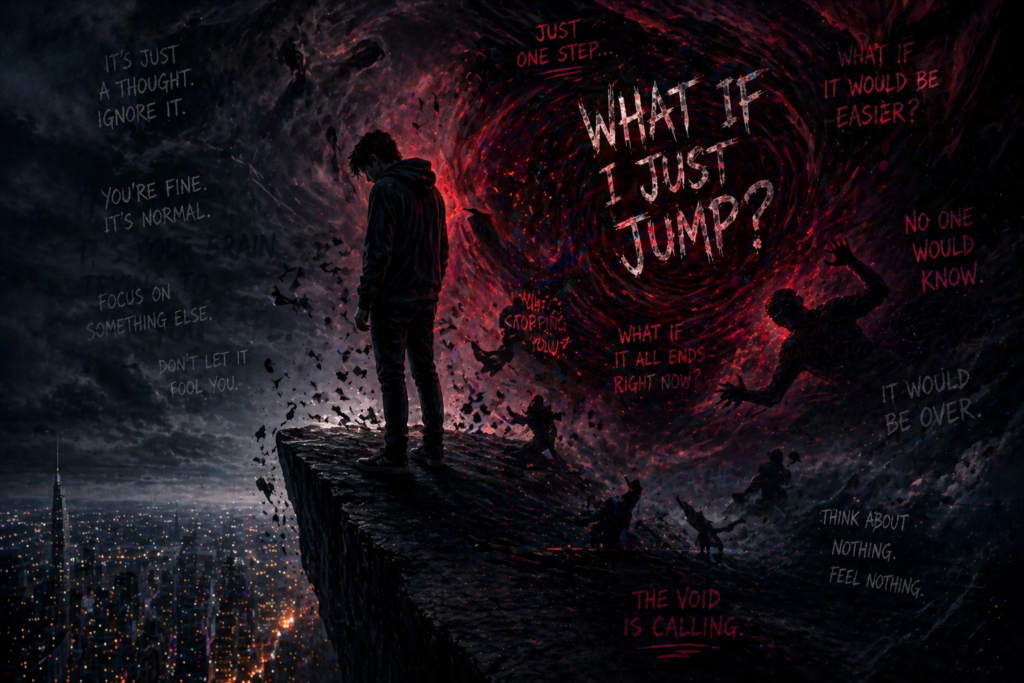
What makes this moment so unsettling is that it doesn’t feel like fear in the way we expect fear to feel, it doesn’t come with panic or urgency, it doesn’t make your heart race or force you to step back immediately, instead, it arrives quietly, almost like curiosity, a calm and intrusive curiosity that feels completely out of place, because it doesn’t match your intentions or your sense of self. The brain is constantly generating possibilities, running silent simulations of actions and outcomes, exploring scenarios without any intention of acting on them, and most of the time, these simulations go unnoticed because they are harmless or irrelevant, but when the scenario involves something extreme, something irreversible, something that challenges your sense of control, it becomes impossible to ignore. For a brief second, your mind explores the idea of stepping forward instead of stepping back, not because it wants you to do it, but because it is trying to understand the full range of what is possible in that moment, and then almost immediately, it rejects that possibility, but by the time your awareness catches up, the thought has already been experienced, and it feels like it came from you, even though it never truly represented your intention.
The Hidden Proof That You Want to Stay Alive
The most important part of this experience is often the one people overlook, because they focus on the thought itself and ignore what happens right after it, the subtle but powerful reaction that follows almost instantly, the slight movement away from the edge, the shift in posture, the quiet tension in your body that pulls you back without conscious effort. That reaction is not random, it is your survival instinct acting with precision, responding faster than your conscious mind can process what just happened, and it reveals something far more important than the thought that triggered it. The thought may suggest a possibility, but the reaction reveals the truth, because your body does not hesitate, it does not consider the option, it simply rejects it, and that rejection is automatic. Some researchers believe that what people describe as the Call of the Void is actually a byproduct of a highly responsive safety system, a moment where your brain becomes intensely aware of risk and generates a rapid internal signal that your conscious mind briefly misinterprets, creating the illusion of an urge when in reality it is a warning. The fear that follows the thought is not evidence that you almost acted on it, it is evidence that you never wanted to, because if the thought reflected your true intention, it would not disturb you, it would not create that immediate sense of discomfort that makes you step back and regain control.
Why Some Minds Notice It More
Not everyone experiences this moment in the same way, and the difference often comes down to how sensitive the brain is to uncertainty and potential danger, because some people naturally have a more active awareness of risk, especially during periods of stress or anxiety, when the brain’s threat detection system becomes more alert. An anxious mind does not just react to danger, it anticipates it, it runs through possibilities constantly, trying to stay ahead of what could go wrong, and in doing so, it increases the likelihood of noticing intrusive thoughts that might otherwise pass unnoticed. This does not mean that something is wrong, it does not mean the person is unstable or at risk, it simply means their brain is working harder to maintain control in an unpredictable environment, and sometimes that effort produces thoughts that feel more intense or more noticeable. The key difference lies in interpretation, because when the experience is understood as a byproduct of awareness rather than a reflection of desire, it loses much of its power to create fear, and becomes something else entirely, a brief and harmless signal that passes as quickly as it arrives.
The Illusion of Losing Control
The most unsettling part is not the thought itself, but the question that follows it, the quiet doubt that lingers for a moment after it disappears, the feeling that asks, “what if I actually did it,” and that question can feel far more dangerous than the original thought, because it challenges your sense of control over your own actions. But this fear is rooted in a misunderstanding of how the mind works, because thoughts are not commands, they are not intentions, they are simply mental events that occur without your permission, generated by a system that is constantly processing information in ways you are not fully aware of. The brain produces thousands of thoughts every day, many of them random, many of them irrelevant, and most of them forgotten almost instantly, but the ones that feel out of place, the ones that contradict your identity, are the ones that stand out, because they demand attention. The disturbing nature of the Call of the Void is exactly what separates it from intention, because true intention does not create fear, it creates alignment, and the discomfort you feel is your mind rejecting the thought as something that does not belong to you.
The Silence That Makes It Feel Bigger
One of the reasons this experience feels so intense is because it is rarely discussed openly, it happens in private moments, in quiet spaces, and then it disappears, leaving behind a memory that feels too strange to share, so it remains unspoken, and in that silence, it begins to feel more significant than it actually is. But the reality is that this is one of the most common shared human experiences, even if people don’t talk about it, because across different cultures, different backgrounds, different personalities, the same pattern appears again and again, the same sudden thought, the same quick reaction, the same brief confusion followed by a return to normal. It is not rare, it is simply misunderstood, and that misunderstanding is what gives it weight, because the moment you recognize it for what it is—a misinterpreted signal, a temporary simulation, a harmless mental event—it begins to lose its intensity, and no longer feels like a reflection of who you are.
The Edge Is More Than Just a Place
There is something deeper happening when you stand at a height, something that goes beyond physical danger and enters the realm of perception, because the edge represents more than just a drop, it represents a boundary between control and uncertainty, between what you know and what you cannot predict, and your brain responds to that boundary in a way that is both instinctive and complex. This experience exists in that space, not as a desire to cross it, but as an awareness that it exists at all, a moment where your mind acknowledges the possibility of stepping beyond safety, even if it never intends to do so. But what matters most is not the awareness of the edge, it is your response to it, because every time that thought appears, it is followed by a decision that feels almost automatic, a movement away, a return to stability, a quiet reaffirmation that even when your mind explores the possibility of falling, your instinct chooses to stay.
And maybe that’s the part worth paying attention to, not the thought that appears for a second and disappears, but the response that follows it every single time, the way your body and mind work together to protect you without hesitation, the way you step back without needing to convince yourself, the way your sense of control remains intact even when your thoughts momentarily wander into unfamiliar territory. The Call of the Void is not a sign that something is wrong with you, it is a reminder of how your mind works, how it processes risk, how it explores possibilities, and how it ultimately chooses safety without needing your conscious approval. So the next time that thought appears, sudden and uninvited, don’t just focus on the fear it brings, notice what happens immediately after, notice how quickly you regain balance, how naturally you move away from the edge, how effortlessly your mind restores stability, because hidden inside that unsettling moment is something unexpectedly reassuring, the proof that even when your thoughts drift toward the unknown, your instinct knows exactly where you belong, and it brings you back without hesitation.
So when you’ve experienced the Call of the Void, what did it actually feel like for you—fear, curiosity, or something you still can’t fully explain?