
Close your eyes right now.
What do you see?
Darkness, probably. Maybe shapes. Maybe the ghost of whatever you were just looking at. But here’s the thing — even in that darkness, your visual brain is still on. Still processing. Still quietly running in the background like software you never close.
Now imagine never having had that. No shapes. No light. No visual ghost of anything. Just… nothing. Not black — because black is still a colour your visual brain creates. Just the complete absence of visual experience, from the very first moment of existence.
What does that person dream?
The answer is one of the most profound rabbit holes in all of neuroscience — and understanding how blind people dream doesn’t just tell us about blindness. It tears open something much bigger: the question of what consciousness actually is, and where it lives.
It Depends on When the Lights Went Out
The first thing science had to wrestle with is that blindness is not one thing.
There are people born blind — congenitally blind, who have never had a single visual experience in their entire lives. There are people who lost their sight in childhood, after seeing the world for a few years. There are people who went blind as adults, with decades of visual memory stored somewhere in their neural architecture.
And how blind people dream is dramatically different depending on which of these categories they fall into.
For people who lost their sight after age five or six — and especially those who were sighted for many years before going blind — visual dreams are common. Not universal, but common. They dream in images. They see faces, places, colours. Some report that their dreams are the only place they still have access to sight, and that waking up is its own quiet grief every single morning.
Over time, studies show these visual dreams fade. The longer a person has been blind, the less frequently visual imagery appears in their sleep. The brain, with nothing new to feed the visual system, slowly lets it go quiet. Like a language you once spoke fluently, slowly forgotten through decades of disuse.
For those born blind — the picture is something else entirely.
The Dreams of the Congenitally Blind
Here is where how blind people dream gets genuinely world-altering.
People born blind do not dream in images. They cannot — they have no visual templates, no stored colour, no memory of a face or a sunset or a shadow on a wall. Their visual cortex was never trained on the world the way yours was.
And yet — they dream just as vividly. Just as emotionally. Just as narratively.
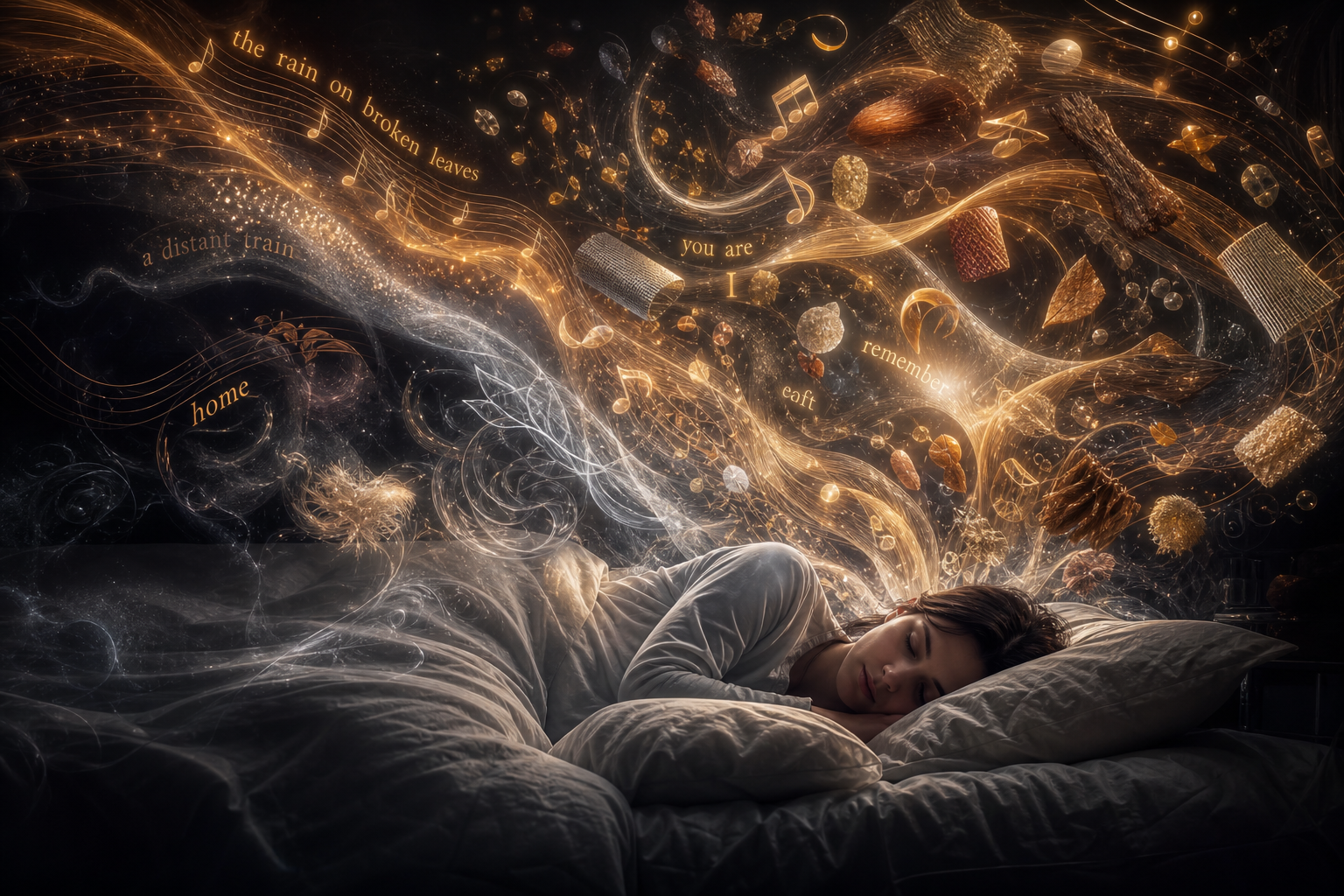
Their dreams are built from the other senses. Sound so detailed and spatially precise that it carries the full weight that vision carries in a sighted person’s dream. Touch — the texture of things, the pressure of presence, the temperature of spaces. Smell and taste woven through dream-scenes with an intensity most sighted dreamers never experience. And emotion, running underneath all of it like a current, sometimes stronger and more articulate than in any visual dream.
Researchers at the University of Copenhagen studied dream content in blind individuals and found something remarkable: congenitally blind people actually experience more sensory richness in the non-visual dimensions than sighted people do. Their dreams compensate. The brain, denied one input channel, amplifies everything else.
The Visual Cortex Has a Secret
Here is the part that should genuinely unsettle you.
In sighted people, the visual cortex — the occipital lobe at the back of the brain — processes vision. That’s its job. That’s what it was “assigned” at birth.
In congenitally blind people, that same region doesn’t sit dormant. It doesn’t atrophy into uselessness. Instead, it gets repurposed. It processes language. It processes touch. It processes spatial navigation and sound. The brain, encountering a sensory input channel that never opens, simply reroutes the real estate to other tenants.
This phenomenon — called cross-modal neuroplasticity — is one of the most extraordinary discoveries in modern neuroscience. It tells us that the brain is not a fixed machine with fixed departments. It is a dynamic, adaptive, relentlessly opportunistic organ that will use whatever it has to build a working model of the world.
And how blind people dream is the nightly proof of this in action. Their visual cortex, repurposed for touch and language during waking hours, continues that work in sleep. Their dreams are not lesser versions of sighted dreams. They are differently architected — built on a different scaffold, using different materials, arriving at the same destination.
A world. A self inside it. A story unfolding in real time.
What This Tells Us About Consciousness
This is where the science stops being just interesting and starts being genuinely philosophical.
If a person born without any visual experience can have a rich, detailed, emotionally complex dream life — built entirely from senses they did have access to — then consciousness is clearly not dependent on any single sensory modality.
It doesn’t need vision. It doesn’t need sound. It could, theoretically, build itself from any sensory input available. Or perhaps, as some researchers now suspect, from no external sensory input at all.
Consciousness, this research suggests, is not a product of what comes in. It’s a product of what the brain does with whatever it has. It is generative. It is creative. It builds experience out of raw material, and if one type of raw material is unavailable, it finds another.
The dreaming brain of a blind person is essentially demonstrating this in real time, every night. With no visual input — ever, not even once — it constructs a complete, coherent, subjectively experienced world. The lights were never on, and the show still runs.
The Nightmare Question
One more dimension of how blind people dream that researchers almost didn’t think to study: nightmares.
Studies show that blind people — particularly those blind from birth — have nightmares at a significantly higher rate than sighted people. Not slightly higher. Meaningfully, measurably higher.
The leading theory connects to their daily reality. The threats a blind person navigates daily — traffic, unfamiliar environments, the fundamental vulnerability of moving through a world designed for sighted people — translate directly into dream content. Their nightmares are often threat-based: being hit by a vehicle, getting lost, losing a guide dog, being unable to navigate a space.
The dream is doing what dreams always do: processing fear. Rehearsing threat responses. Running simulations.
Which is its own answer to the consciousness question. The dreaming brain, regardless of which senses feed it, is doing the same fundamental job. Processing the emotional residue of waking life. Preparing the self for what comes next.
The Bigger Picture
Understanding how blind people dream is, in the end, understanding something about all of us.
It tells us that the version of reality we experience — the one that feels so solid, so external, so simply there — is assembled. Constructed. Built fresh, every moment, by a brain using whatever tools it has available. Change the tools, and the construction changes. But the construction always happens.
Consciousness is not a window. It’s not something you look through at the world outside.
It’s a room you build, every moment, from the inside.
And every night, blind or sighted, your brain locks the doors, turns off the incoming feed, and builds it again from scratch — just to prove that it can.