
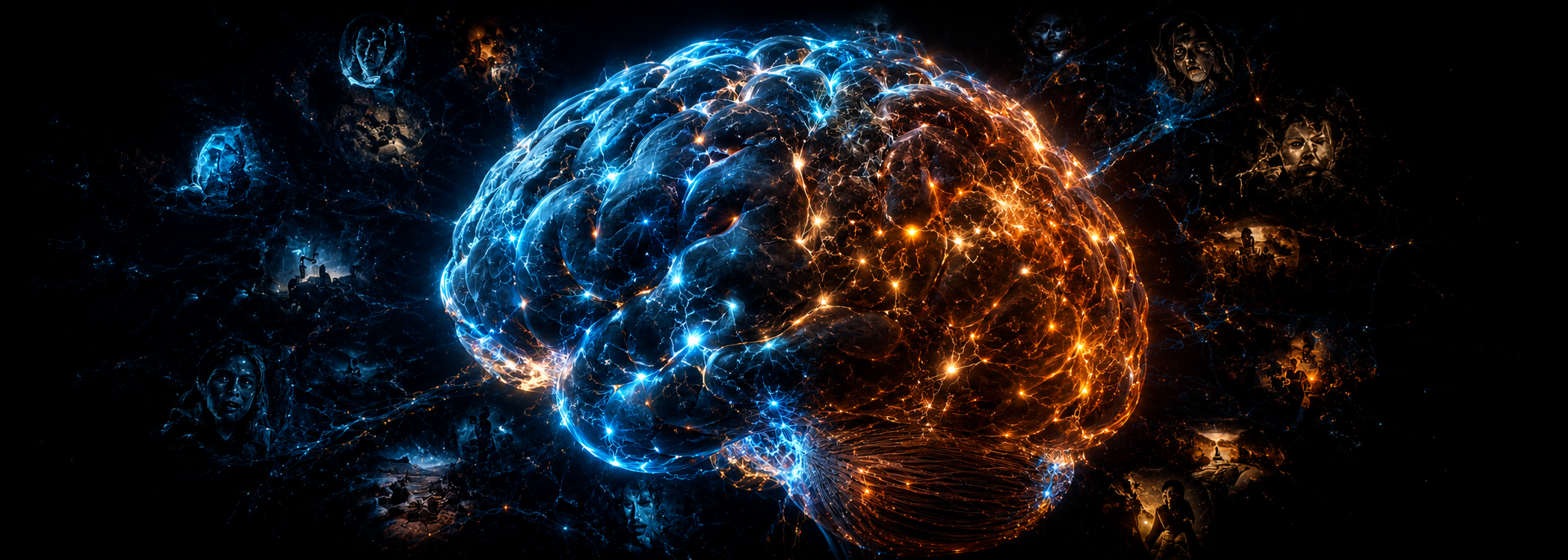
You close your eyes. Your breathing slows. Your body goes still. And for the next seven or eight hours, you assume — reasonably, intuitively — that nothing much is happening.
You are spectacularly wrong.
What your brain does while you sleep is one of the most complex, strange, and genuinely unsettling stories in all of neuroscience. Before the 1950s, scientists largely believed sleep was a passive state — the brain powering down, the body resting, nothing of consequence occurring until morning. Decades of research have dismantled that assumption so completely that what replaced it is almost harder to believe.
Your brain, while you sleep, is not resting. It is working. Harder, in some respects, than it does when you are awake. And some of what it is doing will change the way you think about consciousness, identity, and what it means to be you.
Here are ten things your brain does in the dark that nobody warned you about.
1. It Physically Paralyses Your Entire Body
Every time you enter REM sleep — the deep phase where your most vivid dreams occur — your brain deliberately switches off your ability to move.
Two powerful brain chemical systems, GABA and glycine, work together to paralyse skeletal muscles during REM sleep by switching off the specialised cells that allow muscles to be active. Your arms. Your legs. Your fingers. Everything under voluntary control — frozen. The brain does this specifically to stop you from acting out your dreams and injuring yourself or others.
When this system fails, the result is a condition called REM Sleep Behaviour Disorder — in which people do not become paralysed during REM. They act out their dreams: talking, thrashing, punching, sometimes falling out of bed entirely. It is as alarming as it sounds. And it is also, in a strange way, proof of how elaborate the nightly paralysis system actually is — because you only notice it when it breaks.
Every night, your brain locks your body down. You just never remember it.
2. It Washes Itself Clean
This one was only discovered in 2012, and it is extraordinary.
The brain lacks the lymphatic vessels that collect and move fluid in other parts of the body. For years, scientists were puzzled by how the brain — one of the most metabolically active organs in the body, constantly producing waste products — managed to clean itself. The answer turned out to involve sleep in a way nobody had anticipated.
During sleep, the brain’s glymphatic system activates — a drainage network in which cerebrospinal fluid seeps through the organ via tiny passages alongside blood vessels, sweeping away metabolic waste and toxic proteins that accumulate during waking hours. Sleep plays a housekeeping role that removes toxins in your brain that build up while you are awake.
Among the waste products cleared during this process: amyloid beta and tau proteins — the same proteins that accumulate in the brains of Alzheimer’s patients. Disrupted glymphatic function has been linked to neurodegenerative disease. In other words, poor sleep does not merely make you tired. Over time, it may leave your brain swimming in its own waste.
3. It Deletes Memories On Purpose
Your brain does not keep everything. During sleep, it makes deliberate choices about what to remember and what to throw away.
Specific neurons have been identified that appear to help the brain actively forget new, possibly unimportant information during sleep. This is not a malfunction. It is a design feature. The brain has a finite capacity, and the clearing of irrelevant data makes room for what matters.
Meanwhile, the hippocampus — the brain region involved in memory formation — replays and transfers newly acquired information to the neocortex during sleep, where long-term storage occurs. The memories that survive the night are the ones the brain decided were worth keeping. The ones that dissolve were quietly judged redundant.
You wake up every morning with a slightly edited version of yourself. The editing happens while you sleep, without your knowledge or consent.
4. It Runs a Simulation of Reality
During REM sleep, the brain simulates interactions with the physical world. In a dream, you can act, and those actions have consequences — as if they were executed in reality. The brain generates a complete virtual environment, populates it with people and objects and physics, and places a version of you inside it.
What is remarkable is that during this simulation, the brain represents the consequences of motor commands even though those commands are not actually executed. You reach for something in a dream and your brain models what happens when you reach for it. You run, and your brain calculates the running — without your body moving an inch.
This is not passive fantasy. It is active modelling. The sleeping brain is running a full simulation of the world, testing interactions with it, building what MIT neuroscientist Matthew Wilson has described as “useful models of the world based on how it can manipulate representations of experience.” You are not merely dreaming. You are training.
5. It Fires More Intensely Than When You Are Awake
During REM sleep, the firing pattern of most neurons resembles those of wakefulness — and in some cases, neurons fire in even more intense bursts than when you are conscious. In the pons, the lateral geniculate nucleus, and the occipital cortex, neural activity during REM exceeds waking levels.
Read that again. There are parts of your brain that are more active when you are asleep than when you are sitting here reading this sentence.
The term “paradoxical sleep” — an older name for REM — captures something real. The sleeping brain is not a quieter version of the waking brain. In specific regions, it is a louder one.
6. It Consolidates Skills You Practised That Day
If you spent the day learning something — a new instrument, a physical skill, a language pattern, a work process — your brain spends the night consolidating that learning in ways conscious practice cannot achieve.
Non-REM sleep boosts the performance of newly acquired skills by restoring flexibility and neuroplasticity, while REM sleep stabilises these improvements and prevents new learning from overwriting them. The two stages work together in sequence. Non-REM loosens the neural structure to allow refinement. REM locks the improved version in place.
This is why sleeping after studying genuinely works better than staying awake to revise more. And it is why the common advice to “sleep on a problem” has a real neurological basis — because your brain is not merely resting while you sleep. It is actively working on what you gave it before you closed your eyes.
7. It Keeps Certain Regions Fully Alert
You might assume that when you sleep, your brain withdraws from the external world entirely. It does not.
During non-rapid eye movement sleep, parts of the brain that handle movement and sensory input stay active and keep using energy. The thinking and memory regions quiet down — but the sensory watchmen stay on duty. This is why a parent can sleep through traffic noise but wake instantly at the sound of their child crying. The sleeping brain is still listening. It is still monitoring. It has simply decided which signals merit escalation.
Your brain does not fully surrender consciousness when you sleep. It delegates. The night shift takes over, with different priorities and a narrower brief — but it never fully goes dark.
8. It Processes Emotional Experiences and Strips Away the Pain
This is one of the most clinically significant things what your brain does while you sleep — and one of the least discussed.
During REM sleep, the brain reprocesses emotional memories, but it does so in a neurochemical environment notably different from waking. Norepinephrine — the brain chemical associated with stress and anxiety — is significantly suppressed during REM. This means the brain can revisit difficult, painful, or frightening memories in a state of reduced emotional charge.
The result is that you wake up having processed the emotional weight of an experience without re-traumatising yourself in the process. REM sleep is, in essence, a nightly therapy session. The memories remain, but their emotional sting is reduced. This is one reason why sleep deprivation is so strongly linked to anxiety and depression — without adequate REM, the emotional processing does not complete, and the charge stays attached to the memory.
9. It Rehearses Fears to Make Them Smaller
Related to emotional processing — but distinct from it — the dreaming brain appears to actively rehearse threatening scenarios in a context where they cannot actually harm you.
The threat simulation theory of dreaming proposes that the brain uses the safe environment of sleep to rehearse responses to dangerous situations. By running threat scenarios in a consequence-free simulation, the brain sharpens the circuits it would need to respond to real danger — while simultaneously reducing the emotional intensity of those fears through repeated, safe exposure.
Your nightmares, in other words, may not be your enemy. They may be your brain doing preventive maintenance — testing the alarm systems, running the drills, making sure the fear responses are calibrated.
10. It May Be More Conscious Than You Think
Here is the one that genuinely unsettles neuroscientists.
The assumption underlying most of our intuitions about sleep is that consciousness goes offline — that the sleeping person is, in a meaningful sense, not present. But the evidence increasingly challenges this. During REM sleep, brain activity in regions associated with consciousness and self-awareness is elevated, not diminished. Lucid dreamers — people who become aware they are dreaming while remaining asleep — have demonstrated through pre-arranged eye movement signals that a form of conscious awareness persists even in deep sleep.
The question of where consciousness goes during sleep is not resolved. It may be that it does not go anywhere. It may be that sleep is not an absence of experience but a different kind of experience — one we simply cannot access from the outside, and struggle to remember from the inside.
Every night, you disappear. Something continues in your absence. And in the morning, it hands you back to yourself, slightly altered, with no explanation of what it did while you were gone.