

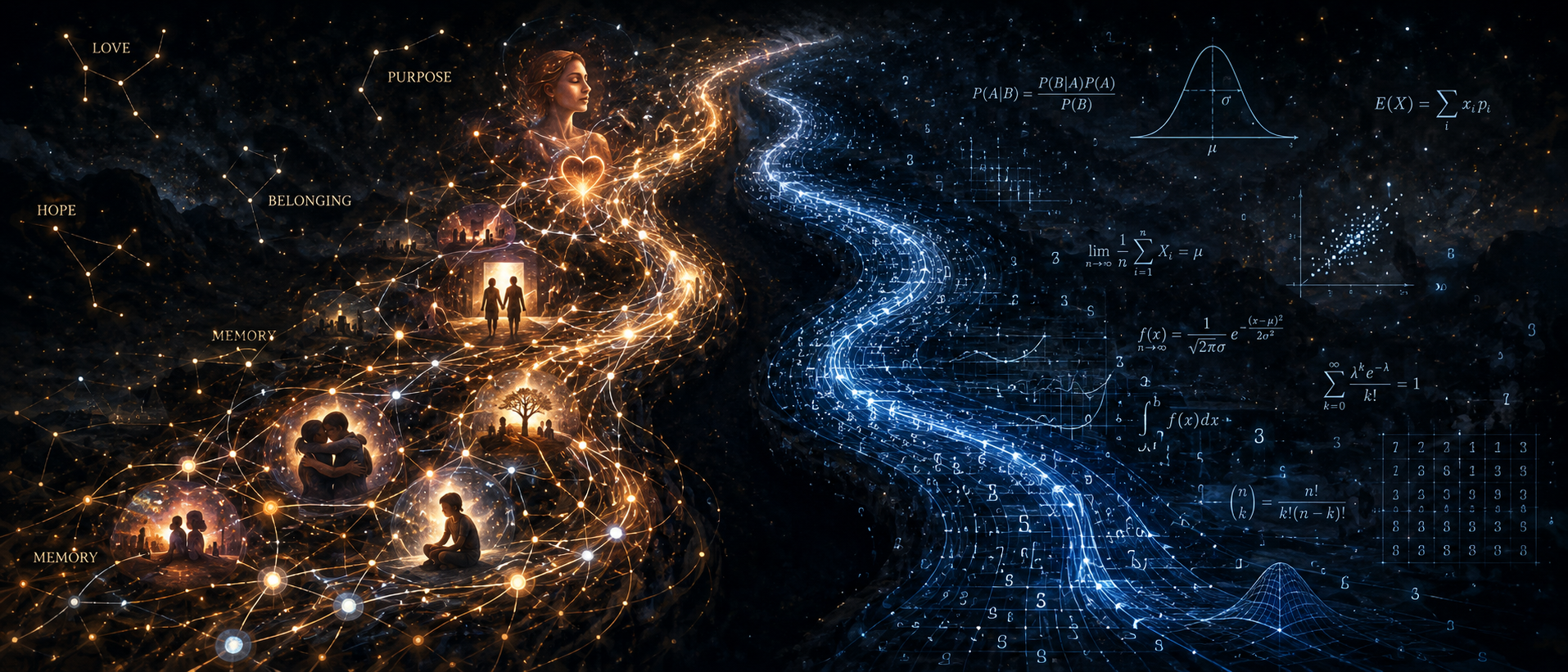
You think of someone you haven’t spoken to in three years, and your phone rings thirty seconds later. It’s them. Your heart rate spikes. The hairs on your arm stand up. Something about this feels impossible — too precise, too timed, too loaded with significance to be random. This is why coincidences feel meaningful: your brain was not built to process probability. It was built to find patterns, assign causes, and construct stories. And when those instincts collide with the cold arithmetic of chance, the math almost always wins — but the feeling doesn’t care.
The science of why coincidences feel meaningful sits at a strange intersection of cognitive psychology, probability theory, and the deep architecture of human perception. Understanding it doesn’t make the feeling go away. But it does reveal something quietly profound about how we make sense of a universe that owes us nothing.
Why Coincidences Feel Meaningful: The Brain’s Pattern Engine
The human brain is, at its core, a prediction machine. Every moment of your waking life, it is scanning the environment for patterns — for regularities, for correlations, for causal chains that let it anticipate what happens next. This capacity is the foundation of everything from language acquisition to tool use to social navigation. It kept our ancestors alive.
The cost of that capacity is a tendency to find patterns even where none exist. Psychologists call this apophenia — the spontaneous perception of meaningful connections between unrelated things. It’s not a malfunction. It’s the predictable output of a system tuned for maximum pattern sensitivity, running on data that is sometimes genuinely random.
When a coincidence occurs, several cognitive mechanisms fire simultaneously. First, there is selective attention — you notice the phone call from a long-lost friend precisely because you were just thinking about them. You do not notice the hundreds of times you think about someone and nothing happens, because unremarkable non-events don’t register. This asymmetry is fundamental to why we overthink everything: the brain weights vivid, emotionally charged moments far above the dull statistical baseline.
Second, there is confirmation bias. Once a coincidence has occurred, the brain actively searches for supporting significance and quietly discards the noise. You remember the phone call. You forget the three hundred days you thought about that person and heard nothing. The archive your brain keeps is curated, not comprehensive.
The Mathematics of Coincidence: Why They’re Less Surprising Than They Feel
Here is where probability theory does something genuinely humbling to human intuition.
Consider the birthday problem — one of the most counterintuitive results in all of mathematics. How many people do you need in a room before there’s a better-than-even chance that two of them share a birthday? Most people guess somewhere around 180. The actual answer is 23. With just 23 people, the probability that at least two share a birthday exceeds 50%. With 70 people, it’s 99.9%.
The reason this surprises us is that we instinctively calculate the probability from our own birthday — the chance that someone else in the room shares my specific birthday. But the birthday problem isn’t about any one person. It’s about any two people out of all possible pairs. With 23 people, there are 253 possible pairings. Each pairing is a separate opportunity for a match.
This is the mathematics that explains coincidences away. We experience events as singular — I thought about this person at this specific moment — but the universe is running an astronomical number of independent trials simultaneously. You think about dozens of people every day. Your phone receives calls at variable intervals throughout the day. The probability that any one of those thousands of weekly thought-call combinations will occasionally overlap is not small. It’s virtually guaranteed over a long enough timeline.
The statistician David Hand formalised this as the Law of Truly Large Numbers: with a large enough number of opportunities, any outrageous event is almost certain to happen. The coincidence that feels like one-in-a-million to the person experiencing it is, from the universe’s perspective, simply an event that was always going to occur to someone eventually. You happened to be that someone today. The psychology of conspiracy theories runs on the same cognitive fuel — the brain’s compulsive need to find agency and intention behind events that statistics would predict as random.
The Clustering Illusion and the Myth of Hot Streaks
Another piece of the coincidence puzzle is the clustering illusion — the tendency to perceive clusters in random data as meaningful patterns rather than the inevitable result of randomness itself.
Truly random distributions are clumpy. If you scatter points randomly across a surface, they don’t space themselves neatly. They cluster in some areas and leave gaps in others, because that’s what randomness looks like. When humans see those clusters, they instinctively assume something is causing them. There must be a reason these points are gathered here. There must be a signal in this noise.
This is why coincidences often seem to come in runs. You experience one, then another, then a third — and it feels like the universe is trying to tell you something. In reality, you’re likely experiencing the clustering effect of a random distribution, combined with heightened attentional bias: once the first coincidence has primed you to notice them, you catch more of what was always there.
The hot hand fallacy in basketball is the same phenomenon applied to sport. Players, coaches, and fans are convinced that some shooters are genuinely “in a zone” — that their recent hits predict future hits. Statistical analysis has repeatedly found that the clustering of successful shots matches what you’d expect from random variation. The hot hand, for the most part, is a coincidence cluster that the brain has promoted to a meaningful pattern. Why humans are addicted to bad news connects here too — the same negativity bias that makes threatening patterns feel urgent also makes meaningful-seeming coincidences feel cosmically significant.
Why Coincidences Feel Meaningful Even When We Know Better
Here is the genuinely interesting psychological question: why does understanding the mathematics not dissolve the feeling?
You can know, intellectually, that the birthday problem explains your eerie phone call. You can understand selective attention and the law of large numbers and the clustering illusion. And then the next coincidence will still send a small electric charge through your nervous system. The feeling and the knowledge run on different tracks.
This is because the emotional weight of a coincidence is processed before the rational evaluation begins. The brain’s threat-detection and significance-tagging systems are fast — they fire subcortically, before the prefrontal cortex has time to apply probability theory. By the time you consciously think this is just apophenia, the emotional stamp has already been applied. You can’t un-feel a coincidence any more than you can un-see an optical illusion after you’ve understood how it works.
There’s also a deeper issue: coincidences are often socially meaningful even when they’re mathematically trivial. The phone call from a long-lost friend isn’t just a probability event. It’s a moment of connection, a prompt to reach out, a small punctuation mark in a long relationship. The meaning isn’t in the timing. It’s in what you do next. Dismissing coincidences entirely — treating every one as mere statistical noise — is its own kind of impoverishment. The science behind first impressions shows how the brain constructs significance from thin information constantly; coincidences are just that process applied to time rather than people.
Synchronicity, Jung, and the Urge to Go Beyond Statistics
No discussion of why coincidences feel meaningful is complete without Carl Jung, who coined the term synchronicity in the 1950s to describe meaningful coincidences that he believed couldn’t be explained by conventional causality. Jung wasn’t arguing for the supernatural — he was arguing that the human experience of meaning was itself a real phenomenon, distinct from physical causation and deserving its own category.
Modern psychology largely disagrees with Jung’s framework while acknowledging the observation that drove it. The experience of synchronicity is real. People genuinely feel that certain coincidences carry significance beyond chance. What’s disputed is whether that feeling tracks something in the external world, or whether it’s an artifact of the pattern-seeking brain operating on probabilistic data.
The philosopher Michael Shermer has argued that humans are believing machines — that belief in meaning and agency is the cognitive default, and that skepticism requires active effort against the grain of our neural architecture. Dark psychology manipulation tactics exploit exactly this architecture — the same instinct that finds meaning in coincidences makes people susceptible to artificially constructed significance.
The mathematics explains coincidences away. But the feeling of meaning, Jung might argue, is itself data — about us, about what we need, about how consciousness constructs a livable world from the raw material of random events. Whether that’s wisdom or wishful thinking probably depends on what you do with it.
The Coincidence That Matters Most
There is one coincidence that probability theory cannot fully explain away, and it’s the largest one of all. Of the billions of sperm and eggs that could have combined, across all the generations of your ancestry, at every point where a different choice or event would have produced a different child — the precise configuration that is you came into being. The improbability is essentially incalculable.
This is why coincidences feel meaningful at their deepest level: they echo that original improbability. They remind us that existence itself is a coincidence of staggering proportions, and that we are pattern-seeking creatures suspended in a universe that generates patterns and noise in equal measure, with no reliable way to tell them apart.
The mathematics explains the phone call. It doesn’t explain why you were here to receive it.
Leave a Reply
You must be logged in to post a comment.