You opened this article knowing the title was about something negative.
And you clicked anyway.
That is not a coincidence. That is not weak willpower. That is one of the oldest, deepest, most hardwired survival mechanisms in the human brain doing exactly what it was built to do — pulling your attention toward threat, danger, and darkness with a force that no amount of “think positive” advice has ever been able to fully override.
Understanding why humans are addicted to bad news is not just an interesting psychological curiosity. It is one of the most important things you can know about yourself in an era where the entire attention economy has been engineered specifically to exploit it.
Your Brain Is Running Ancient Software in a Modern World
The human brain you are using right now is not a 2026 model. It is, at its core, a 200,000-year-old survival machine that evolved in an environment where missing a threat meant death — and where missing an opportunity meant, at worst, being a little hungry.
The math was brutally simple. The ancestor who ignored the rustling in the grass and assumed it was the wind died. The ancestor who snapped to attention, flooded with cortisol, heart rate spiking, eyes wide — that ancestor survived. Passed on genes. Passed on a brain wired to treat negative information as urgent, important, and worthy of priority processing above almost everything else.
This is the foundation of why humans are addicted to bad news. It has a name: negativity bias. And it is not a flaw in your psychology. It was the single most important feature of the human mind for the vast majority of our existence on this planet.
The problem is that the environment changed. The brain did not.
What the Science Actually Shows
Negativity bias is one of the most robustly documented phenomena in all of psychology. The research is not subtle.
A landmark study by psychologists Paul Rozin and Edward Royzman established that negative events are more psychologically potent than positive events of equal objective magnitude. Losing $100 produces measurably more psychological distress than winning $100 produces happiness. A single cruel word from a stranger can undo the emotional effect of five compliments received that same day.
Neuroscience confirms this at the hardware level. The amygdala — the brain’s threat detection centre, two almond-shaped clusters deep in the temporal lobe — processes negative stimuli faster, more intensely, and with greater memory consolidation than positive stimuli. Bad experiences are encoded into long-term memory more readily than good ones. This is why you can recall in vivid detail an embarrassing moment from fifteen years ago, but struggle to remember what made last Tuesday genuinely pleasant.
The brain, at a neurological level, gives negative information preferential processing. It is not that we choose to dwell on the bad. The architecture itself is tilted.
This explains precisely why humans are addicted to bad news — the brain does not experience negative news as unpleasant noise to be filtered out. It experiences it as critical survival data that demands immediate attention and retention.
The Media Figured This Out Long Before the Scientists Named It
Television news editors did not need a psychology textbook to learn that fear, threat, and disaster drive viewership. They figured it out empirically, through decades of watching what made people stay tuned and what made them change the channel.
The result is a media ecosystem almost perfectly calibrated to the negativity bias. Studies analysing news content across major broadcast and print outlets consistently find that negative stories outnumber positive stories by ratios of anywhere from 3:1 to 17:1 depending on the outlet and the news cycle.
This is not a conspiracy. It is an optimisation. Media organisations discovered, through pure commercial incentive, that fear holds attention longer than reassurance, that threat drives engagement more reliably than celebration, and that the human brain — for the precise neurological reasons outlined above — will keep consuming negative information even while consciously hating the experience.
The reason why humans are addicted to bad news is the same reason social media algorithms have been engineered the way they have. Every major platform has published internal research, much of it leaked, showing that outrage and anxiety produce more engagement — more clicks, more shares, more time on platform — than any other emotional category. The algorithm did not create this. It discovered it. And then it optimised for it relentlessly.
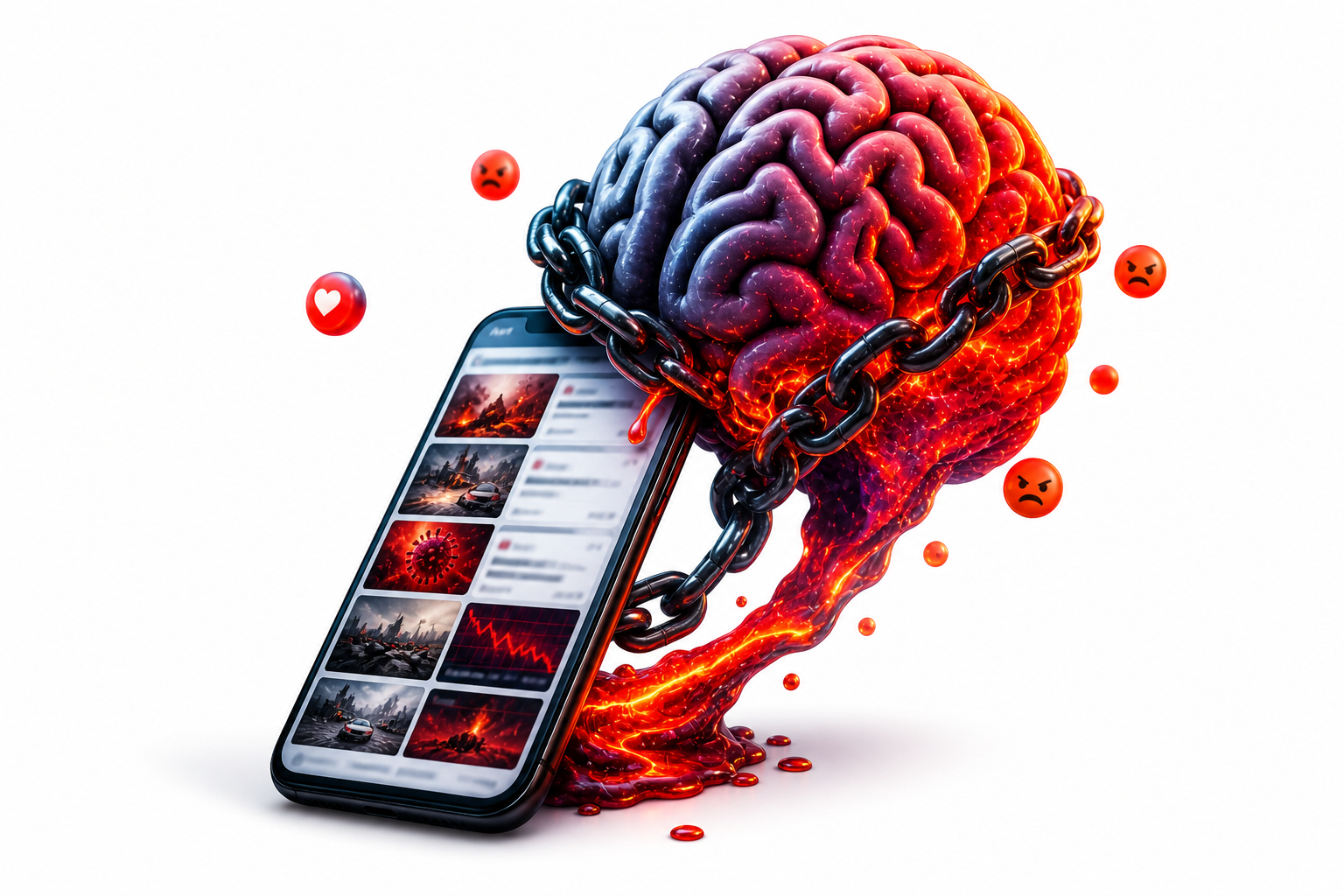
You are not doom-scrolling because you lack discipline. You are doom-scrolling because billion-dollar systems have been specifically designed to exploit a 200,000-year-old feature of your neurology.
The Psychological Mechanisms Underneath
Beyond the amygdala’s basic threat processing, several additional psychological mechanisms compound the effect and help explain the full picture of why humans are addicted to bad news.
The first is the availability heuristic — the mental shortcut by which the brain judges how likely something is to happen based on how easily an example comes to mind. When you are exposed to a constant stream of plane crashes, violent crimes, and disease outbreaks, your brain begins to dramatically overestimate the probability of these events occurring in your own life. The news does not just inform you about danger. It makes danger feel closer, more probable, and more personally relevant than statistics would ever justify.
The second is morbid curiosity — a well-documented psychological drive to seek out information about threatening or disturbing scenarios, even when that information provides no practical benefit. Researchers at the University of California found that morbid curiosity functions as a preparatory mechanism: the brain wants to understand worst-case scenarios in advance so it can build a mental model of how to respond if they occur. This is why people slow down to look at car accidents, why true crime content dominates podcast charts, and why disaster movies have been culturally popular for as long as cinema has existed.
The third is social monitoring. Humans are intensely social animals whose survival has always depended on understanding group dynamics, threats to the community, and shifts in the social environment. Bad news — war, economic collapse, social unrest — triggers not just personal threat responses but deep social threat responses. The brain wants to know what is happening because what is happening to the group has historically been a matter of personal survival.
The Cost of a Brain That Won’t Switch Off
Here is what all of this is doing to you in real time.
Chronic exposure to negative news has been directly linked in peer-reviewed research to elevated cortisol levels, increased generalised anxiety, disrupted sleep architecture, reduced empathy over time, and a measurably distorted perception of how dangerous and threatening the world actually is.
A 2020 study published in Health Psychology found that people who consumed high volumes of news during the early COVID-19 pandemic experienced significantly elevated rates of both physical and mental health symptoms — not primarily because of the pandemic itself, but because of the news consumption pattern. The stress response activated by the news was chronic, unresolved, and biologically indistinguishable from the stress response of actually being in danger.
This is the deepest cost of understanding why humans are addicted to bad news: the brain cannot cleanly distinguish between reading about a threat and experiencing a threat. The cortisol release, the heightened vigilance, the suppression of immune function and digestion and reproductive systems that the stress response triggers — these happen whether the lion is in the room or on the screen.
Your body is paying a biological price for news it will never be able to act on.
Can You Rewire It?
The honest answer is: partially.
The negativity bias is not going away. It is too deeply embedded in the neurological architecture of the human brain to be eliminated through mindset work or media literacy alone. But it can be managed — and understanding the mechanism is the first and most important step.
Research on what psychologists call “the positivity offset” shows that in genuinely neutral or low-stakes environments, humans actually have a slight natural tendency toward positive affect. The negativity bias kicks in hard specifically in response to threat cues — and modern media is a near-constant stream of threat cues, most of which require no action and offer no resolution.
Practical interventions that show genuine efficacy in the research include time-bounded news consumption rather than continuous passive exposure, deliberately seeking high-quality solutions-focused journalism to counterbalance threat-heavy content, and regular practices that downregulate the amygdala response — exercise, sleep, and extended social connection being the three most evidence-backed.
None of these are revolutionary ideas. But knowing why humans are addicted to bad news — understanding the specific neurological machinery being exploited — transforms them from vague wellness advice into something more like maintenance instructions for a system that is currently being run in conditions it was never designed for.
The Takeaway
You are not weak for being drawn to bad news. You are not broken for doom-scrolling. You are not a pessimist by nature.
You are a human being running ancient survival software in an information environment that has been precision-engineered to exploit every vulnerability in that software for profit.
The brain that cannot stop tracking threat is the same brain that kept your ancestors alive on the African savanna for two hundred thousand years. It is magnificent, and it is completely unsuited to a 24-hour global news cycle.
Knowing that does not fix everything.
But it is, at the very least, a start.