

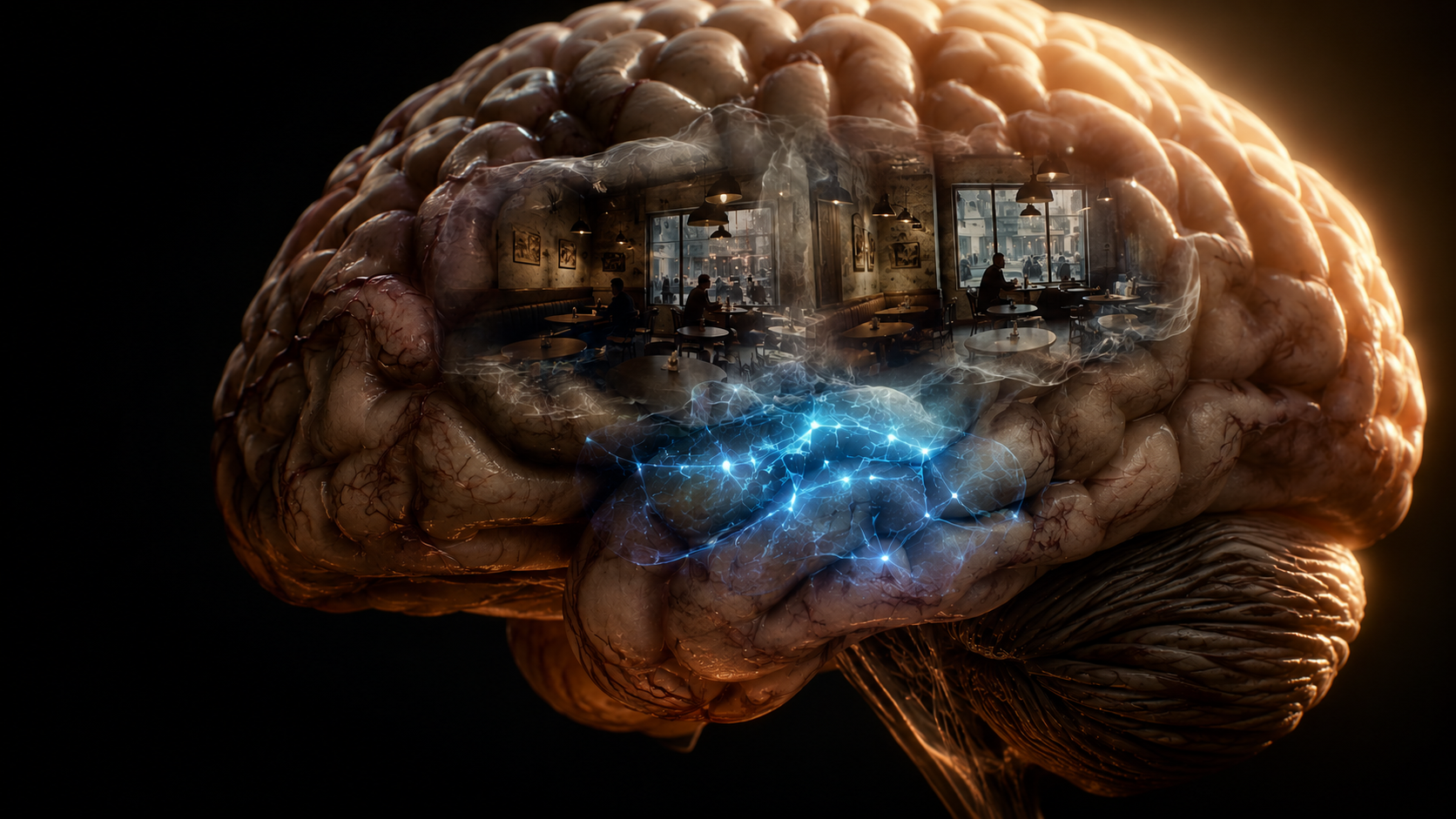
You’re walking into a restaurant you’ve never visited before. The smell of coffee, the hum of conversation, the particular angle of sunlight through the window — and then it hits you. I’ve been here before. Except you haven’t. You’re sure of it.
That strange, fleeting feeling has a name — déjà vu — and for most of human history, it was written off as a glitch of the mind, something mystical, maybe even a brush with a past life. Today, the science of déjà vu tells a far more fascinating story. It’s a window into how your brain constructs memory, checks its own work, and occasionally gets it very, very wrong.
What Does “Déjà Vu” Actually Mean?
The phrase is French for “already seen.” It was coined in 1876 by philosopher Émile Boirac, who used it to describe the uncanny sensation of experiencing something for what feels like the second time — even when you know, rationally, that it’s the first.
It’s remarkably common. Research suggests that roughly 60–70% of people experience déjà vu at some point in their lives. It tends to peak in young adults between the ages of 15 and 25, and becomes less frequent with age. It’s also more common in people who travel frequently, watch a lot of films, and are generally fatigued or stressed.
And it lasts barely a second — typically just long enough to notice before it vanishes.
Why Is the Science of Déjà Vu So Hard to Study?
Here’s the fundamental problem: déjà vu is spontaneous, brief, and unpredictable. You can’t schedule it in a lab. By the time a participant says “I’m having it right now,” it’s already gone.
For decades, this made proper scientific investigation almost impossible. Most of what researchers knew came from anecdotal reports, or from studying people with temporal lobe epilepsy — a condition where déjà vu can occur as a sustained aura before a seizure, lasting long enough to observe and even interrupt with electrical stimulation.
It was only in the last two decades, with advances in brain imaging and clever experimental design, that neuroscientists began to crack open this puzzle for the general population.
The Leading Theory: A Memory Monitoring Error
The most widely accepted explanation in modern neuroscience is that déjà vu is a conflict between two brain systems — one that processes familiarity and one that monitors and checks the accuracy of your memories.
Here’s how it works.
Your brain doesn’t store memories like files in a folder. Instead, it stores patterns — fragments of experience that get reassembled every time you remember something. When you encounter a new situation, your brain rapidly scans it for familiar patterns. Most of the time, it gets this right.
But occasionally, a new scene shares just enough structural similarity with something you’ve experienced before — the same spatial layout, a similar arrangement of objects, a comparable ambient light — that your brain’s familiarity circuits fire prematurely. The scene feels known before the rational part of your mind has had a chance to verify whether it actually is.
The moment your monitoring system catches the error — “wait, this can’t be familiar, I’ve never been here” — you get the conscious experience of déjà vu. The feeling isn’t the error itself. It’s your brain noticing the error.
In other words, déjà vu might actually be a sign that your memory-checking system is working properly, not that something’s going wrong.
What’s Happening Inside the Brain
Neuroimaging studies have pointed to the rhinal cortex and hippocampus as the key players in déjà vu.
The rhinal cortex handles familiarity signals — the raw sense of “I know this.” The hippocampus handles recollection — the ability to actually retrieve a specific memory and place it in context. Normally these two systems work together. But researchers believe that in déjà vu, the rhinal cortex fires its familiarity signal independently, without a corresponding memory from the hippocampus to back it up.
The result: familiarity without recollection. The sense that something is known, with nothing to explain why.
Neuroscientist Chris Moulin at the University of Grenoble has spent years studying this. His research into patients with chronic déjà vu — a rare condition where the feeling persists for hours or days — supports this model. These patients show abnormalities in memory monitoring circuits, not in memory storage itself. Their memories are largely intact; it’s the checking process that’s broken.
The “Overlapping Scene” Hypothesis
In 2012, psychologist Akira O’Connor and his colleagues at the University of St Andrews ran a clever experiment. They used hypnosis to create a kind of artificial déjà vu in participants — making familiar words feel unfamiliar and vice versa — and then observed their brain activity using fMRI.
The results pointed strongly to the frontal decision-making regions of the brain lighting up during déjà vu, which aligns with the idea that it’s a conflict-resolution response. The brain detects a mismatch and flags it.
Other researchers have proposed what’s sometimes called the “overlapping scene” hypothesis: if a new environment you enter happens to share a spatial layout with somewhere you’ve been before — even if the surface details are completely different — your brain’s spatial memory map may trigger familiarity based on structure alone. A restaurant with the same table arrangement as your grandmother’s living room, for example, might produce déjà vu even though the two places look nothing alike.
Does Stress or Tiredness Make It Worse?
Yes — and this is well-supported by research.
When you’re fatigued, your brain’s error-checking systems become less precise. The monitoring process that normally catches false familiarity signals is slower to respond, meaning those signals linger a moment longer. This is why many people report stronger or more frequent déjà vu when they’re exhausted, anxious, or overwhelmed.
Similarly, people who travel frequently are exposed to many new environments in quick succession, increasing the chances that a new scene will partially match something in their memory library.
Déjà Vu vs. Jamais Vu
The lesser-known counterpart to déjà vu is jamais vu — French for “never seen.” It’s the opposite experience: looking at something completely familiar and momentarily finding it utterly strange.
Ever stared at a common word for so long that it suddenly looks like it was invented by aliens? That’s a mild form of jamais vu. It can also happen with faces, places, and even your own reflection.
Both phenomena arise from the same underlying mechanism — a temporary mismatch between your brain’s familiarity systems and its reality-checking circuits. Déjà vu is familiarity without memory; jamais vu is memory without familiarity.
What Déjà Vu Tells Us About the Brain
The science of déjà vu is more than a curiosity. It offers a remarkable glimpse into how memory actually works — not as a recording device, but as a reconstructive, interpretive process that’s constantly making educated guesses and checking its own work.
When déjà vu happens, you’re catching your brain mid-error. And the fact that you can catch it — that your rational mind can say “wait, this can’t be right” even as the feeling persists — says something profound about how many parallel processes are running in your head at any given moment.
The brain you’re reading this with right now is quietly cross-referencing, predicting, flagging, and correcting — thousands of times per second, mostly without your knowledge.
Every now and then, it lets you peek behind the curtain.
Leave a Reply
You must be logged in to post a comment.